When you bite into a ripe, juicy pear, the sweetness is undeniable. It feels like an indulgence, a sugary treat that melts in your mouth. For anyone managing diabetes, pre-diabetes, or just trying to keep their blood sugar stable, that sweetness can set off alarm bells. You might pause mid-bite and wonder, “Is this too sweet? Will this spike my sugar?”
We have been taught to fear sugar in all its forms. But nature is clever. It doesn’t just give us sugar; it packages it with fibre, water, and nutrients. The question is, does the packaging of a pear make it safe?
If you have been searching for the pear glycemic index or wondering if you should swap your apple for a pear, you have come to the right place. In this detailed guide, we are going to look beyond the taste. We will explore the science, compare different pear varieties (like the crunchy Asian pear vs. the soft Bartlett), and give you clear, actionable advice in plain Indian English.
What Is the Glycemic Index (GI)?
Before we can judge the pear, we need to understand the yardstick we are using. The Glycemic Index (GI) is essentially a ranking system for carbohydrates. It measures how fast a food raises your blood glucose (sugar) levels on a scale of 0 to 100.
- High GI (70–100): These are the sprinters. They digest rapidly and dump sugar into your bloodstream all at once. This causes a sudden “spike” followed by a crash. (Example: White bread, glucose, watermelon).
- Medium GI (56–69): These are the joggers. They raise blood sugar at a moderate pace.
- Low GI (0–55): These are the walkers. They digest slowly, releasing energy drop by drop. This keeps your insulin levels stable.
For optimal health, especially for diabetics, we want to fill our plates with “walkers.”
What Is the Pear Glycemic Index?
Here is the good news: Pears are excellent “walkers.”
The pear glycemic index typically falls between 30 and 38.
This puts fresh pears firmly in the Low GI category (0–55). In fact, they are often lower than apples and bananas. Even though they taste incredibly sweet, they do not cause a sudden explosion of sugar in your bloodstream.
Why is the GI so low?
- High Fibre: A medium pear contains about 6 grams of fibre. This is significantly higher than many other fruits. Most of this fibre is in the skin, which acts as a physical barrier to digestion.
- Fructose: The primary sugar in pears is fructose. Fructose needs to be processed by the liver before it enters the bloodstream, which naturally slows down the glycemic response compared to glucose.
- Sorbitol: Pears contain sorbitol, a sugar alcohol that is absorbed very slowly (and helps with digestion too!).
Different Varieties: Do They All Have the Same GI?
You might see different types of pears in the market—some green and hard, some yellow and soft. Does the pear glycemic index change with the variety?
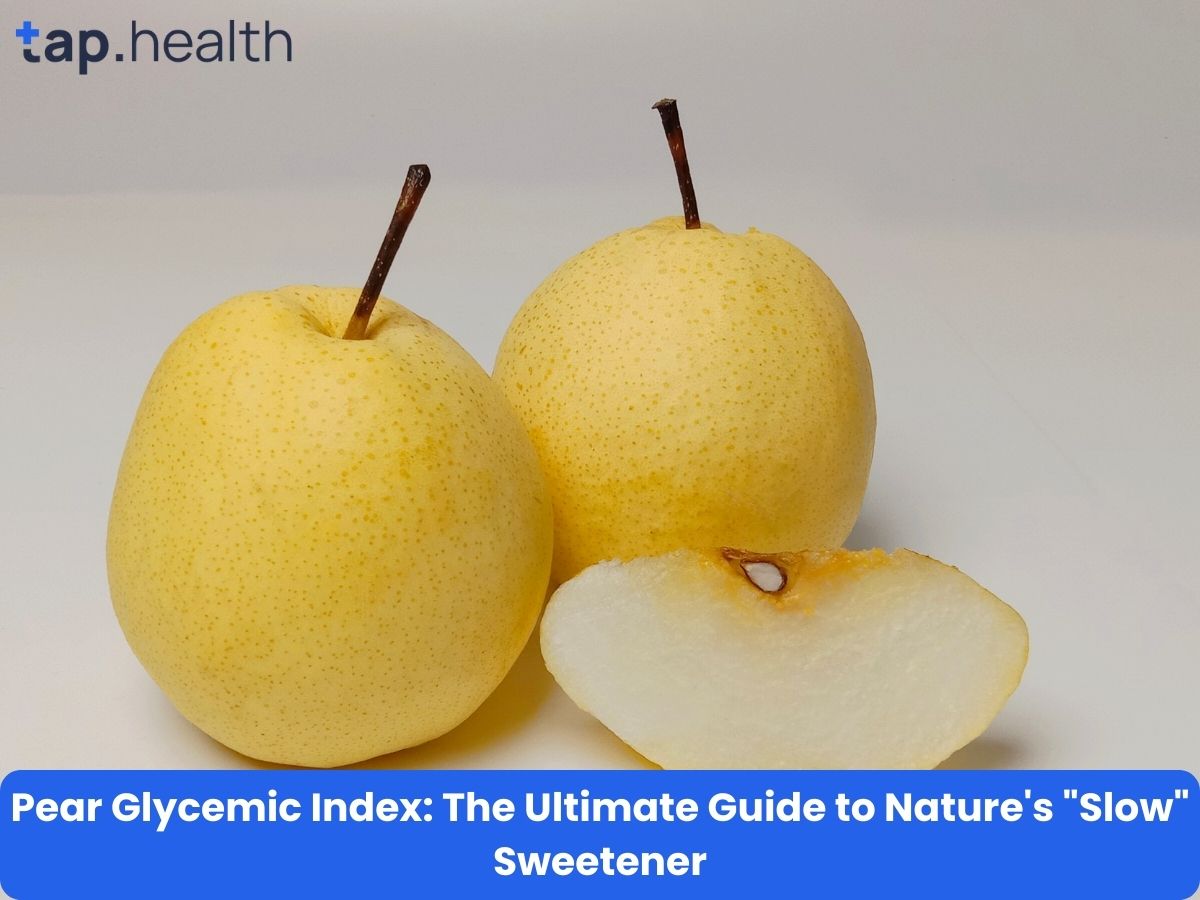
1. Asian Pear Glycemic Index (Nashi Pear)
These are the round, crunchy, apple-like pears often sold in protective foam nets.
- GI Score: ~26 to 30.
- Verdict: Very Low.
- Details: Asian pears have a higher water content and a very crunchy texture. This structure makes them harder to digest quickly, resulting in one of the lowest GI scores in the fruit kingdom.
2. Bartlett (Williams) Pear Glycemic Index
These are the classic green-to-yellow pears that get very soft and juicy.
- GI Score: ~38 to 41.
- Verdict: Low.
- Details: Because they are softer, the sugar is slightly more accessible than in crunchier varieties, but they are still well within the safe zone.
3. Bosc Pear Glycemic Index
These are the brown-skinned, elegant-looking pears.
- GI Score: ~38.
- Verdict: Low.
- Details: Excellent for baking or eating raw. The skin is tougher, providing extra fibre.
4. Anjou Pear Glycemic Index
- GI Score: ~35 to 38.
- Verdict: Low.
The Takeaway: Whether you choose the crunchy Asian pear or the soft Bartlett, the pear glycemic index remains low. You cannot go wrong with any fresh variety.
Fresh vs. Dried vs. Canned: The Processing Trap
This is the most critical section. While fresh pears are a superfood, processing can turn them into a sugar bomb.
1. Fresh Pear
- GI: 38.
- Status: Safe. Eat with the skin on.
2. Dried Pear Glycemic Index
- GI: 43.
- Status: Caution.
- Why? The GI is still low, but the Glycemic Load is high. When you dry a pear, you remove the water and concentrate the sugar. It is very easy to eat 5 dried pear slices in a minute. This delivers a massive carb load, even if it absorbs slowly. Eat sparingly.
3. Canned Pear Glycemic Index
- GI: High (60+ depending on syrup).
- Status: Avoid.
- Why? Most canned pears are peeled (fibre removed) and soaked in “heavy syrup” (sugar water). This destroys the low-GI benefits. If you must buy canned, look for “Packed in Water” or “No Added Sugar.”
Glycemic Load: The Quantity Factor
We cannot talk about the pear glycemic index without discussing the Glycemic Load (GL). While GI tells you the speed, GL tells you the impact of a serving size.
Formula: (GI x Carbs in a serving) / 100
For one medium fresh pear:
- GI: 38
- Carbs: Approx 15g
- Calculation: (38 x 15) / 100 = 5.7
Result: The Glycemic Load is roughly 6.
- Low GL: 0–10
- Medium GL: 11–19
- High GL: 20+
A score of 6 is incredibly low. This confirms that eating a whole pear puts very little stress on your pancreas.
Comparison: Pear vs. Other Fruits
To help you make the best choices at the fruit stall, let’s compare the pear glycemic index with other common fruits found in India.
| Fruit | Glycemic Index (GI) | Glycemic Load (GL) | Verdict |
| Pear | 38 | 6 | Excellent |
| Apple | 36 | 6 | Excellent |
| Orange | 43 | 5 | Excellent |
| Banana (Ripe) | 51–60 | 11 | Moderate |
| Mango | 51–56 | 8 | Moderate |
| Watermelon | 72–76 | 4 | High GI (Limit portion) |
| Grapes | 59 | 11 | Moderate |
Key Takeaway:
Pears act very similarly to apples. They are much safer than tropical fruits like mangoes or pineapples when it comes to blood sugar management.
Health Benefits: Why Diabetics Should Eat Pears
Beyond the low pear glycemic index, this fruit is a powerhouse for health.
- Fibre Champion: Pears provide 20-25% of your daily fibre needs in just one fruit. Fibre helps manage cholesterol and keeps digestion regular—a common issue for diabetics.
- Anti-Inflammatory: The skin contains flavonoids that help reduce inflammation, which is a root cause of insulin resistance.
- Potassium: Essential for heart health and controlling blood pressure.
- Satiety: The high water and fibre content make you feel full. Eating a pear as a snack prevents you from reaching for unhealthy biscuits.
Real-Life Scenario: The Snack Swap
Let’s look at a typical scenario in an Indian household.
The Situation:
Mrs. Iyer, a 60-year-old retired teacher with Type 2 Diabetes, feels hungry at 4 PM. She usually has tea with two rusks (toasted bread).
- The Problem: Rusks are made of refined flour and sugar. Their GI is high (around 70). Her sugar spikes before dinner.
The Swap:
She decides to try a fresh pear instead. She cuts it into slices and sprinkles a little chaat masala on it.
The Result:
- Taste: The crunchy sweetness satisfies her craving.
- Blood Sugar: Because the pear glycemic index is 38 (vs rusk at ~70), her blood sugar remains stable.
- Digestion: The fibre helps her feel full until dinner, preventing overeating later.
The Lesson: Small swaps yield big results.
Expert Contribution
We consulted with certified nutritionists to get their professional take on pears.
Dr. A. Singh, Clinical Dietician:
“I often call pears the ‘underdog’ of diabetic fruits. Everyone talks about apples, but pears are arguably better because of their unique fibre composition. The pectin in pears is very effective at binding to cholesterol and slowing down glucose absorption. My advice? Never peel a pear. If you peel it, you throw away half the medicine. Wash it well and eat it whole.”
Recommendations Grounded in Proven Research and Facts
Based on guidelines from the American Diabetes Association and nutritional research, here is how to safely include pears in your diet:
- Eat the Skin: We cannot stress this enough. The skin holds the majority of the fibre and antioxidants.
- Pair It Up: “Never eat a naked carb.” To make the glycemic impact even lower, pair your pear with fat or protein.
- Pear slices + Peanut butter.
- Pear slices + A slice of cheese.
- Chopped pear in Greek yoghurt.The fat slows down stomach emptying.
- Choose “Crunchy” Over “Mushy”: While all pears are safe, a slightly firmer pear has more resistant starch than a very soft, over-ripe one. Eat them when they are ripe but still have a bite.
- Avoid Juice: Pear juice has a higher GI because the fibre is removed. Stick to the whole fruit.
Myths vs. Facts
Myth: “Pears are sugary, so diabetics should avoid them.”
Fact: False. The pear glycemic index is Low (38). The sweetness comes from fructose and sorbitol, which digest slowly.
Myth: “Canned pears are healthy because they are fruit.”
Fact: False. Most canned pears are in sugar syrup, making them High GI. Only fresh or water-packed canned pears are healthy.
Myth: “You must peel pears to remove wax.”
Fact: Misleading. While you should wash them thoroughly (or buy organic), peeling removes the vital nutrients that regulate blood sugar. A good scrub under water is sufficient.
Conclusion
So, is the pear a friend or a foe?
It is definitely a friend.
With a pear glycemic index of roughly 38 and a very low glycemic load, pears are one of the safest, most nutritious fruits for anyone managing blood sugar. They offer a satisfying crunch, natural sweetness, and a massive dose of fibre that supports your heart and gut.
Whether you choose the crisp Asian pear or the soft Bartlett, you can enjoy this fruit without guilt. Just remember the golden rule: Eat the skin, and skip the syrup.
Key Takeaways:
- The Number: Fresh pears have a Low GI (30–40).
- The Load: The Glycemic Load is extremely low (~6).
- The Hero: The skin contains most of the fibre; do not peel it.
- The Comparison: Pears are as safe as apples and safer than bananas.
- The Tip: Pair with nuts or cheese for the ultimate low-spike snack.
So, next time you are looking for a snack, grab a pear. Wash it, slice it, and enjoy the sweet taste of good health.
Frequently Asked Questions (FAQ) on Pear Glycemic Index
What is the pear glycemic index?
The pear glycemic index typically ranges from 30 to 38 for fresh pears. This places them in the Low GI category (0–55), making them an excellent fruit choice for maintaining stable blood sugar levels.
Are pears safe for diabetics?
Yes, absolutely. Pears are high in fibre (especially in the skin) and have a low GI. They release sugar slowly into the bloodstream. However, portion control is still important—one medium pear is a good serving size.
Is the Asian pear glycemic index different?
Yes, slightly lower. The Asian pear glycemic index is often cited around 26–30 because of its high water content and crunchy texture. This makes it one of the lowest GI fruits available.
Is it better to eat pears with the skin or without?
Always eat them with the skin. The skin contains the majority of the fibre and antioxidants. Peeling a pear removes the “brake” that slows down sugar absorption, potentially raising the glycemic impact.
How does the pear glycemic index compare to apples?
They are very similar. Apples have a GI of roughly 36, and pears are roughly 38. Both are excellent Low GI choices. You can switch between them for variety without worrying about blood sugar spikes.
Are canned pears healthy?
Generally, no. Most canned pears are peeled and soaked in heavy sugar syrup, which gives them a High GI. If you must eat canned pears, look for labels that say “No Added Sugar” or “Packed in Water.”
Can I eat dried pears?
You should be careful. While the dried pear glycemic index is still relatively low, the Glycemic Load is high because the sugar is concentrated. It is easy to overeat dried fruit, so stick to 1 or 2 slices maximum.
Do ripe pears have more sugar?
Yes. As a pear ripens and becomes soft, some of its starch converts to sugar. A very soft, mushy pear will have a slightly higher GI than a firm, crunchy one. It is best to eat them when they are ripe but still firm.
References
- Harvard Health Publishing: Glycemic index for 60+ foods
- American Diabetes Association: Fruit and Diabetes
- The University of Sydney: GI Search Database
- Mayo Clinic: Diabetes diet: Eating the right fruits
- USDA FoodData Central: Pears, raw Nutrition Facts