Walk into any Indian supermarket, pick up a packet of “Sugar-Free” biscuits, a tub of protein powder, or even a packet of soup mix. Turn it over and read the ingredients. Chances are, you will spot a long, complicated word: Maltodextrin.
We often ignore it. It sounds scientific, harmless, maybe even healthy. We focus on the big bold letters on the front that say “NO ADDED SUGAR” and think we are safe.
But here is the shocking truth: Maltodextrin might be worse for your blood sugar than the actual sugar you are trying to avoid.
For diabetics and health-conscious individuals in India, this white powder is a silent enemy. It hides in plain sight, spiking insulin levels and ruining diet plans. But what exactly is it? And more importantly, what is the maltodextrin glycemic index?
In this deep-dive guide, we are going to expose the truth about this common additive. We will look at the numbers, compare it to sugar and dextrose, and help you safeguard your health against this hidden spiker.
What is Maltodextrin?
Before we look at the scary numbers, let’s understand what this powder actually is.
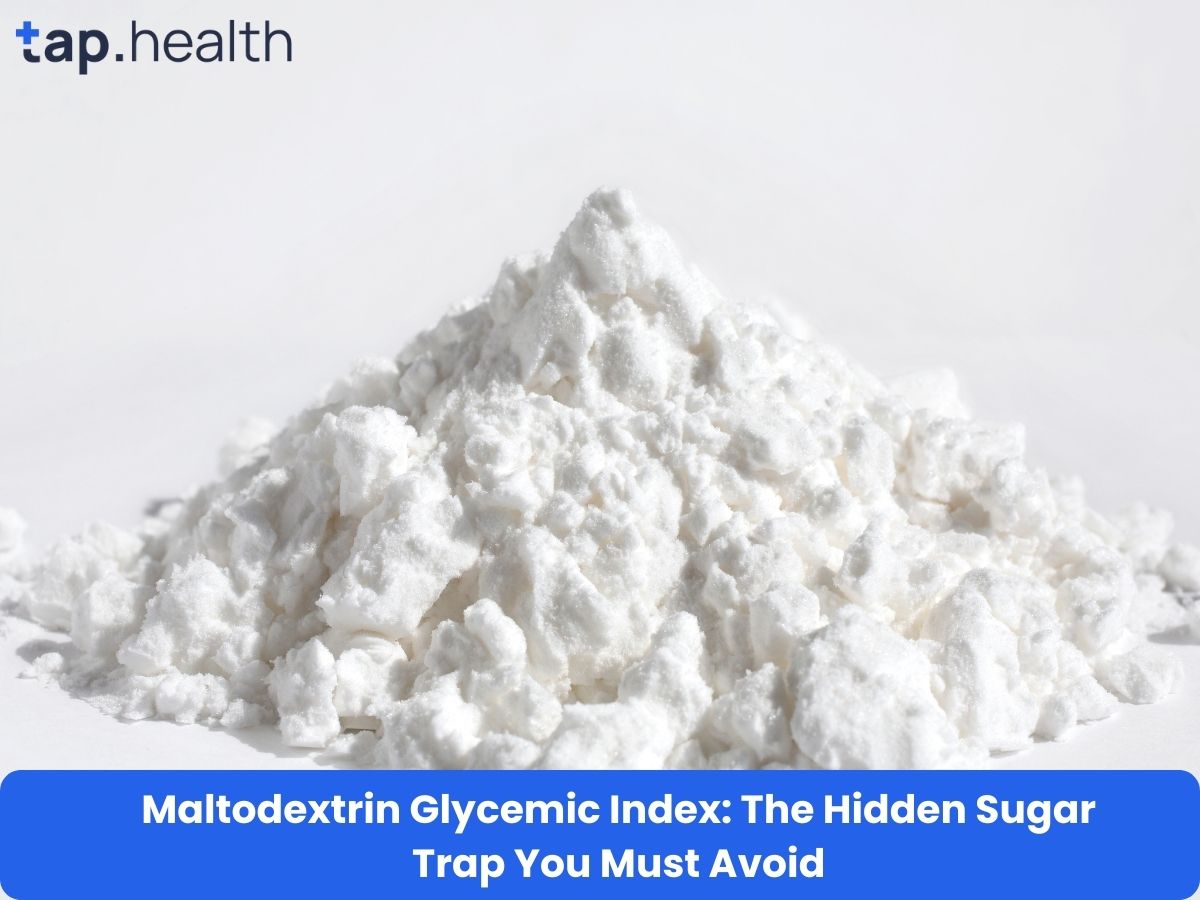
Maltodextrin is a highly processed white powder made from starch. In India, it is usually derived from corn (maize), rice, potato, or wheat. Manufacturers take the starch, boil it, and add acids or enzymes to break it down into smaller pieces.
The result is a white powder that has a neutral flavor or is slightly sweet. It dissolves easily in water and is cheap to produce.
Why is it in everything? Food companies love it. They use it as:
- A Filler: To bulk up artificial sweeteners (like Stevia sachets) so they are big enough to pour.
- A Thickener: To give mouthfeel to low-fat salad dressings and soups.
- A Preservative: To increase the shelf life of packaged foods.
But just because it comes from plants like corn or rice doesn’t mean it is natural. By the time it reaches your food, it is so processed that your body reacts to it very aggressively.
Also Read: 20 Best Food for Diabetes
Understanding Glycemic Index (GI)
To understand why Maltodextrin is dangerous for diabetics, we need to revisit the Glycemic Index (GI).
Think of GI as a speedometer for your blood sugar. It measures how fast a food converts into glucose and hits your bloodstream on a scale of 0 to 100.
- Low GI (0-55): Slow digestion, steady energy (e.g., Dal, Vegetables).
- Medium GI (56-69): Moderate rise.
- High GI (70+): Fast spike, like rocket fuel (e.g., White Bread, Glucose).
Standard pure Glucose has a GI of 100. It is the benchmark. Nothing should theoretically be faster than pure glucose, right?
Wrong.
The Shocking Number: Maltodextrin Glycemic Index
So, what is the maltodextrin glycemic index number?
The Glycemic Index of Maltodextrin ranges from 105 to 110.
Yes, you read that correctly. It is higher than pure glucose. It is significantly higher than table sugar.
When you consume Maltodextrin, it bypasses normal digestion and rushes into your bloodstream with terrifying speed. Because the starch chains are already broken down during processing, your body doesn’t have to do any work. It absorbs it instantly.
The Result? A massive, immediate spike in blood sugar, followed by a huge surge of insulin from your pancreas.
This explains why you might feel hungry, shaky, or tired shortly after eating a “healthy” energy bar or a “sugar-free” snack. The maltodextrin high glycemic index caused a crash.
Maltodextrin Glycemic Index vs Sugar
The most common confusion is how Maltodextrin compares to the sugar we use in chai or coffee. Let’s look at the maltodextrin glycemic index vs sugar battle.
1. Table Sugar (Sucrose)
- Composition: 50% Glucose + 50% Fructose.
- Glycemic Index: ~65.
- Why: The fructose part must be processed by the liver, which slows down the spike slightly.
2. Maltodextrin
- Composition: Chains of Glucose molecules loosely held together.
- Glycemic Index: ~105 to 110.
- Why: It is pure glucose energy that requires almost no digestion.
The Verdict: Maltodextrin spikes blood sugar nearly twice as fast as table sugar.
This is the “Sugar-Free” loophole. Food laws often define “Sugar” as mono- and disaccharides (like sucrose). Maltodextrin is a polysaccharide (a chain). So, a company can legally put “No Added Sugar” on a label even if the product is full of Maltodextrin. For a diabetic, this distinction doesn’t matter—the glucose spike happens regardless.
Maltodextrin vs. Dextrose and Glucose
You might also see “Dextrose” on labels. How does it compare?
Dextrose Glycemic Index
Dextrose is essentially another name for pure glucose derived from corn.
- GI: 100.
- Comparison: Dextrose vs maltodextrin glycemic index is very similar. Both are explosive for blood sugar. Maltodextrin is arguably slightly faster or equal to Dextrose.
Maltodextrin vs Glucose Glycemic Index
As mentioned, Glucose is the baseline at 100. Maltodextrin can exceed this (up to 110) depending on the processing method and the source (corn vs wheat).
Tapioca Maltodextrin Glycemic Index
Lately, health brands have started using Tapioca Maltodextrin, claiming it is a healthier, paleo-friendly alternative to corn maltodextrin.
Does the source matter?
- Corn Maltodextrin GI: ~110
- Tapioca Maltodextrin GI: ~95 to 100
The Verdict: While tapioca maltodextrin glycemic index is technically slightly lower than corn, it is still extremely high. It falls firmly in the “High GI” category. It is not safe for diabetics to consume freely. Do not be fooled by the word “Tapioca” or “Organic.”
Resistant Maltodextrin: The Exception
There is one confusing exception you need to know about: Digestion Resistant Maltodextrin (often sold under brand names like Fibersol-2).
This is processed differently. The chemical bonds are changed so your body cannot digest them.
- Resistant Maltodextrin Glycemic Index: ~5 to 10 (Very Low).
- Function: It acts like dietary fiber.
How to tell the difference? The label will specifically say “Resistant Maltodextrin” or “Soluble Corn Fiber.” If it just says “Maltodextrin,” assume it is the high-GI version.
Maltodextrin and Diabetes: The Danger Zone
For a diabetic patient in India, maltodextrin diabetes complications are real.
1. The Insulin Spike
Because Maltodextrin spikes sugar so fast, the pancreas is forced to pump out massive amounts of insulin. Over time, this worsens Insulin Resistance, the core problem in Type 2 Diabetes.
2. The “Hidden” Carbs
Diabetics are taught to count carbs. But Maltodextrin is often hidden in savory foods like chips, spice mixes, and soups where you don’t expect sugar. This leads to unexplained high blood sugar readings.
3. Does Maltodextrin Spike Blood Sugar?
Yes. It spikes it faster than almost any other food ingredient. If you wear a CGM (Continuous Glucose Monitor), you will see a sharp vertical rise within minutes of consuming it.
Maltodextrin Side Effects
Beyond blood sugar, are there other maltodextrin side effects? Yes.
1. Gut Health and Bloating
Your gut bacteria love Maltodextrin. When you eat it, bad bacteria (like E. Coli) can feast on it and multiply. This can suppress good probiotics, leading to bloating, gas, and an imbalanced gut microbiome.
2. Is Maltodextrin Bad for Your Liver?
Excessive intake of high-GI carbs like Maltodextrin puts a strain on the liver. The liver converts the excess glucose into triglycerides (fat). Long-term overconsumption is linked to Non-Alcoholic Fatty Liver Disease (NAFLD).
3. Weight Gain
Because it causes an insulin spike, your body switches to “Fat Storage Mode.” Once the sugar crashes, you feel hungry again, leading to overeating.
Maltodextrin Benefits: Is It All Bad?
Surprisingly, no. There is one specific group of people who benefit from the maltodextrin high glycemic index: Athletes.
If you are a bodybuilder or a marathon runner, you want a rapid sugar spike after a workout to refill your muscle glycogen immediately.
- Post-Workout: Maltodextrin is a key ingredient in “Mass Gainers” and recovery drinks because it delivers energy to muscles instantly without the bloating that huge meals might cause.
- Digestion: It is easy to digest during intense exercise.
However, unless you are running a marathon or lifting heavy weights for 2 hours, you likely do not need this benefit.
Real-Life Scenario
Let’s meet Vikram, a 40-year-old IT manager from Mumbai.
The Problem: Vikram was recently diagnosed with pre-diabetes. He decided to cut out sugar. He started buying “Sugar-Free” cookies and using a powdered sweetener for his coffee that came in a large jar. Despite quitting sugar, his HbA1c (average blood sugar) did not go down after 3 months. He was frustrated.
The Discovery: He took his sweetener jar to his dietician.
- The Label: “Ingredients: Maltodextrin, Sucralose.”
- The Truth: The sweetener was 99% Maltodextrin (filler) and only 1% Sucralose.
The Fix: Vikram switched to pure Liquid Stevia (no fillers) and stopped eating the processed “Sugar-Free” cookies.
- The Result: His fasting sugar dropped by 20 points in the next month. He realized he had been eating “hidden glucose” the whole time.
Expert Contribution
We consulted medical guidelines to get the professional stance.
Dr. A. Singh, Diabetologist: “I call Maltodextrin the ‘Trojan Horse’ of the food industry. It enters the body looking like a complex carbohydrate (starch) but behaves like pure glucose. I advise my diabetic patients to treat any product containing Maltodextrin exactly as they would treat a product containing sugar. Do not be fooled by the ‘Sugar-Free’ label.”
Nutritionist Perspective: “If you see Maltodextrin in the first three ingredients of a food label, put it back. It is essentially empty calories. However, if it is the last ingredient (used as a preservative in tiny amounts), it might be negligible. Context matters.”
Recommendations Grounded in Proven Research and Facts
Based on data from Healthline and the Journal of Nutritional Science, here are actionable tips:
- Read the Fine Print: In India, ingredients are listed by quantity. If Maltodextrin is at the top of the list, the food is high-GI.
- Watch the Sweeteners: Avoid powdered sweeteners that are fluffy and light (like Spoon-for-Spoon Stevia). They are mostly Maltodextrin. Choose Liquid drops or Erythritol blends instead.
- Gym Goers Beware: If you are diabetic and taking whey protein, check if it has added Maltodextrin for “bulking.” Switch to “Isolate” protein which usually has fewer fillers.
- Which is better, maltodextrin vs erythritol?
- Erythritol (GI 0): Best for diabetics and weight loss.
- Maltodextrin (GI 110): Only for athletes needing rapid energy.
- Winner: Erythritol is the clear winner for health.
- How much maltodextrin per day? There is no “safe” limit for diabetics, but ideally, it should be zero. For healthy individuals, small amounts as a thickener are fine, but avoid it as a main ingredient.
Conclusion
The numbers don’t lie. With a maltodextrin glycemic index of 105-110, this common additive is metabolic dynamite.
It is arguably the most misleading ingredient in the food industry. By masquerading as a starch and hiding in “sugar-free” products, it tricks diabetics into spiking their own blood sugar.
The takeaway is simple: You cannot trust the front of the packet. You must read the back. If you have diabetes, insulin resistance, or fatty liver, Maltodextrin is not your friend. Treat it with the same caution—if not more—than you treat table sugar.
Your health is in your hands, and now that you know the secret of the GI scale, you can make smarter, safer choices for your body.
Frequently Asked Questions (FAQ)
Does maltodextrin spike blood sugar?
Yes, absolutely. Maltodextrin has a Glycemic Index (GI) of 105-110, which is higher than pure glucose. It absorbs rapidly into the bloodstream, causing a sharp and immediate spike in blood sugar and insulin levels.
Which is better, maltodextrin vs erythritol?
Erythritol is far better for general health and diabetes. Erythritol has a GI of 0 and does not affect blood sugar or insulin. Maltodextrin has a GI of ~110 and spikes blood sugar aggressively.
What are the disadvantages of maltodextrin?
The main disadvantages are its extremely high glycemic index (bad for diabetics), its potential to alter gut bacteria (causing bloating), and its lack of nutritional value (empty calories). It can also promote weight gain and fatty liver if consumed in excess.
Is maltodextrin safe for diabetics?
Generally, No. While it is not toxic, it is dangerous for blood sugar control. Diabetics should avoid foods where Maltodextrin is a primary ingredient. Small trace amounts used as a preservative might be tolerated, but should be monitored.
What is the glycemic index of tapioca maltodextrin?
The tapioca maltodextrin glycemic index is approximately 95 to 100. While slightly lower than corn maltodextrin, it is still considered High GI and will spike blood sugar significantly.
Is maltodextrin bad for your liver?
High consumption of high-GI carbohydrates like Maltodextrin can contribute to fatty liver disease. The rapid influx of glucose triggers the liver to store excess energy as fat (triglycerides).
Maltodextrin vs sugar glycemic index – which is higher?
Maltodextrin is higher. Table sugar (sucrose) has a GI of roughly 65. Maltodextrin has a GI of 105-110. This means Maltodextrin raises blood sugar nearly twice as fast as table sugar.
Why is maltodextrin used in fitness supplements?
Because of its high GI, it is used in post-workout “mass gainers” and energy gels to rapidly replenish muscle glycogen stores (energy) that are depleted during intense exercise. For athletes, this spike is beneficial; for sedentary people, it is harmful.
References:
- Healthline: Is Maltodextrin Bad for You? Link
- WebMD: What is Maltodextrin? Link
- Diabetes.co.uk: Maltodextrin and Diabetes. Link
- National Institutes of Health (NIH): Glycemic Index of Carbohydrates. Link
- Mayo Clinic: Artificial Sweeteners and Substitutes. Link
(Disclaimer: This content is for educational purposes only. Always consult your doctor or a certified dietitian before making significant changes to your diet, especially if you have diabetes.)