In India, if you visit a doctor for diabetes or weight loss, you will almost certainly hear one term repeatedly: Glycemic Index (GI). You are told to avoid rice because it has a high GI. You are told to stop eating mangoes because they spike blood sugar.
But then, you see a friend who eats watermelon (which has a high GI) and stays perfectly healthy. Or you see a diabetic diet plan that includes bananas. It gets confusing, doesn’t it?
Here is the secret that many people miss: The Glycemic Index is only half the story. To truly understand how food affects your body, you need to look at the Glycemic Load (GL).
If Glycemic Index is the speed of a car, Glycemic Load is the distance it travels. Both matter, but they tell you very different things.
In this comprehensive guide, we will settle the glycemic index vs load debate once and for all. We will explain the math simply, use Indian food examples, and help you make choices that let you enjoy your Dal-Chawal without the guilt.
What is Glycemic Index (GI)?
Before we compare them, let’s define them.
The Glycemic Index (GI) is a ranking system for carbohydrate-containing foods. It measures how quickly a specific food converts into glucose (sugar) and enters your bloodstream. It is a scale from 0 to 100.
- Pure Glucose: Has a GI of 100. It is the benchmark.
- High GI (70+): These foods break down instantly. They cause a rapid “spike” in blood sugar. Examples include Maida bread, white rice, and glucose biscuits.
- Medium GI (56-69): Moderate digestion speed. Examples include Roti (whole wheat) and brown rice.
- Low GI (0-55): These digest slowly, releasing energy like a slow-burning candle. Examples include Chana Dal, vegetables, and most fruits.
The Problem with GI:
The Glycemic Index only tells you about the quality of the carbohydrate. It assumes you are eating a specific amount (usually 50 grams of digestible carbs) of that food. But in real life, we don’t always eat exactly 50 grams of carbs.
This is where the confusion starts. A food can have a high GI but might be safe if you eat a small portion. This brings us to the hero of our story.
What is Glycemic Load (GL)?
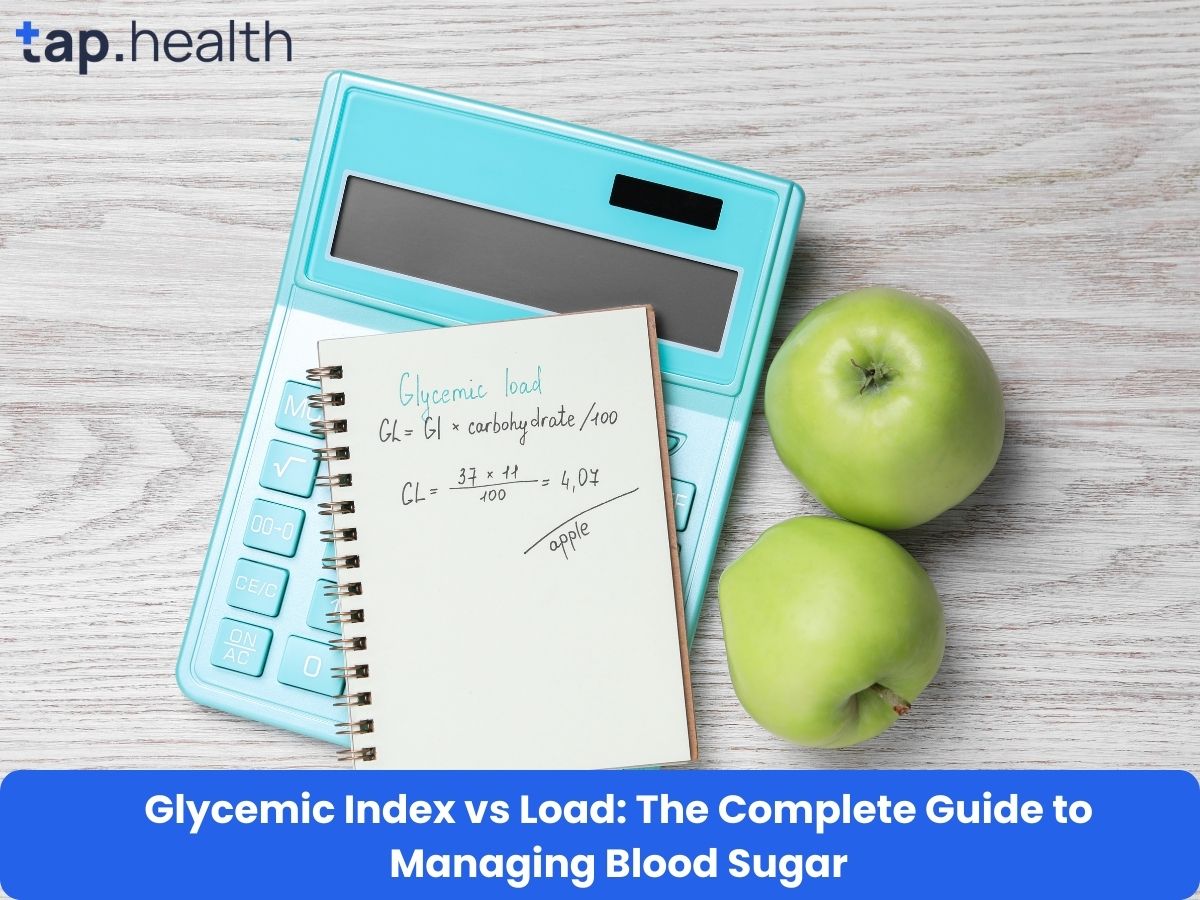
Glycemic Load (GL) is the reality check. It takes the Glycemic Index and multiplies it by the amount of carbohydrates in a standard serving size.
It answers the question: “How much will this specific portion of food actually raise my blood sugar?”
Think of it this way:
- GI tells you how fast the sugar hits your blood.
- GL tells you how much sugar is actually hitting your blood.
This is a much more accurate way to manage diabetes and weight because it accounts for portion size.
How to Calculate Glycemic Load
You don’t need to be a mathematician, but knowing the formula helps you understand the logic.
The Formula:
$$Glycemic Load = \frac{\text{Glycemic Index} \times \text{Carbohydrates per serving (in grams)}}{100}$$
Let’s try this with an Indian favourite: Watermelon.
The Watermelon Paradox
People often search for “watermelon glycemic index vs load” because it is the classic example of why GI can be misleading.
- Glycemic Index of Watermelon:72 (High).
- GI Logic: “Oh no! It’s high GI. Don’t eat it!”
- Carbs in a Serving: A standard slice of watermelon (120g) has only about 6 grams of carbohydrates. (The rest is just water and fibre).
Let’s calculate the GL:
$$GL = \frac{72 \times 6}{100} = 4.32$$
The Result: The Glycemic Load is only 4.3.
The Verdict: Even though watermelon has a High GI, it has a Low GL because there isn’t much sugar in a single slice. Unless you eat a whole watermelon in one sitting, it won’t spike your blood sugar significantly.
Glycemic Load Chart: The Ranges
Just like GI, Glycemic Load has its own categories. When looking at a glycemic load chart, here is what the numbers mean:
- Low GL (10 or less): This is the green zone. These foods have a minimal impact on blood sugar. (e.g., Apple, Dal, Peanuts).
- Medium GL (11 to 19): This is the yellow zone. Eat in moderation. (e.g., Brown rice, Banana).
- High GL (20 or more): This is the red zone. These foods will likely cause a spike. (e.g., a large bowl of White Rice, Pizza).
Glycemic Index vs Load: What is the Difference?
To make it crystal clear, let’s look at the difference between glycemic index vs load side-by-side.
| Feature | Glycemic Index (GI) | Glycemic Load (GL) |
| What it measures | The speed of sugar absorption. | The total impact of a serving size. |
| Does portion matter? | No. It is based on a fixed lab test. | Yes. It changes based on how much you eat. |
| Real-world accuracy | Low. (We don’t eat foods in isolation). | High. (Reflects actual eating habits). |
| Best for | Quick categorisation of “Good” vs “Bad” carbs. | Precise meal planning for diabetics. |
Glycemic index vs glycemic load which is better?
For most people, Glycemic Load is better. It gives you more freedom. It allows you to eat “High GI” foods in small quantities without guilt.
Real-Life Scenario
Let’s meet Vikram, a 45-year-old bank manager from Mumbai who was recently diagnosed with Type 2 Diabetes.
The Fear:
Vikram loves mangoes. When he was diagnosed, he looked up the Glycemic Index of mangoes. He saw it was roughly 51-56 (Medium). But his WhatsApp groups told him mangoes are “pure sugar” and he should never touch them. He felt miserable thinking he would miss the summer mango season.
The Solution:
Vikram visited a certified nutritionist who explained Glycemic Load.
- One medium Alphonso mango has about 25g of carbs.
- Calculation: $(51 \times 25) / 100 = 12.75$.
- This puts a whole mango in the Medium GL category.
The Action:
The nutritionist told him: “Vikram, don’t eat the whole mango after a heavy lunch. Eat half a mango as a mid-morning snack. That cuts the GL to about 6 (Low). You get the taste, but not the spike.”
Vikram realized that by understanding the load, he didn’t have to ban foods; he just had to manage portions.
White Rice Glycemic Index and Load
In India, this is the biggest question. “Can I eat rice?”
- Glycemic Index of White Rice: ~73 (High).
- Carbs in 1 cup cooked rice: ~45 grams.
The Calculation:
$$GL = \frac{73 \times 45}{100} = 32.8$$
The Result: A GL of 33 is Very High.
This is why rice is dangerous for diabetics—not just because it absorbs fast (High GI), but because it is packed with dense carbs (High GL).
How to fix it?
Reduce the portion to half a cup. The GL drops to 16 (Medium). Add a bowl of Dal and Sabzi (fibre), and the overall impact drops even further.
Expert Contribution
We consulted medical guidelines to clarify the gi index vs glycemic load debate.
Dr. S. Gupta, Diabetologist:
“I see patients everyday who are terrified of carrots or watermelons because of high GI charts they saw online. I have to explain that you don’t eat carrots by the kilo. Clinical practice has shifted towards Glycemic Load. It is more practical. It explains why a small piece of cake might spike sugar less than a massive bowl of ‘healthy’ porridge.”
The Consensus:
Organizations like the Harvard School of Public Health agree that Glycemic Load is a more powerful predictor of diabetes risk and coronary heart disease than Glycemic Index alone.
Recommendations Grounded in Proven Research and Facts
Based on the glycemic load list and nutritional science, here are actionable tips for your daily diet:
- Don’t Obsess Over Numbers: You don’t need a calculator at every meal. Just remember: Large portions of carbs = High GL. Small portions = Low GL.
- Focus on Fibre: Fibre reduces the GL of a meal. If you eat a high GI food (like potato), eat it with the skin on, or pair it with leafy greens.
- The “Low GL” Shopping List: Fill your kitchen with these staples:
- Pulses/Dals: Chickpeas (Chana), Kidney beans (Rajma).
- Nuts: Almonds, Walnuts (Near zero GL).
- Grains: Barley, Quinoa, Steel-cut oats.
- Convert High to Low: You can lower the GL of a meal by adding fat and acid. Adding Ghee or Lemon juice to your rice slows down digestion.
- Use Technology: If you are unsure, use a glycemic load calculator app. Many diabetes management apps now show GL alongside calories.
Key Takeaways
- GI is Speed: How fast sugar hits the blood.
- GL is Quantity: How much total sugar hits the blood.
- The Winner: Glycemic Load is a more accurate tool for real-world eating.
- Fruits are Safe: High GI fruits like watermelon and pineapple often have a Low GL because of high water content.
- Rice Warning: White rice has both High GI and High GL, making portion control critical.
- Portion is King: You can turn a High GL food into a Low GL snack simply by eating less of it.
Conclusion
Understanding glycemic index vs load gives you the power to eat smartly. It moves you away from a mindset of “Banned Foods” to a mindset of “Managed Portions.”
You don’t have to live on boiled vegetables. You can enjoy the diverse flavours of Indian cuisine—the mangoes, the potatoes, and yes, even the rice—as long as you respect the load they place on your body. Keep it simple: Watch your portion size, add plenty of fibre, and let the science of Glycemic Load keep your health on track.
Frequently Asked Questions (FAQ) on Glycemic Index vs Load
What is the glycemic load of bananas?
It depends on ripeness. An average ripe banana has a Glycemic Index of 51 and about 27g of carbs. The Glycemic Load is around 13, which is considered Medium. If the banana is over-ripe (spotted), the GI and GL increase.
How to calculate glycemic load?
The formula is: (GI x Carbohydrates in grams) / 100. For example, if an apple has a GI of 40 and 15g of carbs: (40 x 15) / 100 = GL of 6.
What should my glycemic load be?
For optimal health, many nutritionists recommend keeping your daily Glycemic Load under 100. For strict diabetes management or weight loss, aiming for a daily GL under 80 is often suggested.
Is glycemic index or glycemic load better for weight loss?
Glycemic Load is better. It prevents you from overeating “healthy” foods that might still be calorie-dense. It forces you to consider portion sizes, which is the key to weight loss.
Low glycemic index vs load – can a food be both?
Yes. Most non-starchy vegetables (spinach, broccoli) and nuts have both Low GI and Low GL. These are the best foods for diabetics. Conversely, sugary drinks have High GI and High GL.
Where can I find a glycemic load chart pdf?
You can find reliable charts on websites like the University of Sydney (GI Database) or Harvard Health. Searching for “glycemic load chart pdf” on these sites will give you printable lists.
What is the glycemic load of white rice?
A typical serving (150g cooked) of white rice has a Glycemic Load of roughly 29 to 33, which is considered High. This is why diabetics are advised to limit white rice portions.
Does cooking affect glycemic load?
Yes. Overcooking pasta or rice increases the gelatinization of starch, raising both the GI and the GL. Cooking al dente (firm to the bite) or cooling the starch (like in potato salad) can lower the GL.
References:
- Harvard Health Publishing: Glycemic index and glycemic load for 100+ foods. Link
- Oregon State University: Glycemic Index and Glycemic Load. Link
- University of Sydney: The Official GI Database. Link
- Mayo Clinic: Low-glycemic index diet: What’s behind the claims? Link
- American Journal of Clinical Nutrition: International table of glycemic index and glycemic load values. Link
(Disclaimer: This content is for educational purposes only. Always consult your doctor or a certified dietitian before making significant changes to your diet, especially if you have diabetes.)