You are at a party, and a bowl of mixed nuts is placed in front of you.
Your hand instinctively reaches for the Cashew (Kaju). It’s creamy, slightly sweet, and has that satisfying crunch that makes it impossible to stop at just one.
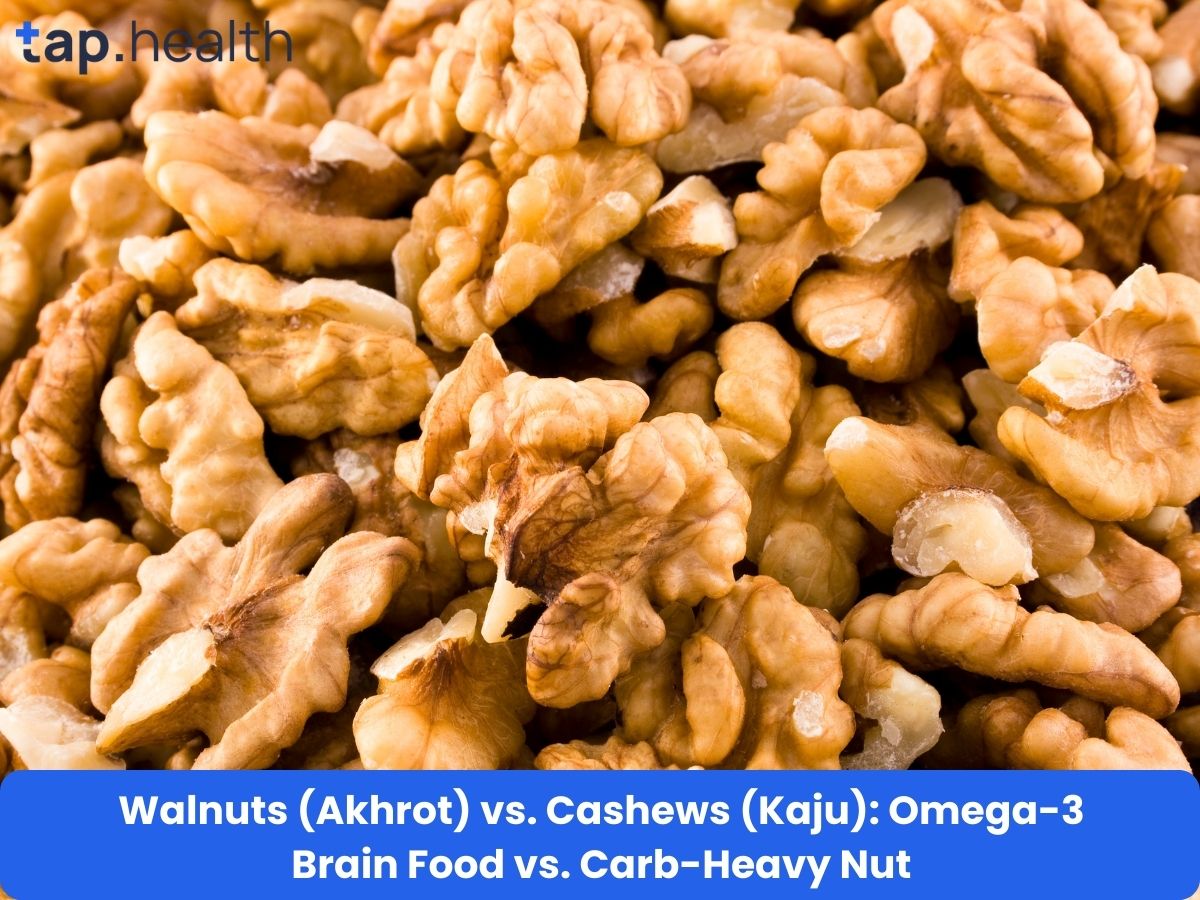
But then you see the Walnut (Akhrot). It looks like a tiny human brain. It tastes slightly bitter, a bit earthy, and feels “serious.”
In India, these two nuts hold very different social statuses.
Cashews are the kings of hospitality—we put them in our Shahi Paneer, our Kaju Katli, and our snacks.1
Walnuts are treated like medicine—we soak them overnight and eat them as a “brain tonic” because of their shape.
But when it comes to your blood sugar, your heart health, and your waistline, which one is actually the “Superfood”?
Is the Cashew really a “fattening” carb-bomb as people claim?
Is the Walnut really the ultimate protector of the heart?
And if you are diabetic, which one will keep your insulin levels stable?
In this comprehensive guide, we are going to crack open the truth about Walnuts vs. Cashews. We will analyze their fatty acid profiles, compare their Glycemic Index (GI), and reveal which nut you should be munching on to stay sharp and lean.
The Contenders: The Brain Mimic vs. The Creamy Kidney
To understand their power, we must look at their biological makeup.
1. Walnuts (Akhrot)
- The Reputation: The “Brain Food.” It is the only nut with a significant amount of plant-based Omega-3.
- The Profile: It is very high in polyunsaturated fats (the “very good” fats) and antioxidants.2
- The Taste: Earthy, slightly bitter (due to the skin), and rich.3
2. Cashews (Kaju)
- The Reputation: The “Indulgent Nut.” Often blamed for weight gain and high cholesterol.
- The Profile: It is lower in fat than most nuts but higher in carbohydrates (starch).
- The Taste: Sweet, buttery, and creamy.
Nutritional Face-Off: The Macros
Let’s compare 28g (about one handful) of both nuts.
| Feature | Walnuts (28g / ~7 halves) | Cashews (28g / ~18 nuts) | The Winner |
| Calories | ~185 kcal | ~157 kcal | Cashews (Lower Calorie) |
| Carbohydrates | ~3.9g | ~8.6g | Walnuts (Lower Carbs) |
| Sugar | ~0.7g | ~1.7g | Walnuts |
| Protein | ~4.3g | ~5.2g | Cashews |
| Total Fat | ~18.5g | ~12.4g | Cashews (Lower Total Fat) |
| Omega-3 (ALA) | ~2.5g | ~0.02g | Walnuts (100x more!) |
| Fiber | ~1.9g | ~0.9g | Walnuts |
The Analysis:
- The Omega-3 Gap: This is the biggest difference. Walnuts are one of the best plant sources of Alpha-Linolenic Acid (ALA).4 Cashews have almost none.
- The Carb Trap: Cashews have double the carbohydrates of walnuts. If you are on a strict Keto or Low-Carb diet, Cashews can kick you out of ketosis much faster than Walnuts.
- The Fat Type: While Walnuts have more fat, it is mostly “healthy” polyunsaturated fat.5 Cashews have less fat, but a higher percentage of it is saturated fat.
The Glycemic Index Battle: Starch vs. Fat
For a diabetic, nuts are usually the safest snack. But not all nuts react the same way.
1. The Glycemic Index of Walnuts
GI Score: ~15 (Very Low)
- The Effect: Walnuts have almost zero impact on blood sugar. The high fat and fiber content slow down the digestion of any other carbs you eat with them.
- The Benefit: Research shows that eating walnuts can improve the function of the lining of your blood vessels (endothelium), which is often damaged in diabetics.6
2. The Glycemic Index of Cashews
GI Score: ~22 to 25 (Low)
- The Reality: While still “Low GI,” Cashews contain Starch.7 This makes them unique among nuts.
- The Spike: Because of the starch, eating a large amount of cashews (like a whole packet) can lead to a gradual rise in blood sugar, unlike walnuts which keep it flat.
- The Verdict: Walnuts are superior for blood sugar management, but Cashews are still a much better snack than biscuits or chips.
The Brain Battle: Why Shape Matters
Is the “Walnuts look like brains, so they help brains” theory just an old wives’ tale?
The Science of Walnuts:
- Omega-3: The ALA in walnuts is converted into DHA/EPA in the body, which are the building blocks of brain cells.8
- Polyphenols: Walnuts have higher antioxidant levels than almost any other common nut.9 These reduce “neuro-inflammation”—the rusting of the brain that leads to Alzheimer’s and memory loss.
The Science of Cashews:
- Magnesium: Cashews are a magnesium powerhouse.10 Magnesium is essential for nerve transmission and protecting the brain against “over-excitation.”11+1
- Tryptophan: Cashews contain an amino acid that helps the body produce Serotonin (the “happy” hormone).12 Some nutritionists call them “Nature’s Antidepressant.”
Winner: Walnuts win for long-term brain structure and memory. Cashews win for mood and relaxation.
Weight Loss: The “Melt” vs. The “Starch”
Will Cashews make you fat?
The Myth: People avoid Cashews because they think they are “fattening.”
The Truth: Studies show that nut eaters generally weigh less than non-nut eaters.13
- The Secret: Our bodies don’t absorb all the calories in nuts. Because nuts are hard, some of the fat stays trapped in the fiber and passes through us.
- Walnut Advantage: Walnuts are more “filling” because they activate a region in the brain (insula) that controls appetite and cravings.14
- Cashew Danger: Because Cashews are sweet and less bitter, it is very easy to “mindlessly” eat 50 of them. That is where the weight gain comes from—portion control.
Real-Life Scenario
Let’s meet Mr. Mehra, a 50-year-old with high blood pressure and a stressful job.
The Habit:
Mr. Mehra used to snack on Roasted Salted Cashews while working. He found them comforting. However, his “bad” cholesterol (LDL) was high, and he was gaining weight around his belly.
The Switch:
His doctor suggested the “Soaked Walnut” routine.
- He started soaking 2-3 whole walnuts overnight and eating them with his morning tea.
- He swapped his afternoon cashew snack for a mix of 1 walnut + 5 almonds.
The Result:
- Cholesterol: After 3 months, his LDL dropped by 10%. The Omega-3s in the walnuts helped thin his blood and clear out some of the fat.
- Stress: He felt less “snacky” in the evenings because the walnuts kept him satiated.
- Blood Pressure: The magnesium and potassium in the nuts helped stabilize his readings.
Expert Contribution
We consulted medical experts to finalize the nut rankings.
Dr. S. Verma, Cardiologist:
“If you are a heart patient, Walnuts are not a snack; they are a prescription. They are the only nuts that significantly improve the health of your arteries. Cashews are fine as a treat, but they don’t offer the same cardio-protective benefits as the Omega-3s in walnuts.”
Nutritionist Perspective:
“Don’t peel the walnuts! That thin, slightly bitter skin contains 90% of the walnut’s antioxidants. If you find the bitterness too much, soaking them in water overnight removes the tannins and makes them creamy and sweet, just like cashews.”
Recommendations Grounded in Proven Research
Based on data from the American Journal of Clinical Nutrition and Harvard Health, here are actionable tips:
- The Soaking Hack:Always soak Walnuts.
- Why? It neutralizes phytic acid (which can block mineral absorption) and makes the Omega-3s easier for your body to process.
- The Roasting Warning:
- Walnuts: Never roast them at high heat. The Omega-3 fats are delicate and “die” (oxidize) when exposed to high heat, making them inflammatory. Eat them raw or soaked.
- Cashews: Light roasting is fine as their fats are more stable.
- Portion Control:
- Walnuts: 2 to 3 whole nuts (4-6 halves) per day.
- Cashews: 5 to 10 nuts per day.
- Avoid the “Fried & Salted” Packets:The health benefits of Cashews are canceled out if they are deep-fried in palm oil and coated in excess sodium. Buy them raw or dry-roasted.
Key Takeaways
- Brain Health: Walnuts are the clear winner due to high Omega-3 and antioxidant content.
- Diabetes: Walnuts are better for insulin sensitivity and have fewer carbs.
- Mood: Cashews help with serotonin production and relaxation.15
- Heart: Walnuts are superior for clearing LDL cholesterol and improving artery health.
- Portion: It is much easier to overeat Cashews; Walnuts are naturally self-limiting due to their rich flavor.
- Verdict: For daily health and longevity, choose Walnuts. For an occasional creamy snack or mood boost, choose Cashews.
Conclusion
So, Walnuts vs. Cashews: Which nut reigns supreme?
The Walnut (Akhrot) is the gold medalist of the nut world. It is a nutritional powerhouse that targets the two most important organs: the heart and the brain.
Cashews (Kaju) are like the “tasty cousin.” They are healthy whole foods, certainly better than a pack of biscuits, but they lack the heavy-hitting medicinal properties of the walnut.
The Best Strategy:
Use Walnuts as your “Daily Medicine.”
Use Cashews as your “Healthy Culinary Indulgence.”
Next time you reach for that bowl of nuts, remember: the brain-shaped one is keeping you sharp, while the kidney-shaped one is just a creamy delight. Balance them both!
Frequently Asked Questions (FAQ)
Why do walnuts taste bitter?
The bitterness comes from the polyphenols and tannins in the thin brown skin.16 These are actually the healthiest parts of the nut! Soaking them overnight in water can significantly reduce this bitterness without losing the nutrients.
Are cashews bad for cholesterol?
No, they are neutral. While cashews have more saturated fat than walnuts, most of it is Stearic Acid, which has a neutral effect on blood cholesterol. However, they don’t lower bad cholesterol as effectively as walnuts do.
Can I eat walnuts if I have a nut allergy?
No. Walnut and Cashew allergies are common. If you are allergic to tree nuts, you must avoid both. Symptoms can range from itching and hives to severe anaphylaxis.
Is “Kaju Katli” healthy if I eat it in moderation?
Not really. While the cashew itself is healthy, Kaju Katli is roughly 50% sugar. The sugar causes an insulin spike that negates the benefits of the nut. It is a sweet treat, not a health food.
Do walnuts help with sleep?
Yes. Walnuts are a natural source of Melatonin, the hormone that regulates your sleep-wake cycle.17 Eating a few walnuts in the evening may help improve the quality of your sleep.
References:
- Harvard Health: Quick Guide to Nuts and Health. Link
- Journal of Nutrition: Walnuts and Brain Health. Link
- American Journal of Clinical Nutrition: Nut consumption and weight gain. Link
- USDA FoodData Central: Walnuts vs Cashews. Link
- Diabetes Care: Nuts as a replacement for carbohydrates in Type 2 Diabetes. Link
(Disclaimer: This content is for educational purposes only. Always consult your doctor or a certified dietitian before making significant changes to your diet, especially if you have nut allergies or are on blood-thinning medication.)