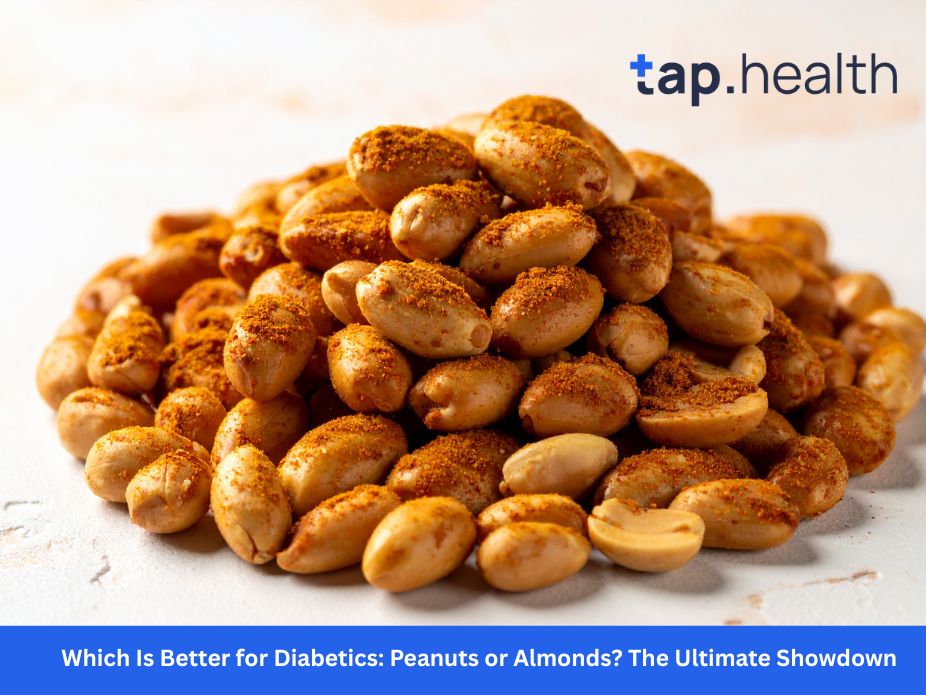
If you visit any nutritionist in India, they will likely tell you to eat a handful of nuts daily. But then you go to the market, and you see the price tag. Almonds (Badam) are expensive, often considered a luxury item. Peanuts (Mungfali), on the other hand, are cheap, delicious, and available everywhere.
This leads to a very common debate in diabetic households: “Is the expensive almond actually better for my sugar than the humble peanut?”
Or, to put it simply: Which is better for diabetics, peanuts or almonds?
Both are packed with healthy fats, protein, and fibre. Both have a low Glycemic Index. But when you look at the microscopic nutrients—the vitamins, minerals, and inflammation fighters—one does have a slight edge.
In this detailed guide, written in simple Indian English, we will pit these two heavyweights against each other. We will compare their impact on blood sugar, their heart health benefits, and help you decide which one deserves the spot in your daily diet.
Round 1: The Glycemic Index (Blood Sugar Impact)
For a diabetic, the most important number is the Glycemic Index (GI)—how fast a food spikes your sugar.
- Almonds: GI is approx 0 to 15 (Extremely Low).
- Peanuts: GI is approx 13 to 14 (Extremely Low).
The Verdict: It’s a Tie. Both nuts are excellent for blood sugar control. Because they digest slowly, neither causes a spike. In fact, eating either of them along with a high-carb meal (like rice or fruit) will help lower the overall sugar spike of that meal.
Round 2: Nutritional Breakdown (The “Micro” Nutrients)
This is where the differences start to show. Let’s look at 28 grams (one handful) of each.
The Almond Advantage (Magnesium & Vitamin E)
Almonds are famous for two things:
- Magnesium: Diabetics are often deficient in magnesium. Low magnesium makes insulin resistance worse. Almonds are one of the best natural sources of this mineral (approx. 76mg per serving).
- Vitamin E: This is a powerful antioxidant that protects your eyes and heart from diabetic damage. Almonds provide nearly 45% of your daily requirement in just one handful.
The Peanut Power (Protein & Folate)
Peanuts are technically legumes (dals), not nuts.
- Protein: Peanuts have more protein (7g) compared to almonds (6g).
- Arginine: Peanuts are very rich in Arginine, an amino acid that helps open up blood vessels and improve blood flow, which is great for diabetic circulation.
The Verdict: Almonds Win (Slightly). While peanuts are great, the high Magnesium content in almonds gives them a specific medical edge for insulin sensitivity.
Round 3: Heart Health (Cholesterol)
Diabetics are at high risk for heart disease, so we need a nut that cleans the arteries.
- Almonds: Rich in monounsaturated fats. Studies consistently show that almonds actively lower LDL (bad) cholesterol and reduce inflammation (CRP levels). The skin of the almond is rich in flavonoids that act as antioxidants.
- Peanuts: Also rich in healthy fats and Resveratrol (the heart-healthy compound found in red wine). However, peanuts also contain more Omega-6 fatty acids. While essential, too much Omega-6 can be inflammatory if not balanced with Omega-3s.
The Verdict: Almonds Win. Almonds have stronger research backing their ability to reduce heart disease risk in diabetics.
Round 4: The Price Factor (The Reality Check)
We cannot ignore this. In India, the price difference is massive.
- Almonds: ₹800 – ₹1,000 per kg.
- Peanuts: ₹120 – ₹160 per kg.
The Verdict: Peanuts Win Hands Down. Peanuts are often called “The Poor Man’s Almond.” Nutritionally, they provide 90% of the benefits of almonds for 20% of the price. If buying almonds stresses your budget, peanuts are a fantastic, healthy alternative.
Which Is Better? The Final Conclusion
So, who wins?
- The Gold Standard: Almonds. If budget is not an issue, almonds are the superior choice for diabetics. Their unique combination of high Magnesium, Vitamin E, and fiber makes them the perfect tool for improving insulin sensitivity and protecting the heart.
- The Smart Choice: Peanuts. If you want high protein and steady blood sugar on a budget, peanuts are excellent. They are not “unhealthy.” They are a superfood in their own right.
Pro Tip: You don’t have to choose just one! The best diet is a varied one.
- Eat Almonds: Soaked and peeled in the morning (for better nutrient absorption).
- Eat Peanuts: Roasted (unsalted) as an evening snack to curb hunger.
Real-Life Scenario
Meet Sunita (45, Type 2 Diabetic): Sunita was forcing herself to buy expensive almonds because her neighbor said peanuts were “bad fat.” She was eating only 4 almonds a day to save money, which wasn’t enough to curb her hunger. The Change: Her dietitian corrected her. “Sunita, eating 4 almonds does almost nothing. It is better to eat a full handful of peanuts than just 4 almonds.” The Result: Sunita switched to a mix. She ate 5 soaked almonds in the morning and a handful of roasted peanuts in the evening. Her hunger vanished, her protein intake went up, and her wallet was happier.
Expert Contribution
We consulted Dt. A. Sharma, a Certified Diabetes Educator, to settle the debate.
“I often tell my patients: Don’t let the ‘perfect’ be the enemy of the ‘good’. Yes, almonds have a slightly better nutrient profile for insulin. But peanuts have more protein. The real enemy is the processing. Salted almonds and Masala peanuts are both bad. Raw or plain roasted nuts of any kind are good. If you can afford almonds, great. If not, eat peanuts with pride—they are a powerhouse.”
Recommendations Grounded in Proven Research
According to the American Diabetes Association and studies in the Journal of Nutrition:
- The “Pre-Load” Trick: Eating a handful of almonds 30 minutes before a meal has been proven to significantly lower the post-meal sugar spike.
- Skin Matters: Do not buy blanched (skinless) almonds or peanuts. Most of the antioxidants (phenols) are in the skin. (Exception: Soaking almonds helps digestion, but you lose some antioxidants in the skin—it is a trade-off).
- Watch the Salt: Whether you choose almonds or peanuts, buy them raw or dry roasted without salt. Sodium is dangerous for diabetic blood pressure.
Read this : is roasted peanuts good for diabetes?
Key Takeaways
- Winner: Almonds are slightly better due to Magnesium and Vitamin E.
- Runner Up: Peanuts are an excellent, high-protein, budget-friendly alternative.
- Impact: Both have a very low Glycemic Index and help stabilise blood sugar.
- Best Practice: Eat a mix of both if possible.
- Avoid: Salted, fried, or honey-coated versions of either nut.
FAQ: Frequently Asked Questions
Which nut lowers blood sugar the most?
Research suggests that Almonds and Walnuts are the most effective at lowering fasting blood sugar and HbA1c levels when eaten daily. Their high fibre and healthy fat content improve insulin resistance effectively.
Can I eat peanuts and almonds together?
Yes, absolutely. Mixing them gives you the best of both worlds—the Vitamin E from almonds and the high protein/arginine from peanuts. A mixed nut trail mix (unsalted) is a perfect diabetic snack.
Do I need to soak almonds for diabetes?
In Ayurveda, soaking almonds is recommended to remove the “heat” and make them easier to digest. It also removes enzyme inhibitors, allowing better nutrient absorption. For diabetes, soaked almonds are great, but eating them with the skin (unsoaked) provides more fiber and antioxidants. Both are fine.
Are cashews good for diabetics?
Cashews are delicious but have a higher carbohydrate content than almonds or peanuts. They also have a slightly higher effect on blood sugar. While safe in moderation, almonds and peanuts are better choices for daily snacking.
How many almonds should a diabetic eat daily?
The recommended portion is about 23–25 almonds (approx. 1 ounce or 28 grams). This provides the optimal amount of magnesium and fibre without adding too many calories.
Disclaimer: This article is for educational purposes only. Always consult your doctor or dietitian before making significant changes to your diet.