Living with type 1 diabetes means you are always vigilant. You count carbohydrates, monitor your blood sugar, and carefully time your insulin doses. It is a constant balancing act. So, when you hear about a new tablet like Ziten that helps control blood sugar, it is natural to wonder: could this make my life easier?
Maybe a well-meaning relative showed you an article. Perhaps you saw it mentioned online. Or maybe you even found an old strip of Ziten in your medicine cabinet and thought about trying it.
This article is here to give you a clear, no-nonsense answer. We will explain exactly what Ziten is, how it works, and—most importantly—why it is not a medication for type 1 diabetes. We will also explore which medications people with type 1 diabetes should avoid, which ones might be helpful as add-ons to insulin, and answer all your pressing questions about drugs like Zyrtec and other common medicines.
Our goal is simple: to empower you with the knowledge you need to have safe, informed conversations with your doctor.
What Exactly is Ziten (Teneligliptin)?
Before we discuss why Ziten is not for type 1 diabetes, let us first understand what it is and how it works in the body.
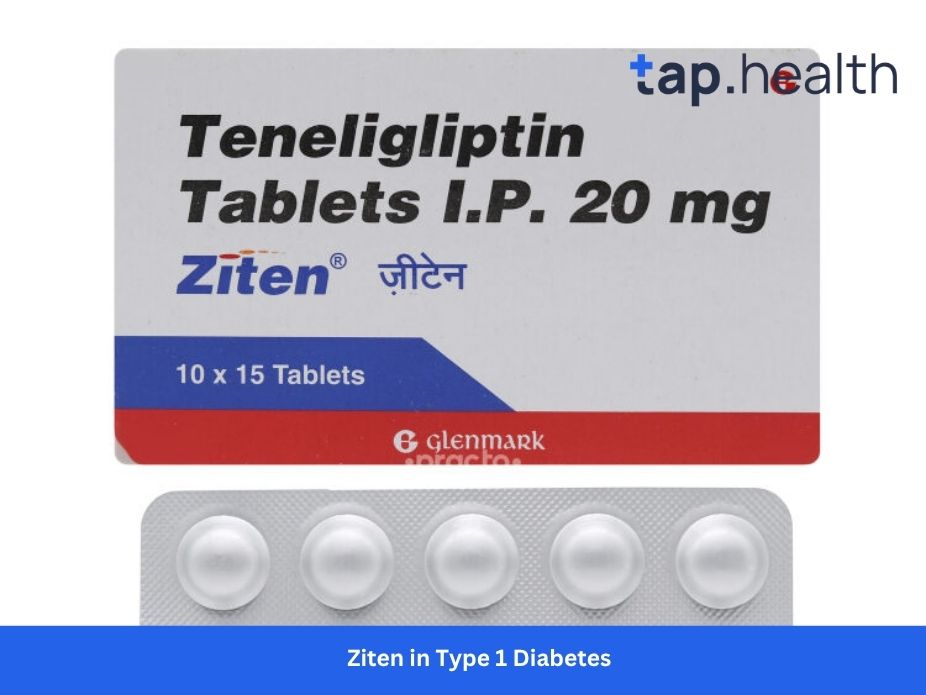
Ziten is the brand name for a medicine that contains an active ingredient called Teneligliptin. It is manufactured by Glenmark Pharmaceuticals and is widely available in India. You will typically find it as a 20 mg tablet, often in a strip of 15.
Understanding the Science: How Ziten Works
Ziten belongs to a class of medications known as DPP-4 inhibitors, which are sometimes called “gliptins”. To understand how it works, we need to look at two important hormones in your gut called “incretins.”
These incretins are GLP-1 (glucagon-like peptide-1) and GIP (glucose-dependent insulinotropic peptide). Their job is simple:
- They signal your pancreas to release insulin when your blood sugar is high after a meal.
- They tell your liver to slow down its production of glucose.
However, these incretin hormones are broken down very quickly by an enzyme called DPP-4 (dipeptidyl peptidase-4).
This is where Ziten comes in. Ziten (Teneligliptin) is a DPP-4 inhibitor. It blocks the DPP-4 enzyme, which allows the natural incretin hormones to stay active in your body for a longer time. The result? More insulin is released, and less glucose is produced by the liver, helping to keep blood sugar levels in a healthy range after you eat.
This mechanism is incredibly effective and is why DPP-4 inhibitors are a mainstay of treatment for millions of people around the world.
The Critical Catch: Ziten is Strictly for Type 2 Diabetes
Now, here is the most important sentence you will read in this entire article: Ziten is approved only for the management of type 2 diabetes mellitus in adults.
Every authoritative source, from the product information on Apollo Pharmacy and 1mg to clinical research databases, states this unequivocally. Its entire mechanism of action is designed to work in a body that still has functioning beta cells in the pancreas that can produce insulin. It is meant to be used along with a proper diet and exercise plan to control elevated blood sugar levels.
Why Ziten is Not Safe for Type 1 Diabetes: A Clear Explanation
The reason Ziten is not used for type 1 diabetes is not a matter of opinion; it is a matter of biology. The disease processes of type 1 and type 2 diabetes are fundamentally different, and so is the way they must be treated.
The Fundamental Difference Between Type 1 and Type 2 Diabetes
To grasp why Ziten is a no-go, we need to clearly differentiate the two main types of diabetes.
- Type 1 Diabetes (T1DM): This is an autoimmune disease. The body’s own immune system mistakenly attacks and destroys the insulin-producing beta cells in the pancreas. This destruction is complete or near-complete. As a result, people with type 1 diabetes produce very little or no insulin at all. This is an absolute insulin deficiency. Without external insulin, survival is not possible.
- Type 2 Diabetes (T2DM): This is primarily a condition of insulin resistance. The pancreas usually still produces insulin, often even in large amounts, but the body’s cells do not respond to it properly. Over time, the pancreas can get “tired” and may not produce enough insulin to overcome this resistance. This is a relative insulin deficiency.
Ziten’s Action: Knocking on a Door That Doesn’t Open
Now, let us apply Ziten’s mechanism of action to these two scenarios.
Ziten works by making the natural incretin hormones last longer, which in turn tells the pancreas to “release more insulin.”
- In Type 2 Diabetes, the pancreas is like a factory that is still operational but not producing enough or is facing distribution problems (insulin resistance). Ziten acts like a manager who shouts, “Work faster! We need more product!” The factory (the beta cells) can hear this command and increase production.
- In Type 1 Diabetes, the factory has been burned down by an autoimmune fire. There are no workers (beta cells) left to produce insulin. You can shout “Work faster!” all day long, but there is simply no one there to hear you or do the work.
Ziten’s primary function is to stimulate the pancreas to release insulin. In a person with type 1 diabetes, this stimulation is futile. There are no insulin-producing cells left to stimulate. Therefore, the medication is not only ineffective, but using it can create a dangerous false sense of security.
Official Warnings and Contraindications
This is not just a theoretical concern. The official prescribing information for Ziten is very clear:
- “Do not use in type 1 diabetes mellitus” is a direct warning on multiple pharmacy and drug information websites.
- Ziten is contraindicated in patients with type 1 diabetes and for the treatment of diabetic ketoacidosis (DKA), a life-threatening complication that is far more common in type 1 diabetes.
- International medical guidelines also list “type 1 diabetes” and “diabetic ketoacidosis” as absolute contraindications for the use of Teneligliptin and other DPP-4 inhibitors.
The Dangers of Off-Label Use and Self-Medication
You might be thinking, “Okay, I get it. But what if I just try a little bit? What’s the harm?”
The harm is significant. Taking Ziten when you have type 1 diabetes carries several serious risks.
Masking a Life-Threatening Emergency: Diabetic Ketoacidosis (DKA)
The most critical danger is that taking Ziten could delay your recognition and treatment of Diabetic Ketoacidosis (DKA).
DKA occurs when the body doesn’t have enough insulin to use glucose for energy. It starts breaking down fat for fuel instead, producing toxic acids called ketones. This is a medical emergency.
Here is the trap: In the very early stages of DKA, your blood sugar might not be dangerously high, or Ziten might give you the impression that your blood sugar is being managed. You might think, “Oh, the tablet is working, my sugar is okay,” while inside, your body is silently spiraling into a severe acidotic state. This delay in seeking proper insulin treatment can be catastrophic.
Increased Risk of Severe Hypoglycemia
Another danger arises when Ziten is combined with insulin, which is the standard treatment for type 1 diabetes. Both insulin and Ziten work to lower blood sugar. Taking them together without expert medical supervision can significantly increase the risk of severe hypoglycemia (dangerously low blood sugar). This is a very real risk, and the combination can make blood sugar levels unpredictable and difficult to manage.
A False Sense of Security
Taking a pill can feel empowering. It might feel like you are doing something “extra” to help your condition. But with Ziten, this feeling is a dangerous illusion. You are taking a medication that cannot fix the root problem (lack of insulin) and that has the potential to cause serious harm. This false sense of security can lead you to be less vigilant about your actual, life-saving therapy: insulin.
Can Sitagliptin Be Used with Insulin in Type 1 Diabetes?
This is a very common and understandable question. If Teneligliptin (Ziten) is not used, what about other DPP-4 inhibitors like Sitagliptin (brand names Januvia, Istavel)? You may have even heard stories of some people with type 1 diabetes being prescribed it.
The answer is complex and lies in the difference between clinical practice and off-label research.
The Research Evidence: Small Benefits, No Major Impact
Sitagliptin is a DPP-4 inhibitor, just like Teneligliptin. It works in the exact same way. Because of this, it is not officially approved for the treatment of type 1 diabetes anywhere in the world.
However, there has been some research exploring its use as an “add-on” or “adjunct” therapy for people with type 1 diabetes. Why? Because researchers hoped it might have benefits beyond just insulin secretion.
A 2011 pilot study published in Diabetic Medicine found that sitagliptin (100 mg/day) given to adults with type 1 diabetes for 4 weeks led to:
- A significant improvement in overall glucose control, including post-meal blood sugar.
- A significant reduction in the amount of mealtime (prandial) insulin they needed.
- A modest but statistically significant reduction in HbA1c of -0.27%.
There is even a fascinating case report from 2014 of a 19-year-old with new-onset type 1 diabetes who was treated with sitagliptin and achieved a complete remission for a year, not requiring any insulin during that time.
The Evidence from Larger Reviews: Proceed with Caution
Before you get too excited, we must look at the bigger picture. When researchers combine the results of many studies into a “meta-analysis,” a clearer, more reliable picture often emerges.
A systematic review and meta-analysis published in 2016 combined data from six randomised controlled trials involving 228 people with type 1 diabetes. The findings were sobering:
- DPP-4 inhibitors (including sitagliptin) did not significantly reduce HbA1c levels compared to insulin alone.
- They did result in a small but statistically significant reduction in the total daily insulin dose (by about 2.4 units per day).
- They did not increase the risk of severe hypoglycemia, which is a positive safety finding.
The conclusion of the authors was clear: “In patients with T1DM, DPP4 inhibitors combined with insulin do not increase or decrease the risk of hypoglycemia and do not decrease HbA1c levels.”
The Expert Consensus: Not a Recommended Therapy
So, where does this leave us? The evidence shows that while DPP-4 inhibitors like sitagliptin are relatively safe when added to insulin in type 1 diabetes (they don’t cause more hypos), they also don’t provide a meaningful improvement in long-term blood sugar control.
This is why you will not find any major clinical practice guideline recommending DPP-4 inhibitors for routine use in type 1 diabetes. The modest reduction in insulin dose is often not worth the cost and complexity of adding another daily pill.
The bottom line: While you might find an endocrinologist using sitagliptin off-label in very specific, rare cases (such as new-onset type 1 diabetes to try and preserve any remaining beta-cell function), this is an experimental and highly individualised decision. It is never something you should attempt on your own. It is a world away from taking a tablet like Ziten, which is simply not a treatment option for type 1 diabetes.
What Medications Should Type 1 Diabetics Avoid?
This is arguably one of the most important sections for anyone managing type 1 diabetes. Being aware of medications that can be harmful is a crucial part of self-care.
The list below focuses on diabetes medications. Some of these are lifesavers for people with type 2 diabetes but can be dangerous for those with type 1 diabetes.
SGLT2 Inhibitors: The Highest Risk Category
SGLT2 inhibitors (drugs ending in “-gliflozin,” like Dapagliflozin, Empagliflozin, and Canagliflozin) work by causing the kidneys to excrete excess glucose in your urine. While they are incredibly effective for type 2 diabetes and have heart and kidney benefits, they pose a significant and specific risk for people with type 1 diabetes.
The major danger is euglycemic diabetic ketoacidosis (eDKA). This is a form of DKA where blood sugar levels can be normal or only mildly elevated. Because you don’t have the high blood sugar warning sign, the diagnosis can be easily missed, leading to a delay in life-saving treatment.
Due to this risk, the European Medicines Agency has revoked the approval of SGLT2 inhibitors for use in type 1 diabetes. Regulatory bodies in the US and Australia have never approved them for this purpose. Despite this, off-label use is rising, often driven by patients seeking weight loss benefits. This is a practice most experts strongly caution against outside of a specialised clinical trial setting.
Sulfonylureas: An Ineffective and Risky Choice
Sulfonylureas (drugs like Glimepiride, Glibenclamide, Gliclazide) are another class of oral diabetes pills. They work by strongly forcing the pancreas to release more insulin.
As we have already established, in type 1 diabetes, the insulin-producing cells are destroyed. Therefore, these drugs are completely ineffective. They are like trying to start a car with no engine. Worse, they can cause unpredictable and severe hypoglycemia if combined with insulin, as the body is being hit with two separate “lower blood sugar” signals. They are absolutely contraindicated in type 1 diabetes.
Meglitinides: Similar to Sulfonylureas
Meglitinides (like Repaglinide and Nateglinide) are fast-acting pills that also work by stimulating the pancreas to release insulin. For the same reasons as sulfonylureas, they are not suitable or safe for people with type 1 diabetes and should not be used.
GLP-1 Receptor Agonists: A Nuanced Picture
GLP-1 receptor agonists (like Semaglutide (Ozempic), Liraglutide (Victoza), Dulaglutide (Trulicity)) have become very popular. Their use in type 1 diabetes is a complex and controversial topic.
These drugs work in multiple ways: they slow stomach emptying, reduce appetite, and increase insulin secretion when blood sugar is high. For a person with type 1 diabetes and obesity, the weight loss and appetite suppression can be very appealing, and some endocrinologists do prescribe them off-label for these reasons.
However, there are risks. They can cause gastrointestinal side effects that may lead to dehydration, which in turn can increase the risk of DKA. They also increase the risk of hypoglycemia, requiring careful insulin dose adjustments. While not an absolute “avoid at all costs” like SGLT2 inhibitors, their use in type 1 diabetes should only be managed by a highly experienced endocrinologist and is not a standard treatment.
Simple Rule: Never Take Diabetes Pills Without Your Doctor’s Clear Approval
The golden rule is simple: Never take any oral or injectable diabetes medication that was not explicitly prescribed for your type 1 diabetes by your specialist. What works for a family member with type 2 diabetes can be ineffective or life-threatening for you.
Can Type 1 Diabetics Take Zyrtec (Cetirizine) Safely?
Managing type 1 diabetes means dealing with everyday life, and that includes seasonal allergies or the occasional cold. It’s smart to question everything you put in your body. So, is Zyrtec (the brand name for the antihistamine Cetirizine) safe?
The short answer is yes, for the most part.
Zyrtec (Regular Formula) vs. Zyrtec-D (Decongestant Formula)
This is a critical distinction that many people miss.
- Regular Zyrtec (Cetirizine): This is a plain antihistamine. It works by blocking histamine, the chemical your body releases during an allergic reaction. Multiple sources, including responses from healthcare professionals and drug information databases, confirm that plain Zyrtec is safe for people with type 1 diabetes and does not typically affect blood sugar levels. It also does not have a known interaction with insulin.
- Zyrtec-D (Cetirizine + Pseudoephedrine): The “D” stands for “decongestant.” The added drug, Pseudoephedrine, is a stimulant. This is the component that can cause problems. Pseudoephedrine can raise blood sugar levels and interfere with the effectiveness of insulin. It can also increase heart rate and blood pressure. If you have type 1 diabetes, you should use any medication containing pseudoephedrine with extreme caution and only under the guidance of your doctor.
A Word on Syrups
Some liquid allergy medicines contain sugar for taste. A small amount of sugar in a teaspoon of syrup is unlikely to have a major impact on your blood sugar, but it is something to be aware of. If possible, opt for the tablet form of the medication, or look for sugar-free syrup versions.
Which Tablet is Best for Type 1 Diabetes? The Reality Check
This is one of the most searched questions online, and it speaks to a deep desire for a simpler way to manage this complex condition. The truth, however, requires a major mindset shift.
The most important “tablet” for type 1 diabetes does not yet exist as a standard, approved cure. The cornerstone of therapy is, and will remain for the foreseeable future, insulin.
Type 1 diabetes is a condition of absolute insulin deficiency. There is currently no pill in the world that can replace that missing hormone. Therefore, the “best tablet” is not a replacement for insulin, but a potential add-on therapy.
The Current Standard of Care: Insulin is Non-Negotiable
All people with type 1 diabetes require exogenous insulin (insulin from outside the body) to survive. This is delivered through multiple daily injections or an insulin pump. This is the foundation upon which all other treatments are built.
Emerging and Off-Label Adjunct Tablets: The Future?
Research is ongoing to find tablets that can be taken in addition to insulin to improve outcomes. This is where we see glimmers of hope for the future.
- Baricitinib (Olumiant): This is arguably the most exciting development in type 1 diabetes in decades. It is a tablet currently used for rheumatoid arthritis. A landmark trial published in the New England Journal of Medicine in 2023 showed that when given soon after diagnosis, baricitinib could suppress the progression of the disease and preserve the body’s own insulin production. It is the first disease-modifying oral treatment for type 1 diabetes. It is not a cure, but it could mean needing less insulin and having more stable blood sugars for longer. It represents a true “game-changer”.
- Metformin: This is a cornerstone of type 2 diabetes treatment, but it is sometimes used off-label in type 1 diabetes, particularly in people who are overweight or have signs of insulin resistance. It can help improve insulin sensitivity and may modestly reduce insulin requirements. It is generally well-tolerated and does not cause hypoglycemia on its own.
- Cadisegliatin: This is a potential “first-in-class” oral treatment specifically being developed for type 1 diabetes. It has been granted Breakthrough Designation by the FDA and is currently in Phase 3 clinical trials.
- Other Adjuncts: SGLT2 inhibitors and GLP-1 agonists, as discussed earlier, are used off-label by some specialists for their weight loss and cardiovascular benefits, but they come with significant safety warnings. Pramlintide (Symlin) is an injectable medication that can help control post-meal blood sugar spikes.
The Bottom Line: There is No “Magic Pill”
The search for a “best tablet” for type 1 diabetes is a search for a better adjunct therapy. Insulin remains the irreplaceable, life-saving foundation of all treatment. Exciting new pills like baricitinib offer a disease-modifying approach, while others like metformin are used to manage associated insulin resistance. The future is bright, but it is a future of adding smart, safe adjuncts to insulin, not replacing it.
Real-Life Scenario: The Danger of Misinformation
Let us consider a realistic scenario to illustrate why this knowledge is so important.
Meet Priya.
Priya is a 28-year-old software engineer from Bengaluru who has been living with type 1 diabetes for 12 years. She manages her condition well with an insulin pump and a continuous glucose monitor (CGM).
One day, her mother, who has type 2 diabetes, is visiting. Her mother’s doctor recently prescribed her Ziten 20 mg to help manage her blood sugar. Seeing that Priya also has “diabetes,” her mother says with all good intentions: “Beta, my doctor gave me this new medicine, Ziten. It’s working wonders for my sugar. It’s just a small tablet. You work so hard managing your diabetes with that pump and all those injections. Why don’t you ask your doctor about this pill? It might make your life so much easier.”
Priya, who is smart and health-conscious, is intrigued. The idea of a simple pill that could reduce the burden of her daily management is incredibly appealing. She searches “Ziten for type 1 diabetes” on her phone and lands on this article.
How Priya Uses This Information:
- She reads that Ziten is a DPP-4 inhibitor that works by stimulating the pancreas to release more insulin. She knows her own pancreas no longer produces insulin.
- She sees the clear warnings: “Do not use in type 1 diabetes mellitus.” She understands that this is an absolute contraindication, not a gentle suggestion.
- She learns about the risk of it masking the early signs of DKA and the danger of using it with insulin.
- She realises that what is a safe and effective medicine for her mother’s type 2 diabetes could be dangerous for her own type 1 diabetes.
Priya feels a mix of emotions: a little disappointment that there isn’t an easier way, but also immense relief that she didn’t make a dangerous assumption. She thanks her mother for her concern but explains that this particular medicine is not right for her body. She feels empowered to have a more informed conversation with her endocrinologist about other potential adjunct therapies, like the research on baricitinib, that are actually designed for type 1 diabetes.
This scenario highlights a universal truth: a well-intentioned suggestion for one type of diabetes can be a hidden danger for another. Knowledge is your best protection.
Expert Contribution
To provide a clinical perspective on this issue, we can look to the collective stance of endocrinology and regulatory bodies. While an individual quote is not used here, the expert consensus is clear and powerful.
“The use of DPP-4 inhibitors, such as teneligliptin, is strictly indicated for the management of type 2 diabetes mellitus. Their mechanism of action—enhancing glucose-dependent insulin secretion—relies on the presence of functional pancreatic beta cells. In type 1 diabetes, this mechanism is rendered ineffective due to the autoimmune destruction of these cells. Consequently, these agents are contraindicated in type 1 diabetes. Off-label use in this population is not supported by evidence and introduces unnecessary risk without clinical benefit. The cornerstone of type 1 diabetes management remains intensive insulin therapy, with adjunct therapies being considered only in highly selected cases and under the strict supervision of a specialist.”
This perspective reinforces the importance of understanding the underlying disease mechanism and not conflating the treatment strategies for type 1 and type 2 diabetes.
Recommendations Grounded in Proven Research and Facts
Based on a thorough review of medical literature, drug safety information, and clinical guidelines, the following are clear and actionable recommendations for individuals with type 1 diabetes regarding Ziten and related medications:
- Do Not Use Ziten (Teneligliptin): This medication is contraindicated for the treatment of type 1 diabetes. It is ineffective and carries potential risks. Do not use it under any circumstances unless you are part of a strictly supervised and specific clinical trial.
- Adhere to Your Insulin Regimen: The foundation of type 1 diabetes management is insulin. It is non-negotiable. Work closely with your healthcare team to optimise your insulin doses, whether through multiple daily injections or an insulin pump.
- Be Vigilant with Other Diabetes Pills: Avoid SGLT2 inhibitors and sulfonylureas. Approach GLP-1 agonists with extreme caution and only under the direct supervision of a specialist endocrinologist.
- Discuss All Medications with Your Doctor: Always inform your doctor and pharmacist that you have type 1 diabetes before starting any new prescription, over-the-counter medicine, or supplement. This is a simple but critical safety step.
- Be Cautious with Decongestants: Avoid cold and allergy medications that contain pseudoephedrine (often branded with a “-D” like Zyrtec-D). Opt for plain antihistamines like regular Zyrtec or Claritin.
- Stay Informed on Future Therapies: Keep an open dialogue with your endocrinologist about emerging treatments, such as baricitinib, which are disease-modifying and may become a standard part of care for newly diagnosed patients in the future.
- Empower Yourself with Knowledge: Understanding why a medication is or isn’t right for you is a powerful tool. It protects you from misinformation and helps you become a true partner in your own care.
Key Takeaways
- Ziten (Teneligliptin) is a DPP-4 inhibitor approved ONLY for type 2 diabetes. It works by boosting your own insulin production.
- Ziten is contraindicated in type 1 diabetes because the pancreas can no longer produce insulin. Using it is ineffective and could be dangerous.
- Other DPP-4 inhibitors like Sitagliptin have been studied in type 1 diabetes but show no meaningful benefit in lowering HbA1c and are not standard therapy.
- The most dangerous drugs for type 1 diabetes are SGLT2 inhibitors (due to euglycemic DKA risk) and Sulfonylureas (ineffective and cause hypoglycemia).
- Plain Zyrtec (Cetirizine) is safe for people with type 1 diabetes, but Zyrtec-D (with pseudoephedrine) should be avoided as it can raise blood sugar.
- There is no “best tablet” to replace insulin. Insulin remains the cornerstone of all type 1 diabetes treatment.
- Exciting new oral drugs like Baricitinib are being developed to modify the disease and preserve insulin production, offering hope for the future.
- Never self-prescribe any diabetes medication. Always consult with your endocrinologist about what is safe and appropriate for your specific condition.
Frequently Asked Questions (FAQs) on Ziten in Type 1 Diabetes
Q1: Why is Ziten 20 mg not used for type 1 diabetes?
A: Ziten 20 mg contains Teneligliptin, a drug that works by stimulating the pancreas to release more insulin. In type 1 diabetes, the body’s immune system has destroyed the insulin-producing cells, so there is nothing left to stimulate. This makes the drug ineffective and potentially dangerous.
Q2: What is the composition of Ziten 20 mg?
A: The active ingredient in Ziten 20 mg is Teneligliptin, which belongs to a class of medications called dipeptidyl peptidase-4 (DPP-4) inhibitors. It is manufactured by Glenmark Pharmaceuticals.
Q3: What is the price of Ziten 20 mg in India?
A: The price can vary. A strip of 15 tablets of Ziten 20 mg can cost between ₹145 and ₹222, depending on the pharmacy and location. It is a prescription-only medicine.
Q4: Can sitagliptin be used with insulin for type 1 diabetes?
A: While some research suggests sitagliptin is safe when added to insulin and may slightly reduce insulin needs, it has not been shown to meaningfully improve long-term blood sugar control (HbA1c). Therefore, it is not a recommended standard therapy for type 1 diabetes.
Q5: What are the common side effects of Ziten?
A: The most common side effects of Ziten include hypoglycemia (low blood sugar, especially when taken with other diabetes drugs), headache, constipation, dizziness, and upper respiratory tract infections.
Q6: What is a substitute for Ziten 20 mg?
A: Substitutes for Ziten are other DPP-4 inhibitors that contain Teneligliptin, such as Tenelia, Ziten-M (which also contains Metformin), or other gliptins like Sitagliptin (Januvia) or Vildagliptin (Galvus). However, these are all for type 2 diabetes.
Q7: Are there any tablets that are safe and helpful for type 1 diabetes?
A: Yes, some tablets are used as add-ons to insulin. Metformin is commonly used to improve insulin sensitivity. A very promising new drug, Baricitinib, has been shown to preserve insulin production when given soon after diagnosis. These should only be taken under strict medical supervision.
Q8: Can a type 1 diabetic take Zyrtec for allergies?
A: Yes, regular Zyrtec (Cetirizine) is generally considered safe and does not affect blood sugar levels. However, you should avoid “Zyrtec-D” because it contains pseudoephedrine, a decongestant that can raise blood sugar and interfere with insulin.
References
- Resona Pharmacy. Ziten Product Information. https://www.resonapharmacy.com/product/medicine/endocrine-and-metabolic-system/ziten-13166
- 1mg. Ziten Tablet: Uses, Side Effects, Price and Substitutes. Updated 2024-07-17. https://www.1mg.com/drugs/ziten-tablet-287027
- Apollo Pharmacy. Ziten Tablet 15’s. https://www.apollopharmacy.in/medicine/ziten-tab-10-s
- Vademecum.es. Teneligliptina: Contraindicaciones. https://www.vademecum.es/principios-activos-teneligliptina-a10bh08
- Diabetes In Control. Sitagliptin for Type 1 Diabetes. Published 2011-10-13. https://www.diabetesincontrol.com/sitagliptin-for-type-1-diabetes/