In the chilly winters of North India, especially in states like Rajasthan, Haryana, and Gujarat, the dining table changes. The light wheat Phulkas are replaced by thick, rustic Bajra Rotis, served with a dollop of white butter (Makhan) and Sarson ka Saag or Gur (Jaggery).
For generations, our elders have told us that Bajra provides “heat” and strength to the body. But today, as India battles a rising wave of Type 2 Diabetes, we are forced to look at our traditional foods through a medical lens. We love the taste, but we fear the sugar spike.
You might be wondering: “Is this heavy grain actually safe for my blood sugar?” or “Should I stop eating wheat and switch to Bajra?”
To answer these questions, we need to understand the glycemic index of bajra.
In this comprehensive guide, we will decode the science behind Pearl Millet (Bajra). We will compare it with Wheat, Jowar, and Ragi, explain the impact of making it into a Roti, and help you decide if this ancient grain deserves a place in your diabetic diet plan.
What is Bajra (Pearl Millet)?
Before we dive into the numbers, let’s understand what we are eating. Bajra, known as Pearl Millet in English, is a hardy crop that thrives in dry regions. Unlike refined grains that are polished and stripped of nutrients, Bajra is almost always consumed as a whole grain.
It is gluten-free, rich in protein, and packed with minerals like Magnesium and Iron. In Indian culture, it is traditionally considered a “heating” food (Ushna), which is why it is consumed primarily in winter.
But the main reason health experts are talking about it today is its complex carbohydrate structure. Unlike the simple carbs in white rice or Maida, Bajra takes time to digest. This brings us to the most important metric for any diabetic: The Glycemic Index.
Also Read: 20 Best Food for Diabetes
Understanding Glycemic Index (GI)
To verify if Bajra is safe, we must look at the Glycemic Index (GI).
Think of GI as a speedometer for glucose. It measures how fast a food raises your blood sugar on a scale of 0 to 100.
- Low GI (0-55): These digest slowly. They release energy like a slow-burning candle. (Best for Diabetics).
- Medium GI (56-69): Moderate rise in sugar. Safe in moderation.
- High GI (70+): These digest instantly, causing a rapid “sugar spike” like rocket fuel. (e.g., White Bread, Sugar, Maida).
For a diabetic patient, the goal is to eat mostly Low GI foods to keep insulin levels stable.
The Magic Number: Glycemic Index of Bajra
So, what is the glycemic index of bajra?
The Glycemic Index of Bajra typically ranges from 54 to 60.
This places Bajra in the Low to Medium GI category.
Depending on the variety and how it is cooked, it often sits right on the borderline of Low and Medium. However, compared to refined wheat flour (Maida) which has a GI of over 70, or white rice which can go up to 73, Bajra is a significantly healthier choice.
Why is the GI moderate?
- High Fiber: Bajra is rich in insoluble fiber. This fiber acts as a barrier, slowing down the enzymes that break starch into sugar.
- Resistant Starch: It contains starch that resists digestion in the small intestine, acting like a prebiotic for your gut.
- Protein Structure: The protein in Bajra binds the starch granules tightly, delaying absorption.
Glycemic Index of Bajra Roti
We rarely eat raw Bajra grains. We grind them into flour (Atta) and make Rotis. Does this change the GI?
Yes, slightly.
When you grind a grain into flour, you break down its physical structure. Smaller particles are easier for the body to digest. Therefore, the glycemic index of bajra flour (and the resulting Roti) is usually around 60 to 66.
While this sounds like it is moving into the “Medium” zone, it is still lower than a standard Wheat Roti. Plus, we usually eat Bajra Roti with Ghee and Sabzi.
- The Ghee Effect: Adding fat (Ghee) lowers the GI of the meal.
- The Sabzi Effect: Adding fiber (Vegetables) lowers the GI.
So, a complete meal of Bajra Roti + Ghee + Dal/Sabzi has a manageable impact on blood sugar.
Glycemic Index of Bajra vs Wheat
This is the ultimate Indian dietary battle. Should you swap your standard Gehu (Wheat) for Bajra? Let’s look at the glycemic index of bajra vs wheat.
| Feature | Whole Wheat (Gehu) | Bajra (Pearl Millet) |
| Glycemic Index | 62 – 69 (Medium) | 54 – 60 (Low/Med) |
| Gluten Content | High | Zero (Gluten-Free) |
| Fiber Content | Moderate | High |
| Magnesium | Moderate | High |
| Digestion Speed | Fast | Slow |
The Verdict:
The glycemic index of bajra vs wheat roti shows that Bajra is the winner. Wheat, especially modern hybrid wheat, digests faster and spikes insulin more than the dense, fibrous Bajra. If you have insulin resistance, Bajra is a better staple than Wheat.
Glycemic Index of Bajra vs Jowar
Sorghum (Jowar) is another popular millet, often eaten in Maharashtra and Karnataka. How do they compare?
- Glycemic index of jowar: Approximately 62.
- Glycemic index of bajra: Approximately 54 – 60.
Comparison:
The glycemic index of bajra vs jowar is very close, but Bajra often edges out Jowar slightly in terms of lower GI. However, Jowar is “cooling” for the body while Bajra is “heating.”
- Tip: Eat Jowar in summer. Eat Bajra in winter. Both are excellent for diabetes.
Glycemic Index of Ragi vs Bajra
Ragi (Finger Millet) is famous in the South.
- Glycemic index of ragi: Approximately 65 to 80 (Depending on preparation).
- Verdict: Surprisingly, Ragi often has a higher GI than Bajra. While Ragi is amazing for Calcium, Bajra is better for strict blood sugar control.
Bajra Flour Glycemic Index and Load
We must also look at the Glycemic Load (GL). While GI measures speed, GL measures the total sugar impact of a portion.
- Bajra GI: ~55
- Carbs in 1 Roti (approx 30g flour): ~20g
- Glycemic Load: ~11 (Medium).
Bajra flour glycemic index and load suggests that while it is healthy, it is calorie-dense.
- Mistake: Eating 4 Bajra Rotis because “it is healthy.”
- Correction: Eat 2 Bajra Rotis. Even low GI foods will spike sugar if you eat too much of them.
Is Bajra Good for Diabetics?
The query “Is bajra good for diabetics?” is one of the most common searches.
The answer is YES.
Here is why Bajra is a medicine for your metabolic health:
- Magnesium Powerhouse: Bajra is one of the richest sources of Magnesium. Magnesium is a cofactor for insulin secretion. It helps your body use insulin more effectively, fighting insulin resistance.
- Satiety: Bajra is a heavy grain. It takes a long time to chew and digest. This signals your brain that you are full. You are less likely to snack on biscuits two hours after a Bajra meal.
- Good Fats: It has a higher healthy fat content than wheat, which further slows down sugar absorption.
- Gluten-Free: Many diabetics also suffer from inflammation or bloating. Removing gluten (wheat) and switching to Bajra often reduces this inflammation.
Real-Life Scenario
Let’s meet Mr. Singh, a 55-year-old farmer from Punjab.
The Problem:
Mr. Singh was diagnosed with Type 2 Diabetes. He loved his food, especially his 4-5 Wheat Parathas for breakfast. His post-meal sugar was hitting 220 mg/dL. He felt lethargic and was gaining weight around his belly.
The Switch:
His doctor advised him to embrace the traditional winter diet.
- The Change: He switched from Wheat Parathas to Bajra Rotis.
- The Method: Instead of pure Bajra, he mixed Bajra + Besan (Chickpea Flour).
- The Portion: Because Bajra is heavy, he could only eat 2 Rotis instead of 5 Parathas.
The Result:
- Energy: He felt full for 5 hours. No mid-morning hunger.
- Blood Sugar: His post-meal sugar dropped to 160 mg/dL within a month.
- Why? The glycemic index of bajra and wheat difference, combined with portion control, reduced his glycemic load drastically.
Read this: Is Bajra Good for Diabetes?
Expert Contribution
We consulted nutritional guidelines to get the professional medical stance.
Dr. S. Agarwal, Diabetologist:
“I frequently advise my patients to rotate their grains. The reliance on wheat alone is a major cause of the diabetes epidemic in North India. Bajra is excellent because of its fiber profile. However, patients must remember it is ‘Ushna’ (heating). I have seen patients getting acidity if they eat Bajra in peak summer. Timing and seasonality are key.”
Nutritionist Perspective:
“Don’t buy processed ‘Multigrain Atta’ from the store; it is mostly wheat with a pinch of millet. Buy pure Bajra Atta and mix it yourself. Freshly ground Bajra has better natural oils and nutrients than packet flour sitting on a shelf for months.”
Recommendations Grounded in Proven Research and Facts
Based on data from the National Institute of Nutrition (NIN) and ICMR, here are actionable tips for using Bajra:
- The “Mix-It” Strategy: If you find pure Bajra roti too hard or dry, mix it.
- The Diabetic Mix: 50% Bajra + 25% Besan (Chickpea flour) + 25% Wheat.
- Why: The glycemic index of besan is very low (~35). Adding it to Bajra lowers the overall GI of the Roti significantly.
- Soak or Sprout: If you use whole bajra grains (for Khichdi), soak them overnight. This reduces phytic acid and improves digestion.
- Don’t Sieve the Flour: Many people sieve (chan-na) the flour to make smoother rotis. Stop! The bran (husk) in the sieve is the fiber that lowers the GI. Put it back in the dough.
- Pair with Protein: Never eat Bajra Roti with just pickle or tea. Eat it with Dal, Paneer, or Curd. The protein slows down the sugar spike.
- Storage Warning: Bajra flour goes rancid (bitter) quickly because of its high oil content. Buy small quantities and consume within 20 days.
Comparison Table: Indian Flours
Let’s visualize where Bajra stands in the Indian kitchen.
| Flour Type | Glycemic Index (GI) | Best For |
| Besan (Chickpea) | ~35 (Low) | Mixing with other flours |
| Bajra (Pearl Millet) | ~54-60 (Low/Med) | Winter Roti, Diabetes |
| Jowar (Sorghum) | ~62 (Medium) | Summer Roti, Weight loss |
| Wheat (Whole) | ~65 (Medium) | Standard daily use |
| Maida (Refined) | ~75+ (High) | Avoid completely |
| Rice Flour | ~75+ (High) | Avoid completely |
Conclusion
The numbers tell a clear story. The glycemic index of bajra (54-60) makes it a superior choice to wheat and rice for managing diabetes.
It is not just a “poor man’s food” as it was once called; it is a nutritional powerhouse. With its ability to keep you full, provide essential magnesium, and release energy slowly, Bajra helps you break the cycle of high sugar spikes and crashes.
However, remember that it is calorie-dense. You cannot eat it in unlimited quantities. Treat it with respect—cook it well, pair it with vegetables, and enjoy it during the cooler months to harness its full power.
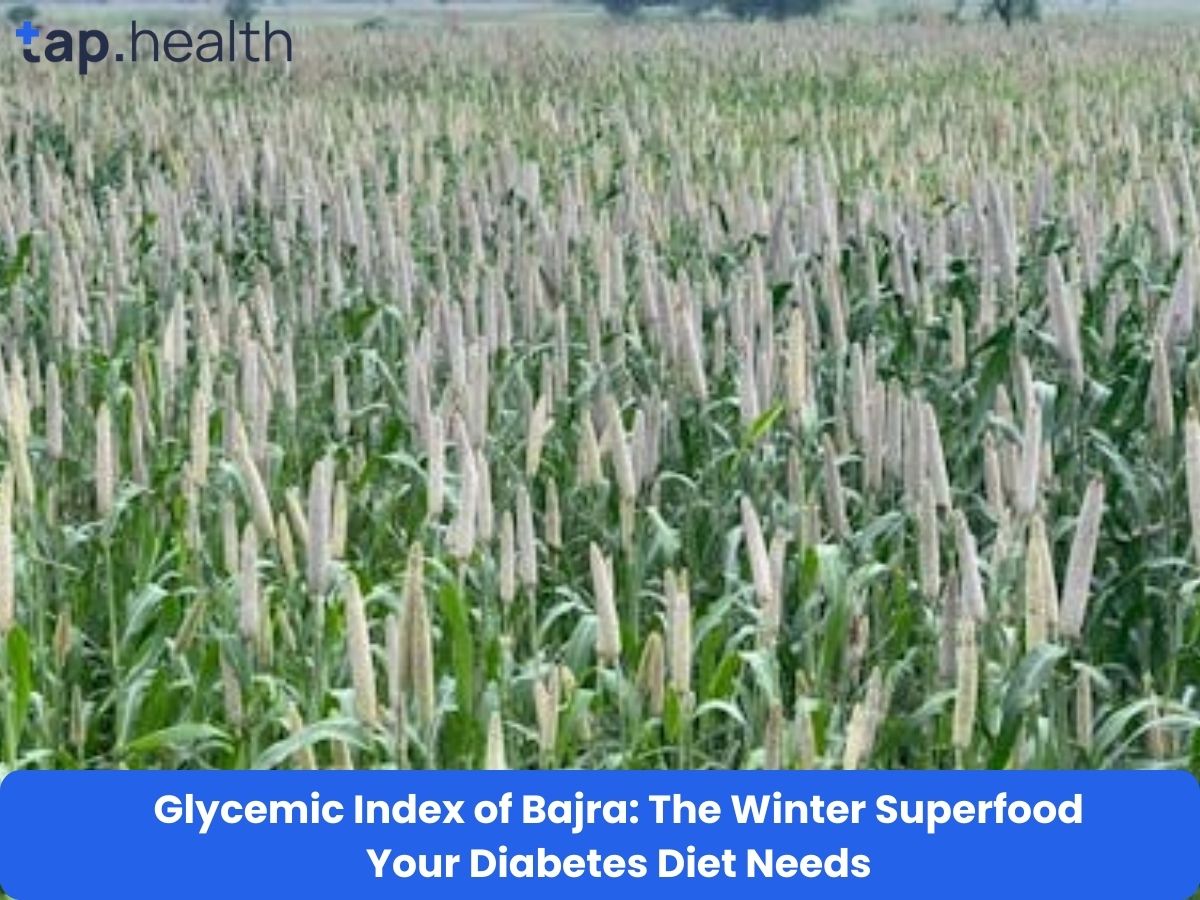
So, this winter, when you see the green fields of Pearl Millet or spot the grey flour in the market, bring it home. Your taste buds might take a day to adjust, but your pancreas will thank you for a lifetime.
Frequently Asked Questions (FAQ) on Glycemic Index of Bajra
Is bajra good for diabetics?
Yes, absolutely. Bajra is rich in fiber and magnesium, which helps control glucose receptors in the body. Its complex carbohydrates digest slowly, preventing sudden blood sugar spikes, making it an ideal grain for diabetics.
Which is better, Jowar or bajra?
Both are excellent, but they serve different purposes. Bajra generally has a slightly lower GI and higher fat/protein content, making it great for winter. Jowar is lighter, easier to digest, and cooling, making it better for summer. For diabetes, both are better than wheat.
What is the lowest GI flour?
Besan (Chickpea Flour) and Soya Flour generally have the lowest GI (around 35 and 25 respectively). Among grains, Barley flour and Bajra flour are among the lowest. Mixing Besan into your Bajra flour creates the ultimate low-GI Roti.
What is the glycemic index of jowar?
The glycemic index of jowar is approximately 62. While this is classified as Medium GI, it is still lower than refined wheat and white rice. Its high fiber content ensures that the glycemic load remains manageable.
Can I eat Bajra Roti at night?
It is generally recommended to eat Bajra for breakfast or lunch because it is a complex grain that takes time to digest. Eating it late at night might cause bloating or heaviness for some people. If you eat it at night, ensure you finish dinner 3 hours before sleeping.
What is the glycemic index of bajra vs wheat?
Bajra has a GI of roughly 54-60, while Whole Wheat has a GI of 62-69. This means Bajra releases sugar into the blood slower than wheat. Additionally, Bajra is gluten-free, whereas wheat contains gluten which can cause inflammation in some people.
Does grinding bajra increase its glycemic index?
Yes. Whole grains always have a lower GI than flour. When you grind Bajra into fine Bajra Flour, the GI increases slightly because the particle size is smaller and easier to digest. To counter this, use a coarse grind (Mota Atta) rather than a fine powder.
Can I mix Bajra and Wheat?
Yes, mixing them is a great strategy. If you find pure Bajra roti too dry or hard to roll, mixing 50% Bajra and 50% Wheat will still give you a lower glycemic index than using 100% Wheat, while making the roti softer and tastier.
References:
- National Institute of Nutrition (NIN): Glycemic Index of Common Indian Foods. Link
- Harvard Health Publishing: Glycemic index for 60+ foods. Link
- WebMD: Health Benefits of Pearl Millet. Link
- Diabetes.co.uk: Millets and Diabetes. Link
- ICMR Guidelines for Management of Type 2 Diabetes. Link
(Disclaimer: This content is for educational purposes only. Always consult your doctor or a certified dietitian before making significant changes to your diet, especially if you have thyroid issues, as millet contains goitrogens.)