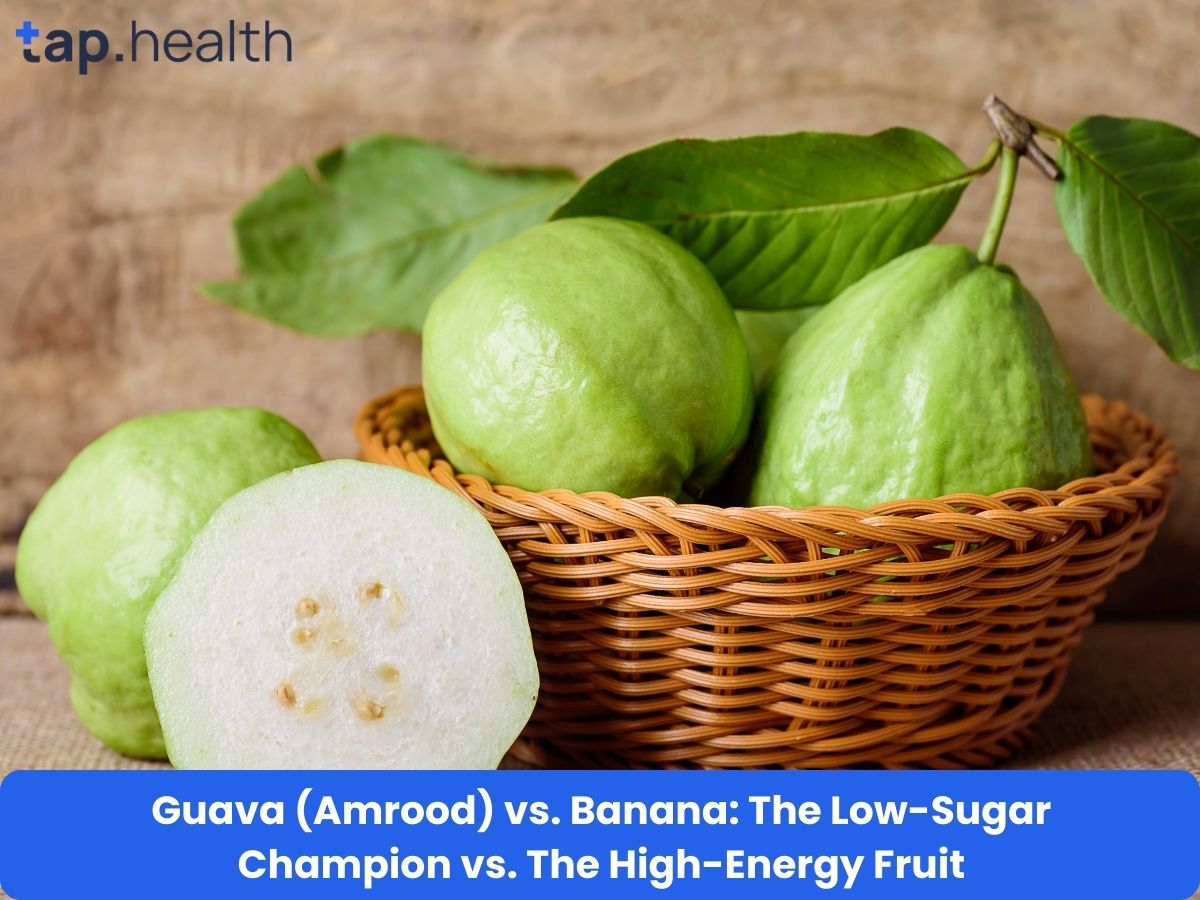
It is a crisp winter afternoon in North India. You are sitting in the sun, peeling a fruit.
In one hand, you have the ubiquitous Banana (Kela)—the most convenient, peel-and-eat snack in the world. It is sweet, creamy, and gives you instant energy.
In the other hand, you have a hard, bumpy green Guava (Amrood), sprinkled with a pinch of pink salt and red chili powder.
We have grown up eating both. But as we get older, and as our waistlines expand or our blood sugar creeps up, we have to make a choice.
Is the Banana “fattening”? Does it really cause a sugar spike?
Is the Guava just “roughage,” or is it a nutritional superhero hiding in plain sight?
In this comprehensive guide, we are going to pit the heavyweight champion of popularity (Banana) against the underdog of nutrition (Guava). We will analyze their Glycemic Index (GI), compare their hidden vitamin powers, and reveal which fruit should be in your fruit bowl if you want to lose weight and control diabetes.
The Contenders: The Creamy vs. The Crunchy
They are opposites in texture and taste, but both are staples in the Indian diet.
1. Banana (Kela)
- The Reputation: “The Athlete’s Fruit.” It is loaded with carbs and potassium. It is the go-to pre-workout snack.
- The Fear: Many diabetics avoid it because it is “too sweet” and mushy.
- The Variety: From the tiny Yelakki to the long Robusta, India grows hundreds of types.
2. Guava (Amrood)
- The Reputation: “The Poor Man’s Apple.” It is cheap, grows everywhere, and is often eaten raw or half-ripe.
- The Superpower: It is surprisingly one of the most nutrient-dense fruits on the planet, often beating imported fruits like Kiwis and Oranges.
- The Texture: Crunchy flesh with a center filled with hard seeds (which are edible!).
Nutritional Face-Off: The Numbers Don’t Lie
Let’s compare a standard serving: 100g (1 Medium Banana vs. 1 Medium Guava).
| Feature | Banana (Ripe, 100g) | Guava (White/Pink, 100g) | The Winner |
| Calories | ~89 kcal | ~68 kcal | Guava (Lower Calorie) |
| Carbohydrates | ~23g | ~14g | Guava (Significantly Lower) |
| Sugar | ~12g | ~9g | Guava (Less Sugar) |
| Dietary Fiber | ~2.6g | ~5.4g | Guava (Double the Fiber) |
| Vitamin C | Low (~8 mg) | Massive (~228 mg) | Guava (20x more!) |
| Potassium | High (~358 mg) | High (~417 mg) | Guava (Surprise Winner) |
The Analysis:
- The Vitamin C Shock: Look at that number. Guava has 20 times more Vitamin C than a banana and 4 times more than an Orange. Eating one guava boosts your immunity for days.
- The Carb Load: Banana has almost double the carbs of Guava.
- The Fiber King: Guava is packed with roughage. This is why it keeps you full for hours, while a banana digests quickly.
The Glycemic Index Battle: The Color of the Peel Matters
For a diabetic, the Glycemic Index (GI) determines whether a fruit is a snack or a poison.
1. The Glycemic Index of Guava
GI Score: ~12 to 24 (Very Low)
Guava is a superstar for diabetics.
- Why? The high fiber content creates a mesh in your stomach. It releases sugar so slowly that it barely registers a spike on a glucose monitor.
- The Seeds: Even if you don’t chew the seeds, they add bulk and slow down digestion.
2. The Glycemic Index of Banana
GI Score: Variable (40 to 70)
This is tricky. The GI of a banana changes every day it sits on your counter.
- Green Banana: GI ~40 (Low). It is full of Resistant Starch (acts like fiber). Safe for diabetics.
- Yellow Banana: GI ~55 (Medium). The starch has turned into sugar. Eat in moderation.
- Brown Spotted Banana: GI ~70 (High). It is almost pure glucose and fructose. Dangerous for diabetics.
The Verdict: Guava is the undisputed winner. You can eat it without worry. Banana requires careful selection of ripeness.
Weight Loss: Energy vs. Satiety
You are hungry at 5 PM. Which one helps you lose weight?
The Banana Scenario:
You eat a banana. It tastes sweet and creamy.
- Result: You get a burst of energy. But because it has less fiber and softer texture, you digest it in 45 minutes. You might reach for a biscuit an hour later.
- Best Use: Eat it before a gym session or a run. It fuels your muscles.
The Guava Scenario:
You eat a guava. You have to chew it hard.
- Result: The act of chewing signals “satiety” to your brain. The massive fiber load expands in your stomach. You feel full for 2 hours.
- Best Use: Eat it as a snack to kill hunger pangs without adding much calorie load.
Winner: Guava is better for fat loss.1 Banana is better for performance maintenance.
Digestion: The Constipation Cure
Both fruits are famous for helping with bowel movements, but they work differently.
- Banana: Contains Pectin.2 It helps normalize bowel function. It is gentle and is often part of the BRAT diet (Bananas, Rice, Apples, Toast) for recovering from diarrhea.
- Guava: Contains Roughage (Insoluble Fiber).3 It adds bulk to the stool and scrapes the colon clean. It is a powerful laxative.
- Warning: If you have a sensitive stomach, do not chew the guava seeds; swallow them whole or scoop them out. Chewing hard seeds can irritate the gut lining or get stuck in dental cavities.
Real-Life Scenario
Let’s meet Mrs. Chadha, a 50-year-old teacher.
The Habit:
Mrs. Chadha carried two bananas in her purse every day. It was her “healthy” lunch supplement. However, she was struggling to lose belly fat, and her sugar levels were borderline (Pre-diabetic).
The Switch:
Her nutritionist advised her to replace the 2 bananas with 1 large Guava.
The Experience:
- Week 1: She missed the sweetness of the banana. The guava felt like “work” to eat.
- Week 2: She started slicing the guava and adding Chaat Masala. She noticed she wasn’t sleepy after lunch anymore (no sugar crash).
- Month 1: She lost 1.5 kg without changing anything else. The calorie deficit (89 kcal vs 68 kcal) combined with the fiber boost improved her metabolism.
Expert Contribution
We consulted medical experts to get the professional stance.
Dr. T. Singh, Endocrinologist:
“I tell my diabetic patients: ‘Make Amrood your best friend.’ It is one of the few fruits you can eat freely. With bananas, you have to be a mathematician—counting the size, the ripeness, and the time of day. With Guava, you just wash and eat. Plus, the potassium in Guava is actually higher than Banana, which is great for blood pressure.”
Ayurvedic Perspective:
“Banana is ‘Guru’ (Heavy) and builds tissue (Kapha). Good for thin, weak people. Guava is ‘Laghu’ (Light) and astringent.4 It dries up excess moisture and fat. Good for obese or Kapha-dominant people.”
Recommendations Grounded in Proven Research
Based on data from the National Institute of Nutrition (NIN) and USDA, here are actionable tips:
- The “Pink” Preference:If you can find Pink Guava (Lalit variety), choose it over white. It contains Lycopene (like watermelon/tomatoes), which protects the skin from UV damage and is heart-healthy.
- The Banana Rule for Diabetics:If you love bananas, buy them Greenish-Yellow.
- Eat a small “Yelakki” banana (the tiny ones) rather than the long “Robusta.”
- Never eat a banana that has brown spots if you are diabetic.
- The Seed Strategy:
- Healthy Gut: Swallow guava seeds whole. They act as natural “scrubbers” for intestines.
- IBS/Sensitive Gut: Scoop out the seeds and eat only the flesh.
- Pre-Workout vs. Post-Workout:
- Pre-Workout: Eat a Banana. The fast carbs give you immediate power for lifting weights.
- Post-Workout: Eat a Guava. The Vitamin C helps repair tissue damage and reduces oxidative stress.5
Key Takeaways
- Guava is the nutritional champion: Low GI, Low Sugar, High Fiber, and massive Vitamin C.
- Banana is the energy champion: Great for athletes and kids, but risky for diabetics due to sugar spikes.
- Weight Loss: Guava keeps you full longer for fewer calories.6
- Blood Pressure: Surprisingly, Guava has more potassium than Banana, making it excellent for hypertension.7
- Verdict: If you have diabetes or want to lose weight, swap the Banana for the Guava.
Conclusion
So, Guava vs. Banana: Who wins?
The Guava (Amrood) is the clear winner for the modern lifestyle.
Most of us are sedentary. We sit at desks. We don’t need the dense energy punch of a banana; we need the metabolic support and fiber of a guava. It controls our sugar, cleans our gut, and boosts our immunity in ways a banana simply cannot.
The Banana is not the enemy—it is a wonderful fruit—but it belongs in the gym bag, not necessarily in the diabetic diet plan. So, this winter, when you see that cart full of fresh, green Amroods, stop and buy a kilogram. Your body will thank you.
Frequently Asked Questions (FAQ)
Does Guava cause cough and cold?
It’s a myth. Guava is rich in Vitamin C, which fights colds.8 However, Ayurveda suggests avoiding Guava at night or early morning during winter because it has a “Sheet” (Cooling) potency. Eating it in the afternoon sun is perfectly safe and beneficial.
Can I eat Banana on an empty stomach?
It is debated. Bananas are rich in magnesium.9 Some studies suggest eating them on an empty stomach can throw off the calcium-magnesium balance in the blood, affecting the heart. Ayurveda also advises against it as it can be acidic for some. It is better paired with nuts or oatmeal.
Do I need to peel the Guava?
No! The skin of the guava contains the highest concentration of Vitamin C and antioxidants. Wash it thoroughly with warm water and salt to remove wax or pesticides, but eat the skin.
Which fruit is better for muscle cramps?
It is a tie. Both are rich in Potassium and Magnesium, the electrolytes needed to prevent cramps. Banana is faster to digest, so it might provide quicker relief during a game, but Guava provides a better long-term mineral supply.
Is Guava juice good for diabetics?
No. Juicing removes the fiber (the seeds and the pulp). Without fiber, the sugar in guava absorbs too fast. Always eat the whole fruit. Commercial guava juices are also loaded with added sugar.
References:
- USDA FoodData Central: Guava vs Banana. Link
- Journal of Human Nutrition and Dietetics: Vitamin C bio-availability. Link
- Glycemic Index Foundation: Fruit Database. Link
- National Institute of Nutrition (NIN) India: Nutritive Value of Indian Foods. Link
- Ayurvedic Home Remedies: Properties of Amrood. Link
(Disclaimer: This content is for educational purposes only. Always consult your doctor or a certified dietitian before making significant changes to your diet, especially if you have kidney disease requiring potassium restriction.)