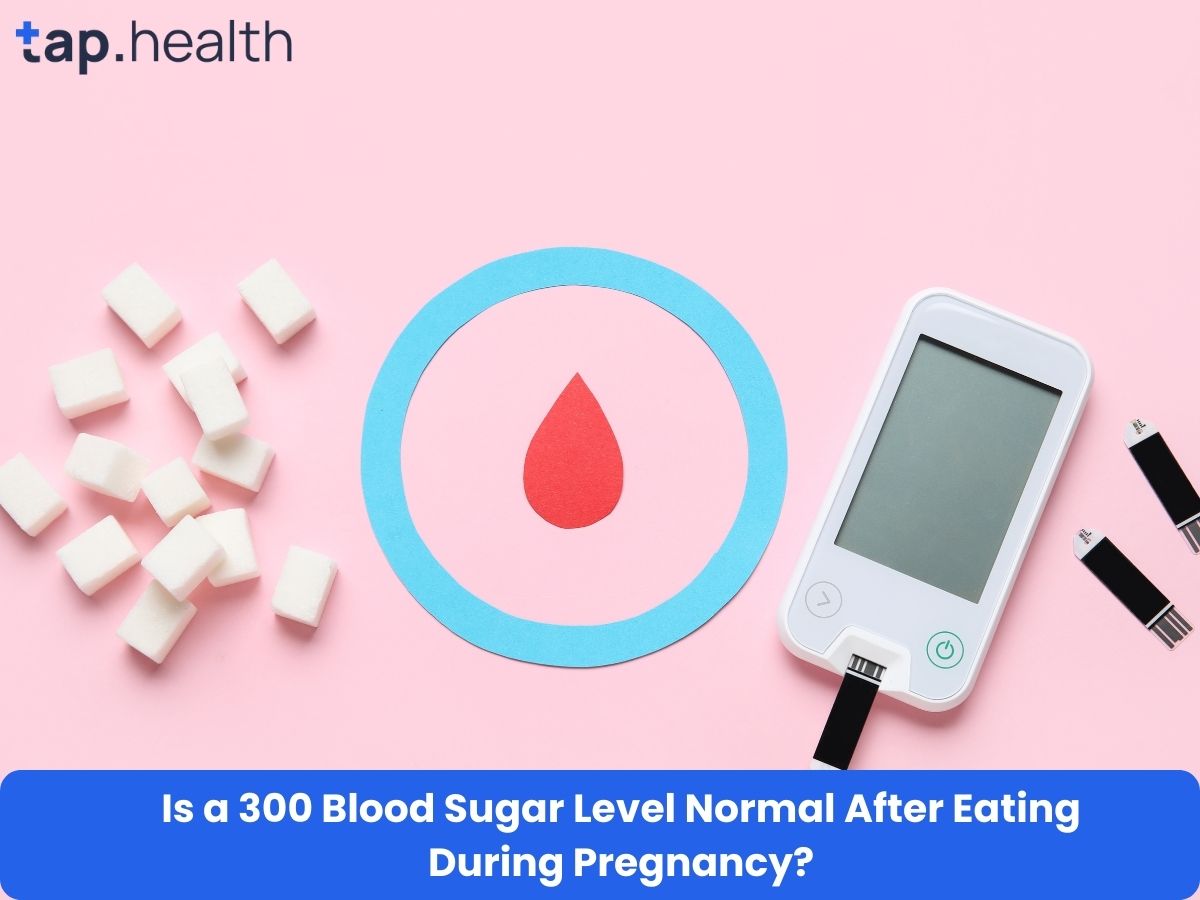
Pregnancy is a beautiful journey, but it comes with its fair share of worries. You are constantly monitoring your health, eating right, and counting kicks. Then, you take a blood sugar test after a meal, and the glucometer flashes a number: 300 mg/dL.
Your heart might skip a beat. You might feel panic setting in. You immediately ask, “Is a 300 blood sugar level normal after eating during pregnancy?”
The short, honest answer is No. A blood sugar level of 300 mg/dL is absolutely not normal, and it can be dangerous.
In medical terms, this is called severe hyperglycemia (high blood sugar). While blood sugar naturally rises after eating, hitting 300 is a red flag that your body is struggling to manage glucose, likely due to Gestational Diabetes Mellitus (GDM) or pre-existing diabetes.
But please, take a deep breath. Panic raises blood sugar too.
In this detailed guide, written in simple Indian English, we will break down exactly what this number means. We will look at the normal ranges, understand why this happens, and most importantly, tell you exactly what steps you need to take right now to keep you and your baby safe.
Also Read: Is Blood Sugar Over 400 an Emergency?
Understanding the Danger Zone: Is 300 mg/dL Safe?
To put it simply: 300 mg/dL is an emergency number.
For a pregnant woman, doctors usually aim for tight blood sugar control. Why? Because high sugar in your blood crosses the placenta to your baby. If your sugar is 300, your baby is getting a sugar overload.
- Normal Post-Meal Level: Usually below 140 mg/dL (1 hour after eating) or 120 mg/dL (2 hours after eating).
- The 300 Level: This is more than double the safe limit.
At 300 mg/dL, you are at risk for Diabetic Ketoacidosis (DKA), a serious condition where your blood becomes acidic. While DKA is rarer in gestational diabetes than Type 1, it is still a risk. You need to contact your healthcare provider immediately if you see this number.
What Is the Normal Blood Sugar Level for a Pregnant Woman After Food?
To know when to worry, you first need to know what “normal” looks like. Pregnancy targets are stricter than normal diabetes targets because the baby is developing rapidly.
According to the American Diabetes Association (ADA) and Indian health guidelines, here are the target numbers for most pregnant women:
- Fasting (Before breakfast): 95 mg/dL or less.
- 1 Hour After Eating: 140 mg/dL or less.
- 2 Hours After Eating: 120 mg/dL or less.
If your numbers are slightly above these (say, 130 after 2 hours), it requires attention. If they are 300, it requires immediate medical intervention.
Normal Blood Sugar Levels During Pregnancy Chart
It can be confusing to remember all these numbers. Here is a simple chart to help you track your levels. We have included both mg/dL (used in India/USA) and mmol/L (used in UK/Canada) as many meters use different settings.
| Test Time | Target (mg/dL) | Target (mmol/L) | Status if 300 mg/dL |
| Fasting | < 95 mg/dL | < 5.3 mmol/L | Dangerously High |
| 1 Hour After Meal | < 140 mg/dL | < 7.8 mmol/L | Dangerously High |
| 2 Hours After Meal | < 120 mg/dL | < 6.7 mmol/L | Dangerously High |
Note: 300 mg/dL converts to roughly 16.6 mmol/L. Compare 16.6 to the normal limit of 6.7, and you can see why doctors get concerned.
Why Does Blood Sugar Rise During Pregnancy? (Gestational Diabetes Explained)
You might be thinking, “I ate the same food before pregnancy and my sugar was fine. Why is it 300 now?”
The culprit is the Placenta.
The placenta is an amazing organ that supports your baby. However, it also produces hormones (like human placental lactogen) that make your body resistant to insulin.
- Insulin is the key that opens your cells to let sugar in for energy.
- Pregnancy Hormones gum up the lock.
Usually, your pancreas works overtime to make extra insulin to overcome this resistance. In Gestational Diabetes, your pancreas can’t keep up. The result? The sugar stays in your blood instead of going into your cells, causing high readings like 160, 200, or even 300.
147, 160 vs. 300: What Do These Numbers Mean?
In search results, you will often see people worrying about numbers like “147 sugar level during pregnancy” or “160 sugar level during pregnancy.” How is 300 different?
The 140–180 Range (High, but Common)
If your sugar is 147 mg/dL or 160 mg/dL after a meal, this is definitely high. It indicates that your current diet or medication plan isn’t working perfectly.
- Action: Your doctor will likely ask you to cut down on carbs (rice/roti), walk more, or start a small dose of medicine. It is a warning sign, but usually manageable at home.
The 300 Range (Severe Hyperglycemia)
A reading of 300 mg/dL is in a different league.
- Action: This often means your body has very little effective insulin working. It usually cannot be fixed just by walking or skipping the next meal. It often requires insulin therapy or immediate hydration in a hospital setting to prevent complications.
Risks of High Blood Sugar for Mom and Baby
Why are doctors so strict about these numbers? High sugar affects both of you.
Risks for the Baby:
- Macrosomia (Big Baby): The baby gets too much sugar and stores it as fat. This creates a larger-than-average baby, which can lead to difficult delivery or the need for a C-section.
- Neonatal Hypoglycemia: After birth, the baby’s source of high sugar (you) is gone, but their own insulin is still high. Their blood sugar can crash dangerously low right after birth.
- Respiratory Distress: High sugar can delay the maturity of the baby’s lungs.
Risks for the Mom:
- Preeclampsia: High blood pressure during pregnancy, which can be life-threatening.
- Infections: High sugar makes you prone to urinary tract infections (UTIs) and yeast infections.
- Future Diabetes: You are at higher risk of developing Type 2 diabetes later in life.
Symptoms of High Blood Sugar to Watch Out For
Sometimes, a reading of 300 mg/dL happens because of a “bad” reading or dirty fingers. But if it is real, you will likely feel it.
Common symptoms include:
- Extreme Thirst: Feeling like no amount of water is enough.
- Frequent Urination: Going to the bathroom every 20 minutes.
- Fatigue: Feeling exhausted, not just “pregnancy tired.”
- Blurry Vision: Things look out of focus.
- Headache: A nagging pain that won’t go away.
Emergency Symptoms (Seek Help Immediately):
- Nausea or vomiting.
- Confusion or difficulty speaking.
- Fruity-smelling breath (a sign of ketones).
Real-Life Scenario
Let’s look at a story to make this relatable.
Meet Anjali (30, from Bangalore):
Anjali is 28 weeks pregnant. At a family wedding, she indulged. She had two gulab jamuns, a large portion of biryani, and a sugary mocktail.
Two hours later, she felt dizzy and extremely thirsty. She checked her sugar: 295 mg/dL.
What she did right:
- She didn’t panic, but she didn’t ignore it.
- She immediately drank two glasses of plain water.
- She called her gynecologist’s emergency line.
- The doctor asked her to check her urine for ketones (using a strip she had at home). It was negative.
- She was advised to take a brisk 20-minute walk and re-test.
- The number dropped to 210, then 160.
- The Lesson: The “carb load” was too much for her placenta-affected body to handle. She learned that portion control is non-negotiable, even at weddings.
Expert Contribution
We consulted Dr. S. Iyer, a Senior Obstetrician and Gynecologist, to understand the medical perspective.
“When a patient calls me with a reading of 300, my first question is: ‘What did you eat?’ and ‘Did you take your insulin?’ Often, it is a dietary slip-up. However, a sugar level of 300 can be toxic to the fetus if it stays there. Glucose crosses the placenta, but insulin does not. This means the baby’s tiny pancreas has to work double-time to process that sugar. If you see a 300, do not wait for the next appointment. Call your care provider. We need to rule out Ketoacidosis immediately.”
Recommendations Grounded in Proven Research and Facts
Based on guidelines from the Mayo Clinic and the National Institutes of Health (NIH), here is what you should do if you see a high number.
1. Wash and Re-test
Sometimes, if you have fruit juice or sweet residue on your finger, the glucometer gives a false high reading. Wash your hands with soap, dry them completely, and test again.
2. Hydrate Immediately
Water helps your kidneys flush out excess sugar through urine. Drink 1-2 large glasses of water immediately.
3. Check for Ketones
If your sugar is over 240 mg/dL, the American Diabetes Association recommends checking for ketones in your urine. You can buy these strips at any pharmacy. If ketones are present, go to the hospital immediately. Do not exercise if you have ketones.
4. Light Movement (If No Ketones)
If there are no ketones and you feel okay, take a 15-minute gentle walk. Exercise makes your muscles use up the glucose in your blood for energy.
5. Review the “Last Meal”
Did you eat white rice, maida, sweets, or sugary drinks? Identify the trigger and eliminate it from your next meal.
How to Lower Blood Sugar During Pregnancy
Preventing that “300” spike is better than treating it. Here is how to keep your numbers in the safe zone (under 140).
- Eat “Complex” Carbs: Swap white rice for Brown Rice, Quinoa, or Broken Wheat (Dalia). Swap Maida for Multigrain Atta. These digest slowly.
- The Plate Method: Half your plate should be vegetables (Bhindi, Gobi, Spinach). One quarter should be protein (Dal, Chicken, Paneer). Only one quarter should be carbs (Rice/Roti).
- Walk After Meals: A 10-15 minute walk after lunch and dinner acts like “natural insulin.” It significantly lowers post-meal spikes.
- Small, Frequent Meals: Don’t eat 3 huge meals. Eat 3 medium meals and 2 small snacks. This prevents the “sugar load” from overwhelming your body.
Key Takeaways
- Is 300 Normal? No. It is dangerously high. Normal post-meal sugar should be under 140 mg/dL (1 hour) or 120 mg/dL (2 hours).
- The Cause: It is usually caused by Gestational Diabetes, where pregnancy hormones block insulin from working.
- The Risk: High sugar can lead to a large baby, birth complications, and future diabetes risks.
- Immediate Action: Wash hands and re-test. Drink water. Call your doctor. Check for ketones.
- Prevention: Control portion sizes, avoid sweets, and walk after meals.
Pregnancy is a time to be careful, but not fearful. With the right diet, monitoring, and medical support, you can manage these numbers and deliver a healthy, happy baby.
FAQ: Is a 300 Blood Sugar Level Normal After Eating During Pregnancy?
What is the normal blood sugar level for a pregnant woman after food?
For most pregnant women, the target is less than 140 mg/dL one hour after eating, and less than 120 mg/dL two hours after eating. Your doctor may give you slightly different targets based on your specific case.
What should I do if my blood sugar is 300 while pregnant?
First, wash your hands and re-test to confirm the number. If it is still high, drink plenty of water to help flush out the sugar. Call your doctor immediately for advice. If you have ketone strips, test your urine; if positive, go to the emergency room.
Is 160 sugar level during pregnancy dangerous?
A level of 160 mg/dL is higher than the recommended target (which is usually <140 or <120). While it is not an immediate emergency like 300, it indicates that your Gestational Diabetes is not well-controlled. You likely need to adjust your diet or medication.
How to lower blood sugar during pregnancy quickly?
To lower it quickly: Drink water, and (if you have no ketones in urine) take a brisk 15-20 minute walk. Exercise helps muscles use up the glucose. Avoid eating any more carbohydrates until the level drops.
Does high blood sugar hurt the baby?
Yes. Consistently high blood sugar crosses the placenta, causing the baby’s pancreas to make extra insulin. This can lead to the baby growing too large (Macrosomia), having low blood sugar after birth, and having breathing problems.
What is 147 sugar level during pregnancy considered?
A reading of 147 mg/dL after a meal is considered elevated. The goal is typically under 140 mg/dL after 1 hour or 120 mg/dL after 2 hours. While 147 isn’t a medical crisis, it shows that your current meal contained too many carbs for your body to handle effectively.
Can stress cause high blood sugar in pregnancy?
Yes. Stress triggers the release of hormones like cortisol, which can raise blood sugar levels and make you more resistant to insulin. Trying to stay calm and getting enough sleep is part of managing diabetes.
References
- American Diabetes Association (ADA): Gestational Diabetes Guidelines
- Mayo Clinic: Gestational Diabetes: Symptoms and Causes
- National Institutes of Health (NIH): Hyperglycemia in Pregnancy
- Centers for Disease Control and Prevention (CDC): Gestational Diabetes
Disclaimer: This article is for educational purposes only and does not constitute medical advice. A blood sugar reading of 300 mg/dL in pregnancy requires professional medical attention. Please consult your doctor immediately.