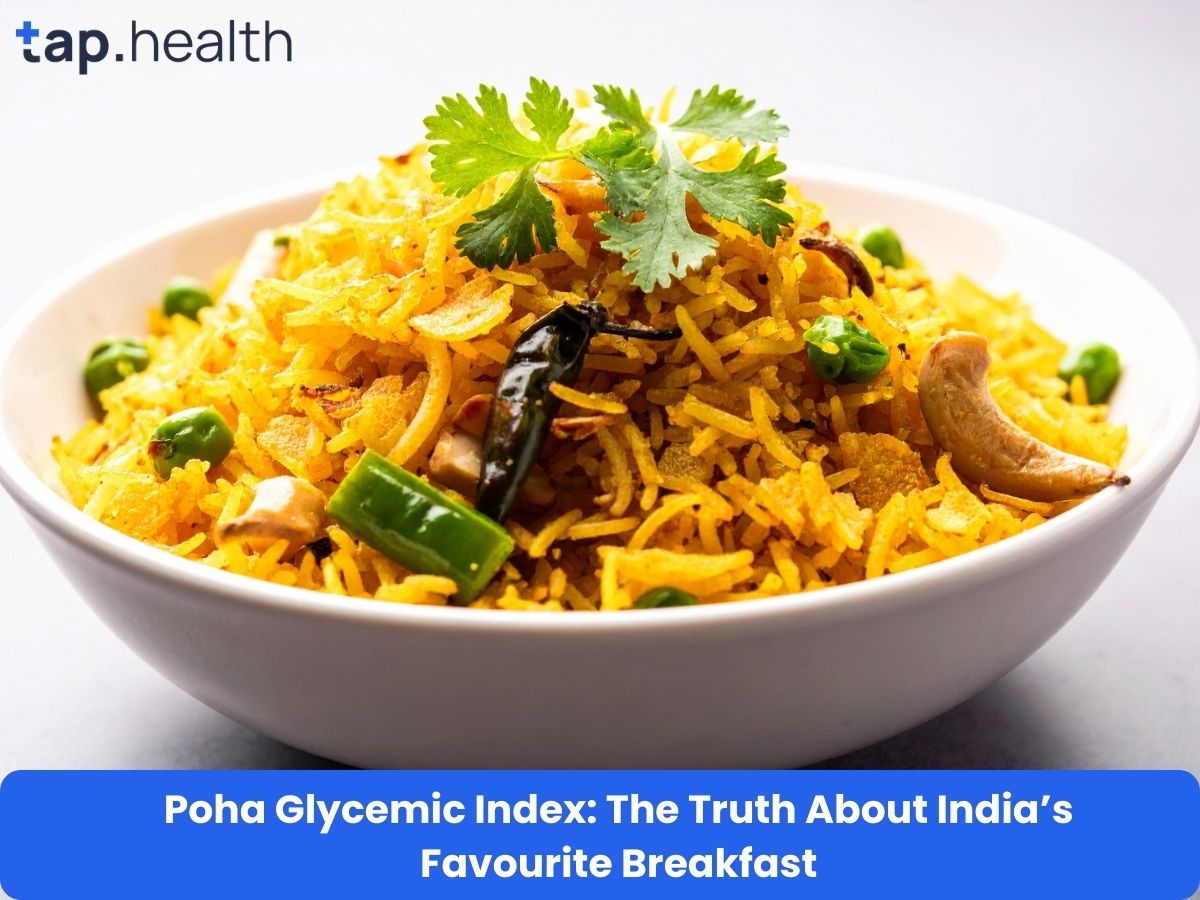
If you grew up in an Indian household, the smell of mustard seeds crackling in hot oil, the bright yellow turmeric, and the fresh coriander leaves can mean only one thing: Poha. From Maharashtra’s Kanda Poha to Indore’s famous street-style Poha-Jalebi, beaten rice is the undisputed king of Indian breakfasts.
But with India rapidly becoming the diabetes capital of the world, many of us are pausing before taking that first bite. We are told to avoid white rice because it spikes blood sugar. Since Poha is made from rice, shouldn’t it be bad for us too?
This brings us to the most critical question for every diabetic and health-conscious Indian: What is the Poha glycemic index? Is it a healthy superfood or a hidden sugar bomb?
In this comprehensive guide, we will flatten the myths just like the rice flakes themselves. We will explore the science behind Poha, compare white vs. red varieties, and explain why this humble dish might just be the secret weapon your diet plan needs.
What is Poha (Beaten Rice)?
Before we dive into the numbers, let’s understand what we are eating. Poha, also known as Flattened Rice, Beaten Rice, or Chivda, is made by parboiling paddy, rolling it, flattening it, and then drying it to produce flakes.
Unlike white rice which is highly polished and stripped of nutrients, the process of making Poha (especially the parboiling step) helps retain some of the iron and B-vitamins. It absorbs water easily and cooks in minutes, making it the ultimate fast food of India.
But does this processing make it better or worse for your blood sugar? The answer lies in the Glycemic Index.
Also Read: 20 Best Food for Diabetes
Understanding Glycemic Index (GI)
To judge if Poha is safe, we need to use the Glycemic Index (GI).
Think of GI as a speedometer for your blood sugar. It measures how fast a carbohydrate-containing food raises your glucose levels on a scale of 0 to 100.
- Low GI (0-55): These foods digest slowly. They release energy steadily, like a slow-burning candle. (Ideal for Diabetics).
- Medium GI (56-69): A moderate rise in sugar. Safe in moderation.
- High GI (70+): These digest instantly, causing a rapid “sugar spike” like rocket fuel. (e.g., White Rice, Sugar, Maida).
For a diabetic patient, the goal is to eat mostly Low to Medium GI foods to prevent insulin spikes.
The Magic Number: Poha Glycemic Index
So, where does our beloved breakfast fit on this scale?
The glycemic index of Poha typically ranges from 38 to 64.
This places Poha in the Low to Medium GI category.
- Red Poha: GI is closer to 38-55 (Low).
- White Poha: GI is closer to 50-64 (Low to Medium).
Compare this to steamed white rice, which often has a GI of 73 or higher. Poha is significantly better for your blood sugar than regular rice.
Why is it lower?
The parboiling process used to make Poha changes the structure of the starch (a process called retrogradation). This creates Resistant Starch, which resists digestion in the small intestine. Instead of turning into sugar immediately, it acts like fibre, keeping your blood sugar stable.
Red Poha vs White Poha: Which is Better?
In recent years, health stores have started stocking Red Poha. Is it just a marketing gimmick, or is it actually healthier?
White Poha
This is the standard variety made from polished white rice.
- GI: ~60
- Nutrition: Good source of carbs and iron, but lower in fibre.
- Verdict: Safe for diabetics if cooked with plenty of vegetables.
Red Poha
This is made from red rice varieties that retain the bran layer (the red skin).
- GI: ~40-50
- Nutrition: Rich in anthocyanins (antioxidants), higher fibre, and more minerals.
- Verdict: Red Poha is the winner. If you have uncontrolled diabetes, switching to Red Poha is a smart move. It has a nuttier taste and keeps you full for longer.
Poha Glycemic Load: The Real Picture
While GI tells you the speed of the spike, Glycemic Load (GL) tells you the amount of the spike based on portion size.
- Poha GI: ~60 (Medium)
- Carbs in 1 cup Poha: ~46g
- Glycemic Load: ~27 (High)
Wait, is it High?
Yes, if you eat plain Poha. But nobody eats raw Poha flakes!
We cook it with onions, mustard seeds, peanuts, and peas. We squeeze lemon juice on it.
- Vegetables (Fibre): Lower the GL.
- Peanuts (Fat/Protein): Lower the GL.
- Lemon Juice (Acid): Lowers the GL.
So, a plate of well-made Kanda Poha with peanuts has a much lower impact on your blood sugar than the raw numbers suggest.
Is Poha Good for Diabetes?
The query “Is Poha good for diabetes?” is one of the most searched health questions in India.
The answer is YES.
Here is why Poha is a diabetic-friendly champion:
- Rich in Iron: Poha production involves passing rice through iron rollers. This fortifies it with iron. Anaemia is common in diabetics, so this helps.
- Probiotic Potential: During the soaking process, Poha undergoes mild fermentation. This is good for gut health. A healthy gut improves insulin sensitivity.
- Low Gluten: Poha is naturally gluten-low (and can be gluten-free depending on processing). This reduces inflammation in the body.
- Satiety: Because it absorbs water and swells up, a small cup of raw Poha becomes a large bowl of cooked breakfast. It fills you up without overloading you on calories.
Real-Life Scenario
Let’s meet Mr. Desai, a 50-year-old businessman from Mumbai.
The Problem:
Mr. Desai has Type 2 Diabetes. He loves his morning breakfast. He used to eat Upma (made from Rava/Semolina) or white bread toast. Both Rava and Bread have high GI. His post-breakfast sugar levels were always spiking to 180 mg/dL, making him feel tired by noon.
The Switch:
His nutritionist advised him to switch to Red Poha with Sprouts.
- The Recipe: He cooked red poha with lots of green peas, onions, and topped it with steamed moong sprouts and roasted peanuts.
- The Trick: He added a generous squeeze of lime.
The Result:
- Energy: The complex carbs gave him steady energy. He didn’t feel the “12 PM crash.”
- Blood Sugar: His post-meal sugar dropped to 140 mg/dL within a month.
- Why? The fibre from the red rice and sprouts slowed down the sugar absorption effectively.
Poha vs. Rice vs. Oats vs. Cornflakes
Let’s put Poha in the ring with other breakfast heavyweights.
| Breakfast Item | Glycemic Index (GI) | Verdict for Diabetics |
| Cornflakes | 81 (High) | Avoid. It is pure processed sugar. |
| Instant Oats | 79 (High) | Avoid. Highly processed oats digest too fast. |
| White Rice | 73 (High) | Limit. Too starchy. |
| Poha | 38-64 (Low/Med) | Good Choice. Best when mixed with veggies. |
| Steel Cut Oats | 55 (Low) | Excellent. But takes time to cook. |
The Surprise: Poha is often healthier than “Instant Oats” or “Cornflakes” which are marketed as healthy but are actually high-GI processed foods.
How to Make Poha Diabetic-Friendly (The 50-50 Rule)
Just because Poha has a lower GI doesn’t mean you can eat a mountain of it. To make it truly safe, follow the 50-50 Rule:
50% Poha + 50% Vegetables/Protein
- Add Veggies: Don’t just use onions (Kanda). Add carrots, capsicum, green peas, and French beans. This adds fibre.
- Add Protein: Poha is mostly carbs. You MUST add protein to balance it. Use peanuts, roasted chana dal (Dalia), boiled sprouts, or soya chunks.
- Don’t Overcook: If you cook Poha until it becomes a mushy paste, the GI goes up. Keep the flakes separate and chewy.
- The Lemon Trick: Always squeeze fresh lemon juice before eating. The acidity reduces the glycemic response of the meal by up to 20%.
Expert Contribution
We consulted nutritional guidelines to get the professional medical stance.
Dr. A. Iyer, Clinical Nutritionist:
“I often recommend Poha over oats for my Indian patients because it is local, sustainable, and satisfying. However, the mistake people make is eating ‘Potato Poha’ (Batata Poha). Potatoes have a high GI. If you are diabetic, skip the potatoes and add green peas or paneer cubes instead. This turns a carb-heavy snack into a balanced meal.”
Ayurvedic Perspective:
Ayurveda considers Poha to be Laghu (light to digest). It is recommended for people with weak digestion. However, because it is essentially rice, it increases Kapha, so it should be eaten with spices like mustard, turmeric, and ginger to balance it.
Recommendations Grounded in Proven Research and Facts
Based on data from the National Institute of Nutrition (NIN) and various diabetes studies, here are actionable tips:
- Watch the Oil: Poha absorbs oil very quickly. Using too much refined oil increases the calorie count and causes inflammation. Use a teaspoon of Ghee or Mustard oil.
- Avoid Bhujia Toppings: In places like Indore, Poha is buried under a mountain of Sev (fried noodles). This is dangerous for diabetics. Use roasted peanuts or pomegranate seeds for crunch instead.
- Portion Control: Stick to 1 to 1.5 cups of cooked Poha.
- Curd Poha (Dahi Chivda): In Bihar and UP, Poha is eaten with curd. This is an excellent combination. The protein and probiotics in curd lower the GI of the Poha further. It is a perfect summer breakfast.
Key Takeaways
- The poha glycemic index is Low to Medium (38-64), making it safer than white rice and cornflakes.
- Red Poha is superior to White Poha due to higher fibre and antioxidants.
- It is a good source of Iron, Vitamin B, and Probiotics.
- Batata Poha (Potato Poha) should be avoided by diabetics; swap potatoes for peas or sprouts.
- Always follow the 50-50 Rule: Half plate Poha, half plate veggies and protein.
- Adding Lemon Juice and Peanuts lowers the glycemic load effectively.
Conclusion
Poha is not just a convenient breakfast; it is a scientifically sound choice for the Indian diabetic.
It bridges the gap between taste and health. It allows you to enjoy a traditional, hot, savory breakfast without the guilt of eating high-GI white rice. By choosing the right variety (Red Poha) and cooking it with plenty of vegetables and proteins, you can turn this humble street food into a metabolic superfood.
So, tomorrow morning, don’t reach for the box of cornflakes. Soak some Poha, chop some veggies, and enjoy a breakfast that keeps your heart happy and your blood sugar stable.
Frequently Asked Questions (FAQ) on Poha Glycemic Index
Is Poha good for diabetics?
Yes. Poha is a good breakfast option for diabetics. It has a lower glycemic index than white rice and contains resistant starch. However, it should be cooked with vegetables and sprouts to increase fiber and protein, which further prevents blood sugar spikes.
What is the glycemic index of Poha?
The glycemic index of Poha ranges from 38 to 64, depending on the variety (red vs. white) and processing. This places it in the Low to Medium GI category, making it a healthier alternative to white bread or instant oats.
Which is better: Red Poha or White Poha?
Red Poha is better. It is made from red rice which retains the bran layer. This means it has more fiber, antioxidants, and a lower glycemic index compared to polished white poha. It keeps you fuller for longer.
Can I eat Batata Poha (Potato Poha) if I have diabetes?
It is better to avoid Batata Poha. Potatoes have a high glycemic index (around 78). Adding potatoes to Poha increases the overall carb load of the meal. Instead, use green peas, carrots, or paneer to add volume and nutrition.
Does Poha increase weight?
No, Poha helps in weight loss if eaten correctly. It is low in calories and gluten. The probiotics generated during soaking improve gut health and metabolism. However, if you add too much oil or fried Sev toppings, it can lead to weight gain.
Is Poha better than Oats?
Compared to Instant Oats, Poha is often better because instant oats are highly processed and have a high GI. However, Steel Cut Oats or Rolled Oats are nutritionally superior to Poha. Poha wins on taste and digestion for the Indian palate.
Can we eat Poha daily?
Yes, you can eat Poha daily as breakfast. Just ensure you rotate the vegetables and proteins you add to it so you get a variety of nutrients. Do not eat it for every meal as it is primarily a carbohydrate source.
Does soaking Poha produce probiotics?
Yes. The soaking process allows for mild fermentation, which retains microbial flora and generates healthy probiotics. This makes Poha excellent for digestion and gut health, unlike boiled rice which is sterile.
References:
- National Institute of Nutrition (NIN): Glycemic Index of Common Indian Foods. Link
- Healthline: Is Poha Healthy? Link
- Diabetes.co.uk: Rice and Diabetes. Link
- WebMD: Resistant Starch Health Benefits. Link
- Harvard Health Publishing: Glycemic index for 60+ foods. Link
(Disclaimer: This content is for educational purposes only. Always consult your doctor or a certified dietitian before making significant changes to your diet, especially if you have diabetes.)