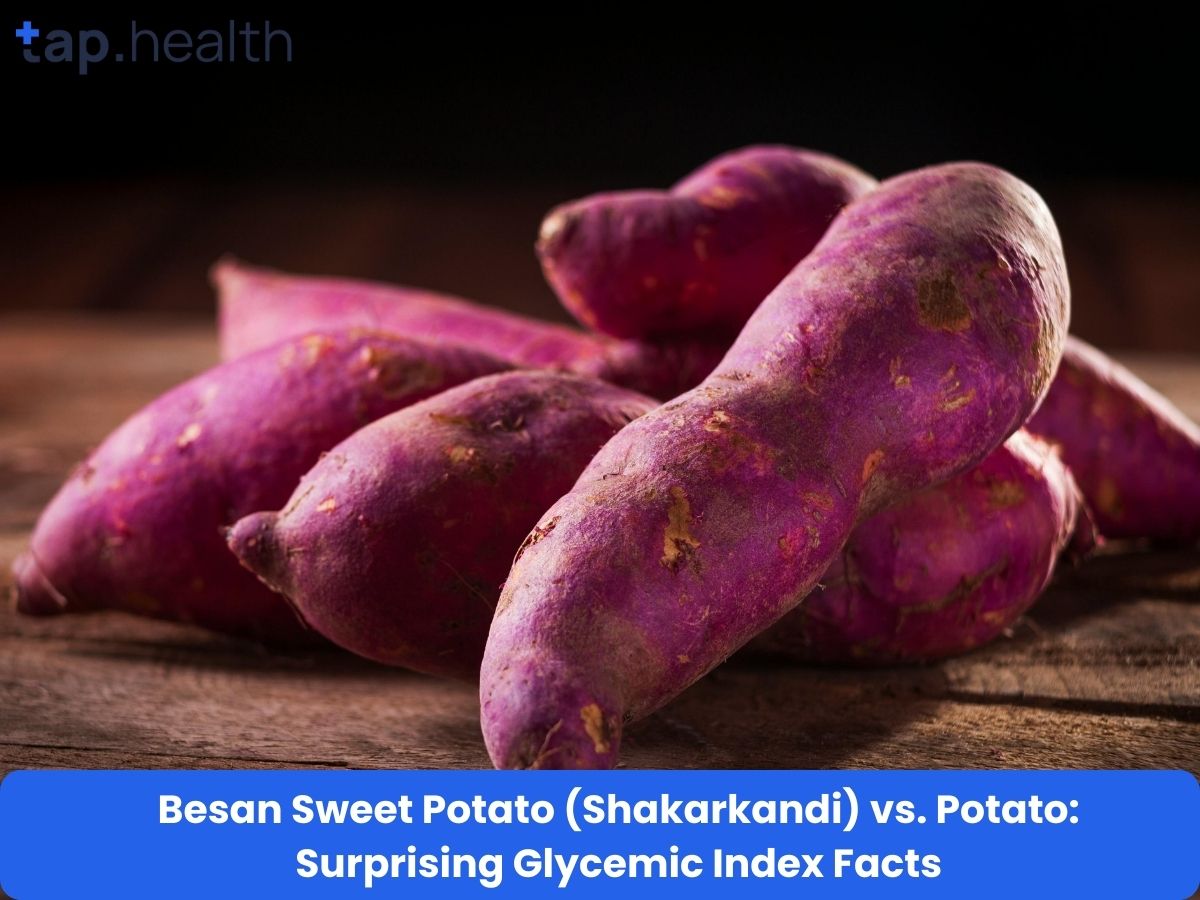
It is a crisp winter evening in North India. You are walking down the market street, and you smell something smoky, sweet, and delicious. It is the Shakarkandi Wala (Sweet Potato seller) roasting tubers over coal.
Your mouth waters. You want a plate of that spicy, tangy fruit chaat. But then, a voice in your head stops you. “Wait! It is called SWEET potato. Surely, it must be full of sugar? Surely, it is bad for my diabetes?”
On the other hand, we have the humble Potato (Aloo)—the villain of every diet plan. Doctors say “No Aloo.” Gym trainers say “No Aloo.”
But here is the twist: What if I told you that the “Sweet” potato might actually be better for your blood sugar than the regular potato? And what if I told you that how you cook them changes everything?
In this comprehensive guide, we are going to uncover the Sweet Potato vs. Potato Glycemic Index mystery. We will reveal the surprising facts that most people (and even some doctors) get wrong. We will break down the science, the nutrition, and the cooking secrets to help you decide which tuber belongs on your plate.
The Contenders: Aloo vs. Shakarkandi
Before we fight, let’s meet the players. They look similar, grow underground, and are loved by Indians everywhere. But biologically, they are distant cousins, not brothers.
1. The White Potato (Aloo)
- Family: Nightshade family (related to tomatoes and eggplant).1
- Reputation: The “Bad Boy” of nutrition. Blamed for weight gain and diabetes.
- Taste: Bland, starchy, savoury.
- Usage: Curries, fries, samosas, parathas.
2. The Sweet Potato (Shakarkandi)
- Family: Morning Glory family.
- Reputation: The “Superfood.” Loaded with vitamins.
- Taste: Naturally sweet, creamy.
- Usage: Roasted snacks (chaat), boiled, desserts.
Understanding Glycemic Index (GI)
To judge the winner, we use the Glycemic Index (GI).
Think of GI as a speedometer for your blood sugar. It measures how fast a food converts into glucose and hits your bloodstream on a scale of 0 to 100.
- Low GI (0-55): Digests slowly. Releases energy steadily. (The Goal).
- Medium GI (56-69): Moderate rise. Safe in moderation.
- High GI (70+): Digests instantly. Causes a rapid “sugar spike.”
We want foods that are in the Low to Medium range.
The Shocking Truth: Cooking Method Matters
This is the most important section of this entire article. Please read it carefully.
Most foods have a fixed GI. An apple is an apple. But potatoes are shapeshifters. Their Glycemic Index changes drastically depending on how you cook them.
1. The White Potato (Aloo)
- Boiled & Hot: GI is High (~78). The starch gelatinizes and turns to sugar fast.
- Mashed: GI is High (~80-85). The mashing breaks down fibers, making it instant sugar.
- Fried (French Fries): GI is Medium (~65). Wait, what? Yes, the fat slows down digestion, but the calories are dangerously high. (Do not eat fries for diabetes!).
- Cooled (The Secret): If you boil a potato and put it in the fridge for 24 hours, the GI drops to ~50 (Low)! This is due to Resistant Starch.
2. The Sweet Potato (Shakarkandi)
Here is the surprise.
- Boiled: GI is Low (~44-46). This is excellent! It is diabetic-friendly.
- Roasted / Baked: GI skyrockets to High (~94).
Wait, what?
Yes. When you roast a sweet potato (like the street vendor does), the dry heat breaks down the complex starch into a simple sugar called maltose. It becomes almost as sweet as candy, and it spikes your blood sugar just as fast.
The Lesson:
- Boiled Shakarkandi = Healthy.
- Roasted Shakarkandi = Sugar Spike.
Sweet Potato vs. Potato: The Nutritional Showdown
Let’s look beyond the sugar. What else do you get in a serving?
| Feature | White Potato (100g) | Sweet Potato (100g) | The Winner |
| Calories | ~90 cal | ~86 cal | Tie |
| Carbohydrates | ~21g | ~20g | Tie |
| Fiber | ~2.2g | ~3g | Sweet Potato |
| Vitamin A | Almost Zero | Huge Amount | Sweet Potato (Champion) |
| Potassium | High | Medium | White Potato |
| GI (Boiled) | High (~78) | Low (~44) | Sweet Potato |
Why Vitamin A Matters:
The orange colour of the Sweet Potato comes from Beta-Carotene, which converts to Vitamin A. One medium sweet potato gives you 400% of your daily Vitamin A requirement! This is crucial for eye health and immunity. White potatoes have none.
Why Potassium Matters:
White potatoes are actually excellent sources of Potassium (more than bananas!), which helps control blood pressure. So, Aloo isn’t “useless”; it is just starchy.
Does “Sweet” Mean “High Sugar”?
This is the biggest myth in the Indian kitchen.
“Doctor, I can’t eat Shakarkandi, it is sweet!”
Fact: The sweetness you taste is fructose and sucrose. However, because sweet potato is packed with fiber, that sugar absorbs slowly—if you boil it.
White potato doesn’t taste sweet, but it is pure Starch. Starch is just a long chain of glucose molecules holding hands. As soon as it hits your saliva, those hands let go, and it becomes pure sugar.
So, ironically, the non-sweet Aloo spikes your sugar faster than the sweet Shakarkandi.
Real-Life Scenario
Let’s meet Mrs. Gupta, a 58-year-old homemaker from Delhi.
The Context:
Mrs. Gupta loves her winter snacks. Every evening, she would stop by the Shakarkandi cart and eat a plate of roasted, masala-spiced sweet potato. She thought she was making a healthy choice over eating a samosa. Yet, her dinner-time sugar readings were high (180 mg/dL).
The Discovery:
Her doctor explained the “Roasting Effect.” The high heat of the coal fire was turning the healthy starch into instant maltose sugar.
The Switch:
She didn’t stop eating it. She changed the method.
- She bought raw sweet potatoes.
- She pressure-cooked (boiled) them at home with a pinch of salt.
- She added lemon juice and chaat masala.
The Result:
Her taste buds were happy, and her sugar levels dropped to 140 mg/dL. The simple switch from roasting to boiling reduced the Glycemic Index by nearly half.
Expert Contribution
We consulted medical experts to get the professional stance.
Dr. R. Chadha, Diabetologist:
“I tell my patients: Don’t fear the Sweet Potato, fear the method. Boiled sweet potato is a superfood. It has a lower Glycemic Load than a standard chapati! But roasted or fried is a dessert. Treat roasted Shakarkandi like a Gulab Jamun—eat it rarely.”
Nutritionist Perspective:
“The skin is the hero. Whether you eat Aloo or Shakarkandi, never peel the skin. The skin contains 50% of the fiber. That fiber acts as a net, trapping the sugar and slowing down digestion. Scrub it well, boil it, and eat it whole.”
Recommendations Grounded in Proven Research and Facts
Based on data from the University of Sydney GI Database and Harvard Health, here are actionable tips:
- The “Boil” Rule:Always boil or steam your sweet potatoes. This keeps the GI low (around 44). Avoid baking or roasting if you have diabetes.
- The “Cooling” Hack (Resistant Starch):If you love white potatoes (Aloo), boil them and keep them in the fridge overnight. Use them the next day in a salad or Aloo Chaat. This cooling process creates Resistant Starch, lowering the GI from 78 to roughly 50.
- Portion Control:Even though boiled sweet potato is healthy, it is still a carbohydrate.2 Limit your portion to one medium-sized tuber (approx 150g). Do not eat it with roti or rice. Eat it instead of roti or rice.
- Pair with Fat:Add a drizzle of olive oil, a sprinkle of peanuts, or some curd to your potato dish. Fat slows down gastric emptying, further blunting the sugar spike.3
Key Takeaways
- Boiled Sweet Potato has a Low GI (~44) and is excellent for diabetics.
- Roasted Sweet Potato has a High GI (~94) and should be avoided or eaten sparingly.
- White Potato (Boiled) has a High GI (~78) but can be lowered by cooling (Resistant Starch).
- Sweet Potato wins on Nutrition: It is packed with Vitamin A and fiber.4
- Don’t trust the taste: The non-sweet white potato turns to sugar faster than the sweet one.
Conclusion
So, Sweet Potato vs. Potato: Which is better?
The winner is the Boiled Sweet Potato (Shakarkandi).
It offers a rare combination: it satisfies your craving for something sweet and starchy, yet it is gentle on your blood sugar—provided you keep it away from the roasting fire.
For the potato lovers, all is not lost. You don’t have to banish Aloo forever. Just use the “Cooling Trick” and eat it with the skin on. But this winter, don’t feel guilty about enjoying that plate of Shakarkandi. Just make it at home, keep it boiled, and enjoy nature’s own vitamin pill.
Frequently Asked Questions (FAQ)
Is sweet potato good for diabetes?
Yes, absolutely. But only if it is boiled. Boiled sweet potato has a low Glycemic Index (~44) and is rich in fiber, which helps regulate blood sugar. Avoid roasted or fried sweet potato, as these have a high Glycemic Index.
Can I eat potatoes if I want to lose weight?
Yes, in moderation. Potatoes are filling and have a high satiety index, meaning they stop you from feeling hungry.5 However, avoid fried potatoes (chips/fries). Eat boiled or baked potatoes with the skin on to get the fiber benefits.
Why does roasting increase the glycemic index of sweet potatoes?
Roasting or baking dehydrates the potato and subjects it to high heat. This breaks down the complex starch structure into simpler sugars (maltose). This pre-digestion means the sugar hits your bloodstream much faster when you eat it.
Which is better: Red or White Sweet Potato?
Red/Orange is better. The orange-fleshed sweet potato is rich in Beta-Carotene (Vitamin A) and antioxidants.6 The white/purple varieties are healthy too, but the orange one is a nutritional superstar.
Is potato skin healthy?
Yes. The skin contains the majority of the fiber, iron, and potassium. Peeling a potato removes much of its nutritional value and increases its Glycemic Index. Always wash well and cook with the skin on.
Does cooling potatoes really lower their GI?
Yes. This is a scientifically proven phenomenon called Resistant Starch. When starch is cooked and then cooled, its structure crystallizes and resists digestion in the small intestine, acting like fiber.7 This significantly lowers the glycemic impact.
How many sweet potatoes can I eat a day?
For a diabetic or someone watching weight, one medium-sized sweet potato (100-150g) is a good daily portion. It counts as your carbohydrate serving, so reduce your rice or roti intake for that meal accordingly.
References:
- Harvard T.H. Chan School of Public Health: The Nutrition Source – Sweet Potatoes. Link
- University of Sydney: GI Search Database (Sweet Potato). Link
- Diabetes.co.uk: Potatoes and Diabetes. Link
- WebMD: Health Benefits of Sweet Potatoes. Link
- National Institute of Nutrition (NIN): Glycemic Index of Indian Foods. Link
(Disclaimer: This content is for educational purposes only. Always consult your doctor or a certified dietitian before making significant changes to your diet, especially if you have diabetes.)