The Indian summer is unforgiving. The sun beats down, the temperature crosses 40°C, and your body screams for hydration.
You walk past a fruit stall.
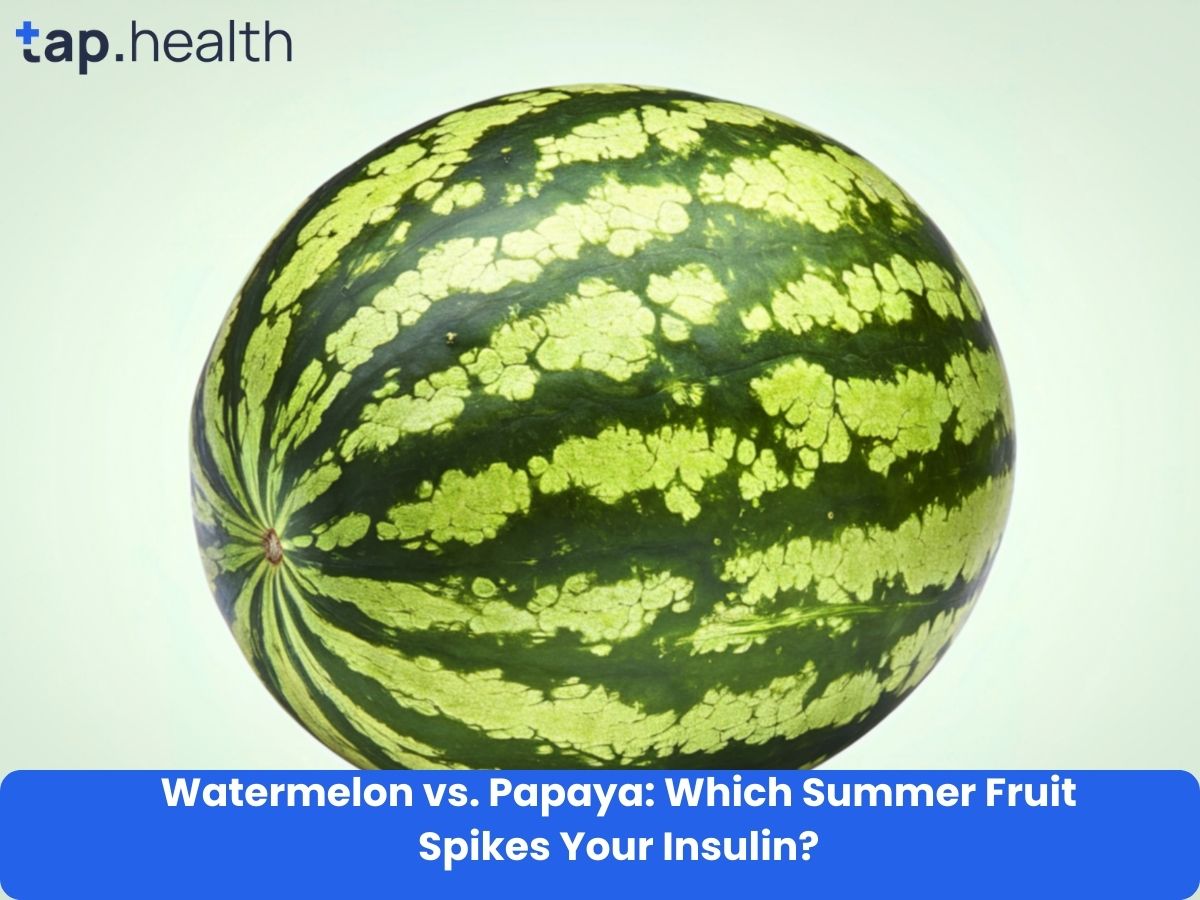
On one side, you see giant, green Watermelons (Tarbooz), cut open to reveal that tempting, juicy red flesh.
On the other side, you see ripe, orange Papayas (Papita), glowing with sweetness.
Both look refreshing. Both are sweet. But for a diabetic, this fruit stall is a minefield. You have heard the rumors: “Watermelon is basically sugar water!” or “Papaya heats the body, be careful!”
When you eat a slice of these fruits, does your blood sugar cool down or boil over? Which one forces your pancreas to work overtime?
In this comprehensive guide, we are going to stage the ultimate summer showdown: Watermelon vs. Papaya. We will analyze their Glycemic Index (GI), debunk the “Sugar Spike” myths, and use the concept of Glycemic Load to tell you exactly which fruit belongs in your bowl this summer.
The Contenders: The Red vs. The Orange
1. Watermelon (Tarbooz)
- The Vibe: The ultimate thirst quencher. It is 92% water.
- The Taste: Sweet, granular, and refreshing.
- The Fear: Because it tastes like sugary water, many diabetics assume it is pure glucose.
2. Papaya (Papita)
- The Vibe: The year-round staple. Known for digestion.
- The Taste: Creamy, musky sweetness.
- The Fear: It is very sweet when fully ripe, leading people to believe it is high-carb.
Understanding Glycemic Index (GI) vs. Glycemic Load (GL)
To judge the winner, we need two tools, not just one.
- Glycemic Index (GI): The Speed. How fast does the sugar hit your blood?
- Glycemic Load (GL): The Amount. How much actual sugar is in a normal slice?
Think of it this way:
- GI is how fast the car is driving.
- GL is how heavy the car is.Even if a car is fast (High GI), if it is a tiny toy car (Low GL), it won’t hurt you if it hits you.
1. Watermelon Glycemic Index: The “High Speed” Racer
Here is the scary number that doctors often quote.
The Glycemic Index of Watermelon is High, approximately 72 to 80.
This places it in the High GI category.
Biologically, the sugar in watermelon is easily accessible. There is very little fiber to block it. So, when you eat it, the sugar enters your blood rapidly. This causes a quick Insulin Spike.
BUT (The Plot Twist):
Watermelon is mostly water.1
In a standard serving (1 cup/150g), there are only about 11 grams of carbs.
So, the Glycemic Load is Low (~5).
Translation: It spikes your sugar fast, but the spike is small and short-lived—unless you eat half the watermelon in one sitting.
2. Papaya Glycemic Index: The “Steady” Cruiser
Now, let’s look at the orange fruit.
The Glycemic Index of Papaya is Medium, approximately 60.2
This places it in the Medium GI category.
It is lower than watermelon.
The Digestion Bonus:
Papaya contains an enzyme called Papain.3 This enzyme aids in protein digestion. While it doesn’t directly lower sugar, it helps overall gut health.
- Carbs: A cup of papaya has roughly 15 grams of carbs (slightly more than watermelon).
- Glycemic Load: It is also Low (~9).
Translation: Papaya raises your blood sugar more slowly and steadily than watermelon.
Head-to-Head Comparison: The Insulin Impact
Let’s put them side-by-side to see the winner.
| Feature | Watermelon (Tarbooz) | Papaya (Papita) | The Winner |
| Glycemic Index (Speed) | ~72 (High) | ~60 (Medium) | Papaya (Slower) |
| Glycemic Load (Impact) | ~5 (Very Low) | ~9 (Low) | Watermelon (Surprise!) |
| Fiber | Low (~0.4g) | High (~1.7g) | Papaya |
| Water Content | 92% | 88% | Watermelon |
| Insulin Spike | Sharp & Fast | Moderate & Steady | Papaya (Safer) |
The Analysis:
- Watermelon enters your blood fast. It demands a quick burst of insulin. If your pancreas is slow (Type 2 Diabetes), this can be stressful.
- Papaya enters slower due to fiber. It demands a steady stream of insulin, which is easier for the body to handle.
The Volume Trap: Why Watermelon is Tricky
The problem with watermelon isn’t the fruit; it’s the Serving Size.
- Papaya: You cut a few cubes, eat them, and feel full because of the creamy texture and fiber.
- Watermelon: You don’t eat cubes. You eat giant wedges. It is so light and watery that you can easily eat 500g without realizing it.
500g of Watermelon = 30g Sugar.
Suddenly, that “Low Glycemic Load” becomes a “High Glycemic Load.”
If you can stop at one cup, Watermelon is fine. If you can’t, Papaya is safer.
Real-Life Scenario
Let’s meet Mrs. Bhalla, a 55-year-old from Chandigarh.
The Context:
Mrs. Bhalla loved summer. She would sit on her veranda with a big bowl of chilled watermelon every afternoon. “It’s just water,” she told herself. But her evening sugar readings were consistently high (190 mg/dL).
The Mistake:
She was eating close to 3-4 cups of watermelon. The speed of the sugar (High GI) combined with the volume created a massive glucose rush that her insulin couldn’t match.
The Switch:
Her doctor advised: “Switch to Papaya for the afternoon snack. It has fiber.”
- The Result: She ate a bowl of papaya. The fiber made her feel full faster. She ate less quantity. Her sugar stabilized at 150 mg/dL.
Expert Contribution
We consulted medical experts to get the professional stance.
Dr. K. Nair, Diabetologist:
“I prefer Papaya over Watermelon for my diabetic patients. Yes, Watermelon has a low load, but the high GI is risky for patients with poor insulin control. Papaya has a moderate GI and more fiber.4 Plus, Papaya is excellent for constipation, which is a common issue in diabetics.”5+1
Nutritionist Perspective:
“Never drink Watermelon Juice. This is the biggest crime. When you juice it, you remove the tiny bit of fiber it has. You are essentially drinking red sugar water. It hits your blood like a rocket. Always eat the fruit whole, and chew the seeds if you can—they have protein!”
Recommendations Grounded in Proven Research and Facts
Based on data from the American Journal of Clinical Nutrition and NIN, here are actionable tips:
- Portion Control is King:
- Watermelon: Limit to 1 cup (diced).6 Do not eat a large wedge.
- Papaya: Limit to 1 cup (cubes).
- Add a “Brake”:Never eat these sweet fruits alone.
- Sprinkle Roasted Jeera (Cumin) or Black Salt on Watermelon.
- Eat a few Almonds or Walnuts with your Papaya.The fat and spice slow down the sugar absorption.
- Timing:
- Best Time: Mid-morning (11 AM) or Mid-afternoon (4 PM).
- Worst Time: Immediately after a heavy lunch or dinner. Adding fruit sugar on top of a carb-heavy meal spikes insulin dangerously.
- The Seed Hack:Don’t spit out Watermelon seeds! They are high in protein and healthy fats. Chewing them along with the fruit actually lowers the overall glycemic impact of the bite.
Key Takeaways
- Watermelon has a High GI (~72). It causes a rapid insulin spike, but has a low carb load per cup.
- Papaya has a Medium GI (~60). It causes a slower, steadier rise and is rich in fiber.
- Insulin Impact: Watermelon is riskier for those with uncontrolled diabetes due to the speed of absorption.
- Juice Warning: Never juice these fruits. Eat them whole.
- Verdict: Papaya is the safer, more balanced choice. Watermelon is a permissible treat if portion-controlled.7
Conclusion
So, Watermelon vs. Papaya: Which Summer Fruit Spikes Your Insulin?
Watermelon spikes it faster.
While it is delicious and hydrating, the high speed at which watermelon sugar hits your blood makes it a “yellow light” food for diabetics—proceed with caution.
Papaya is the steady, reliable friend. With its moderate speed, digestive enzymes, and fiber, it is the safer bet for keeping your insulin levels calm while enjoying the sweetness of nature.
This summer, enjoy both, but know your limits. A bowl of Papaya is a meal; a bowl of Watermelon is a treat.
Frequently Asked Questions (FAQ)
Is Watermelon bad for diabetics?
Not if eaten in moderation. While it has a high Glycemic Index, it has a low Glycemic Load.8 A diabetic can safely eat one small cup (approx 150g) of watermelon as a snack.9 The danger comes from overeating it.+1
Does Papaya help reduce blood sugar?
Not directly. Papaya does not “lower” blood sugar like medicine. However, its medium GI and fiber content mean it doesn’t spike sugar as much as other tropical fruits. It is a safe fruit option, not a cure.
Can I eat fruit at night?
Avoid it. Eating high-GI fruits like watermelon at night can lead to high fasting sugar levels the next morning. Your body’s insulin sensitivity is lower at night. Eat fruits before sunset.
Which is better for digestion?
Papaya. Papaya contains Papain, a powerful enzyme that helps break down proteins and clean the digestive tract.10 It is excellent for people suffering from constipation or bloating.
Is Muskmelon (Kharbuja) safe?
Yes. Muskmelon (Cantaloupe) falls somewhere between watermelon and papaya. It has a GI of roughly 65. Like watermelon, it is mostly water. It is safe in moderation (1 cup).
Do I need to remove Papaya seeds?
You don’t have to. Papaya seeds are edible and peppery.11 They are actually good for gut health and fighting parasites. However, most people remove them due to the strong taste.
Can I eat unripe (green) papaya?
Yes! Green papaya is excellent for diabetics.12 It can be cooked as a vegetable (Sabzi) or used in salads. It has very little sugar and acts as a fibrous vegetable.
References:
- University of Sydney: GI Search Database. Link
- Medical News Today: Watermelon and Diabetes. Link
- Healthline: Can Diabetics Eat Papaya? Link
- American Diabetes Association: Fruit Choices. Link
- Journal of Medicinal Food: Papaya and Glucose. Link
(Disclaimer: This content is for educational purposes only. Always consult your doctor or a certified dietitian before making significant changes to your diet, especially if you have diabetes.)