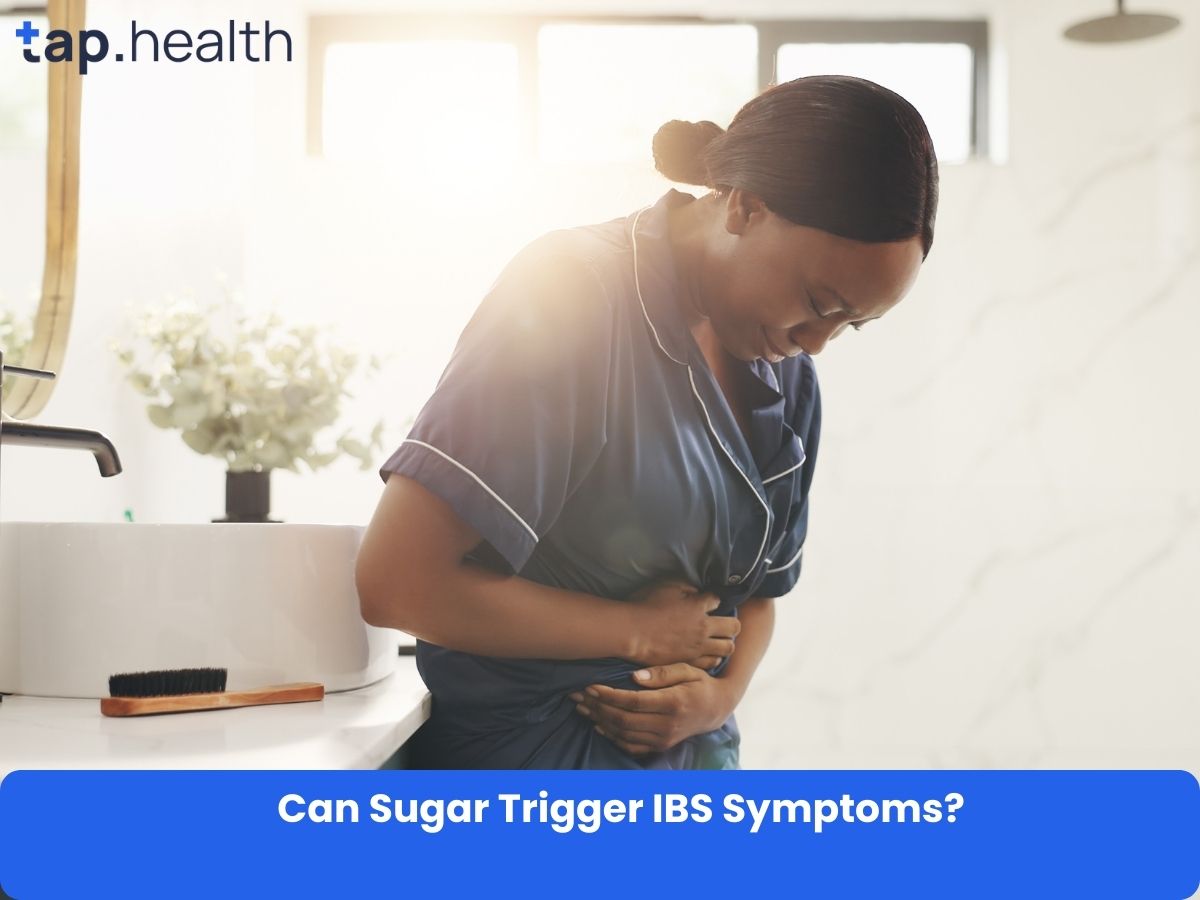
You are at a birthday party. The cake looks delicious, and the Gulab Jamuns are calling your name. You eat a small bowl, feeling happy. But an hour later, your happiness turns into dread. Your stomach starts rumbling, the bloating sets in, and you find yourself rushing to the washroom.
You wonder: “Was it the milk? Was it the oil? Or could it be the sugar?”
If you live with Irritable Bowel Syndrome (IBS), food often feels like a minefield. You know that spicy curries or rajma (kidney beans) might cause trouble, but sugar is often a hidden enemy. It is in everything—from your morning chai to the biscuits you snack on.
So, the big question is: Can sugar trigger IBS?
The short answer is Yes, but it is complicated. Not all sugars are bad for you. Some might send you running to the toilet, while others are perfectly safe. It depends on the type of sugar and how your body digests it.
In this comprehensive guide, written in simple Indian English, we will decode the relationship between sugar and your gut. We will explain why that ladoo might hurt your stomach, which sweeteners are actually safe, and how to satisfy your sweet tooth without the pain.
Short Answer – Does Sugar Trigger IBS?
Yes, certain types of sugar can definitely trigger IBS symptoms.
However, it is rarely “Table Sugar” (the white sugar in your tea) that is the main culprit. The biggest triggers are usually Fructose (found in honey and some fruits), Lactose (milk sugar), and Sugar Alcohols (artificial sweeteners like Sorbitol).
These sugars can be difficult for your gut to absorb. When they sit in your stomach undigested, they ferment and pull water into your intestines, leading to the classic IBS symptoms of gas, bloating, and diarrhea.
What Is IBS (Irritable Bowel Syndrome)?
Before we blame sugar, let’s understand what is happening inside. IBS is a common disorder affecting the large intestine. It is a “functional” disorder, meaning your gut looks normal on scans, but it doesn’t function properly.
The connection between your brain and your gut is sensitive. For people with IBS, the nerves in the gut are extra sensitive.
Common Symptoms of IBS
If sugar is triggering you, you will likely feel these signs within 30 minutes to 2 hours of eating:
- Bloating: Your stomach feels tight and full like a balloon.
- Abdominal Pain: Cramps that usually go away after passing stool.
- Diarrhea (IBS-D): Sudden, urgent need to go.
- Constipation (IBS-C): Difficulty passing stool.
- Gas: excessive wind and burping.
How Sugar Affects the Digestive System
Digestion is a complex process. When you eat sugar, your body is supposed to break it down using enzymes and absorb it into the bloodstream for energy.
- Enzymatic Breakdown: Your saliva and stomach acids start breaking sugar down.
- Absorption: In the small intestine, sugars are absorbed through the walls into the blood.
- The IBS Problem: In people with IBS, or with certain sugars (like Fructose), this absorption is slow or incomplete.
Why Does Sugar Trigger IBS Symptoms?
When sugar is NOT absorbed in the small intestine, it travels down to the large intestine (colon). This is where the trouble starts.
1. The Fermentation Factory
Your colon is full of bacteria. These bacteria love sugar. When undigested sugar arrives, the bacteria have a feast. They rapidly ferment the sugar, producing gases (Hydrogen and Methane). This gas causes severe bloating and pain.
2. The Osmotic Effect (Water Magnet)
Sugar molecules act like a sponge. They attract water. When sugar sits in your bowel, it pulls fluid from your body into your intestines to dilute the sugar.
- Result: The bowel fills with excess liquid, leading to loose, watery stools or diarrhea.
The Link Between Sugar and IBS Symptoms
The link is often confusing because you might eat a chocolate bar one day and be fine, but drink a mango shake the next day and get sick.
Why the difference?
It comes down to FODMAPs.
This stands for Fermentable Oligosaccharides, Disaccharides, Monosaccharides, and Polyols. These are short-chain carbohydrates (sugars) that the gut struggles to absorb.
- High-FODMAP sugars trigger IBS.
- Low-FODMAP sugars are usually safe.
Also, Natural vs. Added Sugar matters less than the chemical structure of the sugar. Honey is natural, but it is high in fructose, so it is a major IBS trigger. Table sugar is processed, but it is often better tolerated.
What Types of Sugar Trigger IBS Symptoms?
This is the most critical section for your diet planning. Knowing your enemy is half the battle.
1. Fructose (The Fruit Sugar)
Fructose is found in fruits, honey, and high-fructose corn syrup (HFCS).
- The Issue: The human body can usually handle Fructose if it is balanced with Glucose. But foods with excess fructose (like Honey, Mangoes, Apples, and soft drinks) are hard to absorb.
- IBS Trigger: High. Causes bloating and diarrhea.
2. Lactose (The Milk Sugar)
Lactose is the sugar found in milk, curd, and excessive cheese.
- The Issue: Many adults lack the enzyme “Lactase” to break this down.
- IBS Trigger: Very High. Indian diets are heavy on dairy (chai, lassi), making this a common culprit.
3. Sorbitol and Mannitol (The “Hidden” Sugars)
These are “Sugar Alcohols” (Polyols). They are found naturally in stone fruits (peaches, plums) and artificially in “Sugar-Free” chewing gums and diet sweets.
- The Issue: Our bodies absorb these very poorly. They act almost like a laxative.
- IBS Trigger: Severe. Even a small piece of sugar-free gum can cause major gas.
4. High-Fructose Corn Syrup (HFCS)
This is a cheap sweetener used in processed foods like ketchup, soda, and packaged biscuits.
- IBS Trigger: High. It is a concentrated dose of fructose.
5. Excess Sucrose (Table Sugar)
Sucrose (standard white sugar) is usually well absorbed because it is 50% glucose and 50% fructose.
- IBS Trigger: Low to Moderate. Most people tolerate small amounts. However, large amounts (like a big piece of Barfi) can overwhelm the gut and cause an “Osmotic” flush (diarrhea).
Could It Be Sucrose Intolerance?
Sometimes, it is not IBS at all.
There is a condition called Congenital Sucrase-Isomaltase Deficiency (CSID), also known as Sucrose Intolerance.
- What it is: Your body lacks the specific enzyme to break down Table Sugar (Sucrose).
- Symptoms: Gas, bloating, and diarrhea immediately after eating sugar or starchy foods.
- Difference from IBS: Symptoms happen specifically after eating sugar/starch, not just stress or other triggers.
- Action: If you feel sick every time you eat cake or sugary tea, ask your doctor about this.
What About Sugar Substitutes?
If you have diabetes or want to lose weight, you might use sweeteners. Be careful—some are worse for IBS than real sugar.
Artificial Sweeteners That Worsen IBS (The “Avoid” List)
Avoid anything ending in “-ol”. These are Polyols (high FODMAP).
- Sorbitol: Found in sugar-free gum and diet drinks.
- Xylitol: Found in mints and toothpaste.
- Mannitol: Found in some diet foods.
- Maltitol: Often found in “Sugar-Free” chocolates or biscuits.
Better Sweetener Options for IBS (The “Safe” List)
These are generally well-tolerated because they don’t ferment in the gut.
- Stevia: A natural, zero-calorie sweetener. Usually gut-friendly.
- Pure Maple Syrup: Low FODMAP and delicious.
- Rice Malt Syrup: A good alternative for baking.
- Table Sugar (in moderation): Regular white sugar is safer than honey or agave.
Can IBS Patients Eat Sugar at All?
You don’t have to live a life without sweetness. The key is Moderation and Timing.
The “Bucket” Theory:
Imagine your gut is a bucket.
- A small spoon of sugar adds a little water to the bucket (Fine).
- A piece of fruit adds more water (Still fine).
- A big glass of mango shake adds a huge jug of water (Overflow = IBS Attack).
You can eat sugar, but you must respect your bucket’s limit.
- Safe: A small piece of dark chocolate or one biscuit with tea.
- Risky: A large dessert after a heavy meal.
Real-Life Scenario
Meet Rahul (28, Software Engineer from Bangalore):
Rahul suffered from constant bloating and “morning urgency” (diarrhea). He thought it was the spicy cafeteria food. He cut out spices, but the problem continued.
The Discovery: Rahul started keeping a food diary. He realized his symptoms spiked at 4 PM.
The Culprit: Every day at 3:30 PM, Rahul drank a large “Healthy” fruit juice (Apple + Beetroot) and chewed sugar-free gum to stop smoking.
The Fix: The Apple juice (High Fructose) and Gum (Sorbitol) were bombing his gut. He switched to eating an Orange (Low Fructose) and stopped the gum. His bloating vanished in 3 days.
How to Identify Sugar as an IBS Trigger
Since everyone is different, you need to be your own detective.
- Keep a Food Diary: Write down everything you eat and how your stomach feels 2 hours later.
- The “Elimination” Test: Stop all added sugars and fruits for 3 days. See if you feel better.
- Read Labels: Look for hidden triggers like “High Fructose Corn Syrup,” “Sorbitol,” or “Honey” in packaged foods like muesli or ketchup.
Expert Contribution
We consulted Dr. S. Chatterjee, a Gastroenterologist, about sugar sensitivity.
“I often see patients who think they are gluten intolerant. They stop eating Roti but still feel sick. Why? Because they are replacing Roti with ‘Health Bars’ or ‘Granola’ that are loaded with Honey or Dates. Both Honey and Dates are high-FODMAP sugars. For an IBS patient, these healthy sugars are actually harder to digest than a spoon of white sugar. I advise patients to stick to low-FODMAP fruits like Papaya and Banana and avoid processed ‘health’ foods.”
Managing IBS with a Low-Sugar or Low-FODMAP Diet
The most effective way to calm your gut is the Low-FODMAP Diet. This isn’t a “forever diet,” but a way to reset your system.
The Strategy:
- Swap High Fructose for Low Fructose:
- Stop: Apple, Mango, Watermelon, Honey.
- Start: Banana, Orange, Papaya, Blueberry, Maple Syrup.
- Swap Lactose:
- Stop: Regular Milk, Soft Cheese.
- Start: Lactose-free milk, Hard Cheese (Cheddar), Almond Milk.
- Watch the “Stacking”: Don’t eat sweet fruit and a sweet dessert in the same meal. Space them out.
Alternative Sweeteners for People with IBS
If you want to bake a cake or sweeten your coffee, what should you use?
| Sweetener | IBS Safety Rating | Notes |
| White Sugar | ✅ Safe (Moderate) | Contains Sucrose. Usually fine in tea/coffee. |
| Brown Sugar | ✅ Safe (Moderate) | Same as white sugar. |
| Honey | ❌ Avoid | High Fructose. Major trigger. |
| Agave Nectar | ❌ Avoid | Very High Fructose. |
| Stevia | ✅ Safe | Natural and non-fermenting. |
| Maple Syrup | ✅ Safe | Delicious and Low FODMAP. |
| Jaggery (Gud) | ⚠️ Caution | Can be high in sucrose/fructose. Test small amounts. |
Are There Other Foods to Avoid If You Have IBS?
Sugar is rarely the only villain. It often works in a gang with fat and fiber.
- Ultra-Processed Foods: Cakes, pastries, and cookies often contain high sugar + high fat + white flour. This “triple threat” slows digestion and increases gas.
- Caffeine: Coffee stimulates the bowel. Sweet sugary coffee is a double trigger for diarrhea.
- Carbonated Drinks: Soda has sugar (trigger) + bubbles (gas). It is a guaranteed bloating recipe.
Tips for Reducing Sugar Intake Without Feeling Deprived
You don’t have to eat boiled vegetables forever. Here is how to enjoy food safely:
- Natural Sweetness: Add cinnamon or vanilla essence to your oats or yogurt. It tricks the brain into thinking the food is sweeter than it is.
- Dark Chocolate: A square of 70% dark chocolate is low in sugar and usually safe for IBS.
- Homemade Treats: Make your own kheer using lactose-free milk and a little white sugar, instead of buying store-bought sweets loaded with additives.
Recommendations Grounded in Proven Research and Facts
According to Monash University (the creators of the FODMAP diet) and the NHS (UK):
- The “15 Minute” Rule: If you experience diarrhea within 15-30 minutes of eating sweets, it is likely the Osmotic Effect (sugar pulling water). Reduce portion sizes immediately.
- Gut Bacteria: High sugar intake feeds “bad” bacteria in the gut (Dysbiosis), which can worsen IBS long-term. Reducing sugar helps healthy bacteria thrive.
- Probiotics: Research suggests that taking a probiotic supplement (Bifidobacterium strains) can help your gut handle sugar fermentation better, reducing gas.
Conclusion: Key Takeaways
So, can sugar trigger IBS?
- Yes. Especially Fructose (honey, mango), Lactose (milk), and Sugar Alcohols (sugar-free gum).
- Table Sugar is Okay: Regular white sugar is usually safe in small amounts.
- Watch the Quantity: Even safe sugars can cause diarrhea if you eat too much at once.
- Check Labels: Avoid hidden triggers like “High Fructose Corn Syrup” or “Sorbitol.”
- Listen to Your Body: Keep a diary. Your trigger might be different from someone else’s.
You don’t have to give up sweetness. You just have to be smarter than the sugar. Choose the right type, watch the portion, and your gut will thank you.
FAQ: Can Sugar Trigger IBS Symptoms?
Can sugar trigger IBS diarrhea?
Yes. Consuming large amounts of sugar, especially fructose or artificial sweeteners, causes an “osmotic effect.” This means the sugar pulls water from your body into your intestines, making the stool watery and causing urgent diarrhea.
Is white sugar bad for IBS?
Generally, no. White sugar (Sucrose) is broken down easily by most people and is considered “Low FODMAP.” In moderation (like 1-2 teaspoons in tea), it rarely triggers symptoms. However, large amounts (like in a sugary dessert) can still cause issues.
Can brown sugar trigger IBS?
Unlikely. Brown sugar is simply white sugar with some molasses added. It has the same chemical structure (Sucrose) and is considered low-FODMAP. Most IBS patients tolerate it well in small amounts.
What are the worst trigger foods for IBS?
The top trigger foods are usually High-FODMAP items: Garlic, Onion, Wheat, Milk (Lactose), Honey (High Fructose), Beans (Rajma), and artificial sweeteners like Sorbitol found in chewing gum.
Can sugar cause an IBS flare-up immediately?
Yes. If you are sensitive, symptoms can start as quickly as 30 minutes after eating. The osmotic effect (water rushing into the gut) happens fast, leading to cramping and diarrhea shortly after a sugary meal.
How to get rid of stomach ache from sugar?
If you have eaten too much sugar and feel pain:
- Hydrate: Drink water to replace fluids lost to the gut.
- Walk: Gentle movement helps gas pass.
- Peppermint Tea: Peppermint oil relaxes gut muscles and relieves cramping.
- Heat: Apply a hot water bag to your tummy.
Is jaggery (Gud) good for IBS?
Proceed with caution. Jaggery is less processed than white sugar but still contains sucrose and some fructose. While many Indians use it for digestion, for IBS patients, it can still cause fermentation. Test a small piece to see how you react.
References
- Monash University: The Low FODMAP Diet for IBS
- Healthline: IBS and Sugar: What You Need to Know
- Johns Hopkins Medicine: FODMAP Diet: What You Need to Know
- National Institutes of Health (NIH): Dietary Sugars and Irritable Bowel Syndrome
Disclaimer: This article is for informational purposes only and does not constitute medical advice. If you experience severe or persistent digestive issues, please consult a gastroenterologist.