Is Jaggery Good for Diabetes? What Diabetics Should Know
It is a chilly winter morning in North India. You are sitting in your verandah, craving a hot cup of Masala Chai. You know you shouldn’t have sugar because your doctor warned you about your blood glucose levels. So, you reach for that golden-brown jar of Jaggery (or Gur) instead.
“It is natural,” you tell yourself. “It has iron. It is medicinal. Surely, it must be better than that chemical white sugar?”
This is the story in millions of Indian households. We have grown up hearing our grandmothers praise the health benefits of Gur. It is used to cure coughs, aid digestion, and sweeten our festive kheer. We see it as a “superfood.”
But here is the bitter truth behind the sweet taste: If you have diabetes, your body does not care about tradition. It cares about chemistry.
So, the big question is: “Is jaggery good for diabetes?” Can you safely replace sugar with jaggery and protect your health? Or are you unknowingly spiking your blood sugar just as badly?
In this comprehensive guide, we are going to peel back the layers of this golden sweetener. We will look at the hard numbers, the Glycemic Index, the nutritional facts, and what doctors actually say. By the end of this article, you will know exactly whether to put that spoonful of Gur in your tea or put it back in the cupboard.
What Is Jaggery (Gur) and How Is It Made?
To understand if jaggery is safe, we first need to know what it is.
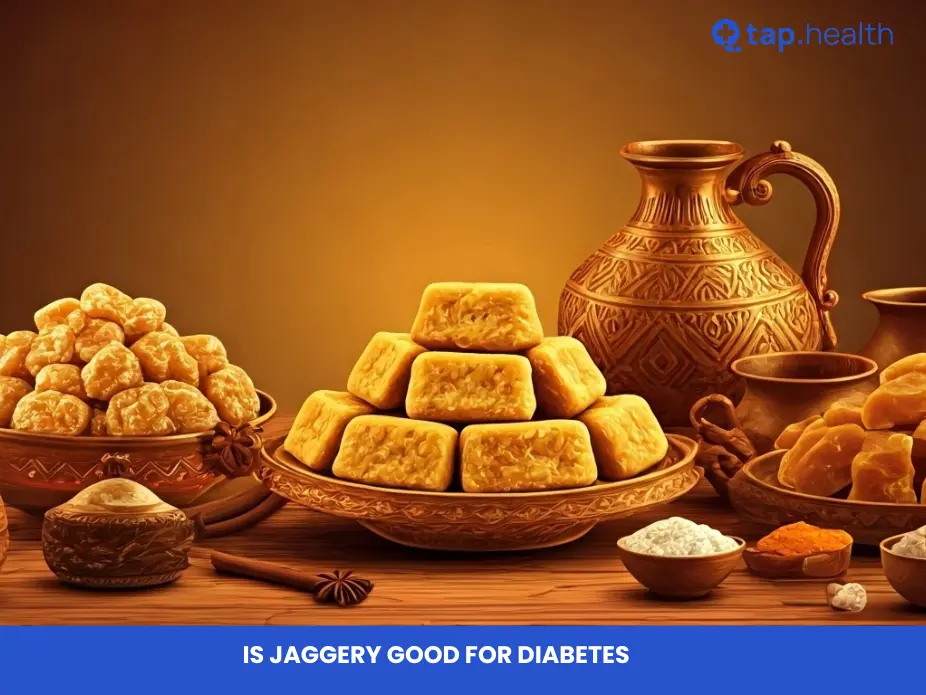
Jaggery is an unrefined sugar. In India, it is mostly made from sugarcane juice (though date palm and coconut jaggery exist too).
- Extraction: Sugarcane juice is extracted.
- Clarification: It is boiled in massive iron pans. Impurities are removed (often using okra stems or lime).
- Concentration: The juice is boiled until it turns into a thick, golden paste.
- Setting: It is poured into moulds to cool and harden into blocks.
The Key Difference: Unlike white sugar, jaggery is not spun in a centrifuge to remove the molasses. This means it keeps some minerals and its brown colour. But make no mistake—it is still concentrated sugarcane juice.
Can Diabetics Eat Jaggery?
The Short Answer: No.
If you are looking for a sugar substitute that won’t raise your blood glucose, jaggery is not the answer.
While it is “better” than white sugar in a general nutritional sense (because it isn’t “empty calories”), for a diabetic, the metabolic impact is almost identical. Your body sees jaggery primarily as Sucrose (sugar). Whether that sucrose comes from a white crystal or a brown block, it breaks down into glucose and spikes your blood sugar.
Jaggery vs Sugar – What’s the Real Difference?
Let’s look at the numbers. Many people believe jaggery is vastly different from sugar. Is it?
| Feature | White Sugar (Refined) | Jaggery (Gur) |
| Source | Sugarcane | Sugarcane |
| Main Component | Sucrose (~99.9%) | Sucrose (~65-85%) + Glucose/Fructose (10-15%) |
| Calories (100g) | ~387 kcal | ~383 kcal |
| Glycemic Index | ~65 | ~84.4 |
| Nutrients | None | Traces of Iron, Magnesium, Potassium |
| Digestion Speed | Fast | Very Fast |
The Shocking Truth:
Look at the Glycemic Index. Jaggery actually has a higher Glycemic Index (GI) than table sugar in many studies.
- White Sugar: Is 50% Glucose + 50% Fructose. Fructose takes time to process in the liver.
- Jaggery: Contains more simple glucose chains that hit the blood instantly.
So, when you ask, “which is better sugar or jaggery for diabetic patients?”, the answer regarding blood sugar control is: Neither. In fact, jaggery might spike you faster.
Does Jaggery Raise Blood Sugar Levels?
Yes, absolutely.
There is a dangerous myth floating around on WhatsApp and YouTube that jaggery is “diabetes-friendly.” This is scientifically false.
How Jaggery Affects Glucose and Insulin
When you eat jaggery:
- It dissolves rapidly in your stomach.
- It is absorbed into your bloodstream as glucose.
- Your blood sugar levels rise sharply.
- Your pancreas is forced to pump out Insulin to manage this spike.
For a diabetic, whose pancreas is already weak or whose cells are resistant to insulin, this spike is dangerous. It keeps your average blood sugar (HbA1c) high, leading to complications like nerve damage and kidney issues over time.
Why “Natural” Sugar Can Still Spike Blood Sugar
“Natural” does not mean “Safe.”
- Honey is natural.
- Mangoes are natural.
- Jaggery is natural.All of them raise blood sugar. Poison ivy is also natural, but you wouldn’t eat it! Just because Gur comes from a plant and isn’t bleached doesn’t mean it stops being sugar.
Glycaemic Index and Glycaemic Load of Jaggery
If you are managing diabetes, you need to live by the Glycaemic Index (GI). This measures how fast a food raises your sugar.
Why GI Matters for Diabetes
- Low GI (<55): Good (Dal, Veggies).
- Medium GI (56-69): Okay in moderation (Roti).
- High GI (70+): Dangerous (White Rice, Sugar).
Jaggery has a GI of approximately 84.4.
This places it firmly in the High GI category. Eating high GI foods causes rapid fluctuations in energy and hunger, leading to cravings and weight gain.
Why Portion Size Matters Even More
This is where the trap lies. Because people think jaggery is “healthy,” they tend to eat more of it.
- You might put half a spoon of sugar in tea.
- But you might put a piece the size of a lemon of Gur in your tea because “it’s healthy.”This increases the Glycaemic Load—the total amount of sugar hitting your system. A large piece of jaggery is a sugar bomb for a diabetic.
Nutritional Value of Jaggery – Benefits and Limits
To be fair, jaggery is not useless. It has benefits—just not for blood sugar.
Minerals in Jaggery (Iron, Potassium, Magnesium)
Because it retains the molasses, jaggery contains:
- Iron: Helps fight anemia (good for pregnant women without diabetes).
- Magnesium: Good for muscle relaxation.
- Potassium: Helps reduce water retention.
- Antioxidants: Helps fight cell damage.
What Jaggery Does Not Have (Fibre and Protein)
Crucially, jaggery has Zero Fibre and Zero Protein.
Fibre and protein are the nutrients that slow down sugar absorption. Without them, there is no “brake” on the sugar spike.
The Reality Check:
To get enough iron from jaggery to make a difference to your health, you would have to eat 100 grams of it. That 100g contains nearly 400 calories of pure sugar! It is much better to eat spinach or take a supplement than to use jaggery as a vitamin source.
Common Myths About Jaggery and Diabetes
Let’s bust the myths that confuse patients.
Myth: Jaggery Is “Safe” Because It’s Natural
Fact: As mentioned, nature is full of sugars. Your body processes the sucrose in jaggery exactly the same way it processes the sucrose in white sugar.
Myth: Jaggery Helps Control Blood Sugar
Fact: False. No sugar helps control blood sugar. Jaggery raises blood sugar. The only foods that help control it are those high in fibre (like Methi seeds or Karela) or protein.
Myth: Jaggery Is a “Healthy Replacement” for Sugar
Fact: It is a “Less Bad” replacement for healthy people because of the minerals. For diabetics, it is just a “Different Coloured” sugar. It is not a healthy replacement; it is a substitute indulgence.
When Jaggery Might Be Less Harmful (But Still Not “Good”)
Are there any exceptions? Maybe.
Very Small Portions
If you have well-controlled diabetes (HbA1c < 6.5%) and you crave a specific sweet dish once a month, using a tiny amount of jaggery (e.g., 5 grams) is acceptable as a treat. Not because it is healthy, but because the quantity is too small to cause a massive spike.
Taken With Fibre/Protein (Still Limited Benefit)
If you eat jaggery mixed with peanuts (Chikki) or sesame seeds (Til), the fat and protein in the nuts slow down the sugar spike slightly. This is safer than eating plain jaggery or putting it in tea, but it still adds calories.
Who Should Avoid Jaggery Completely?
While some can have a tiny bite, others must treat it as a red light.
Uncontrolled Diabetes
If your HbA1c is above 7.5% or your fasting sugar is erratic, avoid jaggery completely. Even a small amount can throw your numbers off for days.
Prediabetes With High Fasting Sugar
If you have pre-diabetes, you are at a tipping point. Eating jaggery daily (thinking it is safe) is the fastest way to push yourself into full Type 2 Diabetes.
Diabetic Kidney Disease or Weight Gain Concerns
- Kidney: High blood sugar damages kidneys. Since jaggery spikes sugar, it contributes to kidney stress.
- Weight: Jaggery is calorie-dense (almost same as sugar). If you are trying to lose weight to reverse diabetes, jaggery will sabotage your calorie deficit.
How Much Jaggery Can a Diabetic Eat?
If you absolutely must have it (e.g., for a festival Prasad), follow these rules.
Safer Portion Range
- Maximum: 5 grams (approx. 1 teaspoon) in a day.
- Condition: Do not eat any other sweet, fruit, or high-carb food (like rice) in that same meal.
How Often Is Too Often?
Daily is too often. Treat it as a weekly or monthly indulgence.
Pro Tip: Never eat it on an empty stomach. Eat it after a meal full of vegetables and protein to buffer the spike.
Better Sweet Alternatives for Diabetes
If you miss sweetness, don’t use jaggery. Use these instead.
Stevia
- Source: A plant leaf.
- GI: Zero.
- Calories: Zero.
- Verdict: The best option. It is natural and does not raise blood sugar at all.
Erythritol (If Digestion Allows)
- Source: Fermented fruit.
- GI: Zero.
- Verdict: Good for baking. Doesn’t have the bitter aftertaste of some stevia brands.
Cinnamon and Natural Flavour Alternatives
Instead of sweetening your tea, flavour it. Use Cardamom (Elaichi), Ginger, or Cinnamon (Dalchini). Cinnamon is actually proven to help improve insulin sensitivity!
Practical Tips to Reduce Sugar Without Feeling Deprived
- The 2-Week Challenge: Cut out all added sugar (including jaggery) for 14 days. Your taste buds will reset. Suddenly, milk will taste naturally sweet, and you won’t need the jaggery.
- Use Fruits: If you need sweet oatmeal, add apple slices instead of jaggery. The apple has fibre; jaggery doesn’t.
- Read Labels: “Sugar-Free” cookies often have jaggery or honey. Check the “Total Sugars” line on the back.
Real-Life Scenario
Meet Sunita (52, Home Maker from Delhi):
Sunita was diagnosed with Type 2 Diabetes. She loved her morning & evening Masala Chai. She immediately stopped white sugar but started adding a piece of organic Gur to her tea, believing it was healthy.
The Problem:
Three months later, her HbA1c had actually gone up from 7.2 to 7.6. She was shocked. “Doctor, I don’t touch sugar!” she cried.
The Reality Check:
Her dietician calculated that she was consuming about 25g of jaggery a day through her tea. That’s nearly 100 calories of pure sugar!
The Fix:
Sunita switched to Stevia drops. It took her a week to get used to the taste.
The Result: At her next checkup, her HbA1c dropped to 6.8. She realized that “Natural” Gur was the hidden villain in her cup.
Expert Contribution
We consulted Dr. R. Gupta, Senior Diabetologist:
“I face this question every day: ‘Doctor, can I eat Gur?’
My answer is always the same: For a diabetic, Gur is just dirty sugar. It is ‘dirty’ because it has some soil minerals, but chemically, it is still sugar.
Patients often think that because Jaggery is ‘hot’ (creates heat in the body according to Ayurveda), it burns sugar. This is a myth. It adds fuel to the fire. If you want to control your diabetes, you must say goodbye to both the white crystals and the brown blocks.”
Recommendations Grounded in Proven Research and Facts
According to the Indian Council of Medical Research (ICMR) and National Institute of Nutrition (NIN):
- Sugar Limit: A diabetic should consume less than 5% of their daily calories from free sugars. For a 1500 calorie diet, that’s less than 18g. A small piece of jaggery hits this limit instantly.
- Palm Jaggery: Some studies suggest Palm Jaggery has a lower GI than sugarcane jaggery. If you must choose, Palm Jaggery is slightly better, but still risky.
- No “Safe” Sugar: The American Diabetes Association states there is no evidence that nutritive sweeteners (like jaggery/honey) have any advantage over sugar for weight loss or glycemic control.
Conclusion: Key Takeaways
So, is jaggery good for diabetes?
- The Verdict: No. It spikes blood sugar just like white sugar.
- The Index: It has a High Glycemic Index (~84.4).
- The Nutrition: The minerals (Iron/Magnesium) are too low to justify the high sugar content.
- The Trap: Don’t fall for the “Organic” or “Natural” marketing. Sugar is sugar.
- The Solution: Use Stevia for sweetness, or train your palate to enjoy low-sugar foods.
Your health is sweeter than any dessert. Don’t let a block of Gur melt away your hard work in managing your diabetes.
Frequently Asked Questions on Is Jaggery Good for Diabetes
Does jaggery increase sugar level?
Yes. Jaggery is composed of sucrose and glucose. It dissolves rapidly in the bloodstream and causes a sharp spike in blood sugar levels, similar to refined white sugar.
Jaggery is sugar free or not?
No. Jaggery is almost 100% sugar (sucrose, glucose, and fructose). Calling it “sugar-free” is a marketing myth. It is simply “unrefined” sugar.
Which is better sugar or jaggery for diabetic patients?
Technically, neither is good. However, if forced to choose for a non-diabetic, jaggery is better due to trace minerals. For a diabetic, both are equally harmful as they both spike insulin. Stevia is the better choice.
Is organic jaggery good for diabetes?
No. “Organic” just means the sugarcane was grown without pesticides. It does not change the chemical structure of the sugar. Organic sugar will spike your blood glucose just as fast as non-organic sugar.
Is jaggery good for pre diabetes?
No. If you are pre-diabetic, your goal is to reduce insulin resistance. Eating jaggery keeps your insulin levels high, which can push you from pre-diabetes into full Type 2 diabetes faster.
Jaggery tea is good for diabetes?
No. Adding jaggery to tea makes it a high-sugar drink. While ginger or spices in the tea are good, the jaggery negates the benefits by spiking your glucose. Try drinking tea without sweetener or with Stevia.
Can jaggery cause diabetes?
Directly, no single food causes diabetes. However, a diet high in calories and sugar (including jaggery) leads to weight gain and insulin resistance, which are the primary causes of Type 2 Diabetes.
Is palm jaggery good for diabetes?
Palm Jaggery (Karupatti) generally has a lower Glycemic Index than sugarcane jaggery and is richer in micronutrients. While it is a better option than regular jaggery, it is still a form of sugar and should be used very sparingly by diabetics.