In an Indian household, a meal is rarely complete without “Kuch Meetha” (something sweet).1 Whether it is a celebratory Kheer, a morning cup of Chai, or just a post-dinner craving, sweetness is woven into our culture.
But for the diabetic, the weight watcher, or the health-conscious individual, sugar is the enemy. We are told to fear the white crystals. We are told they are “white poison.”
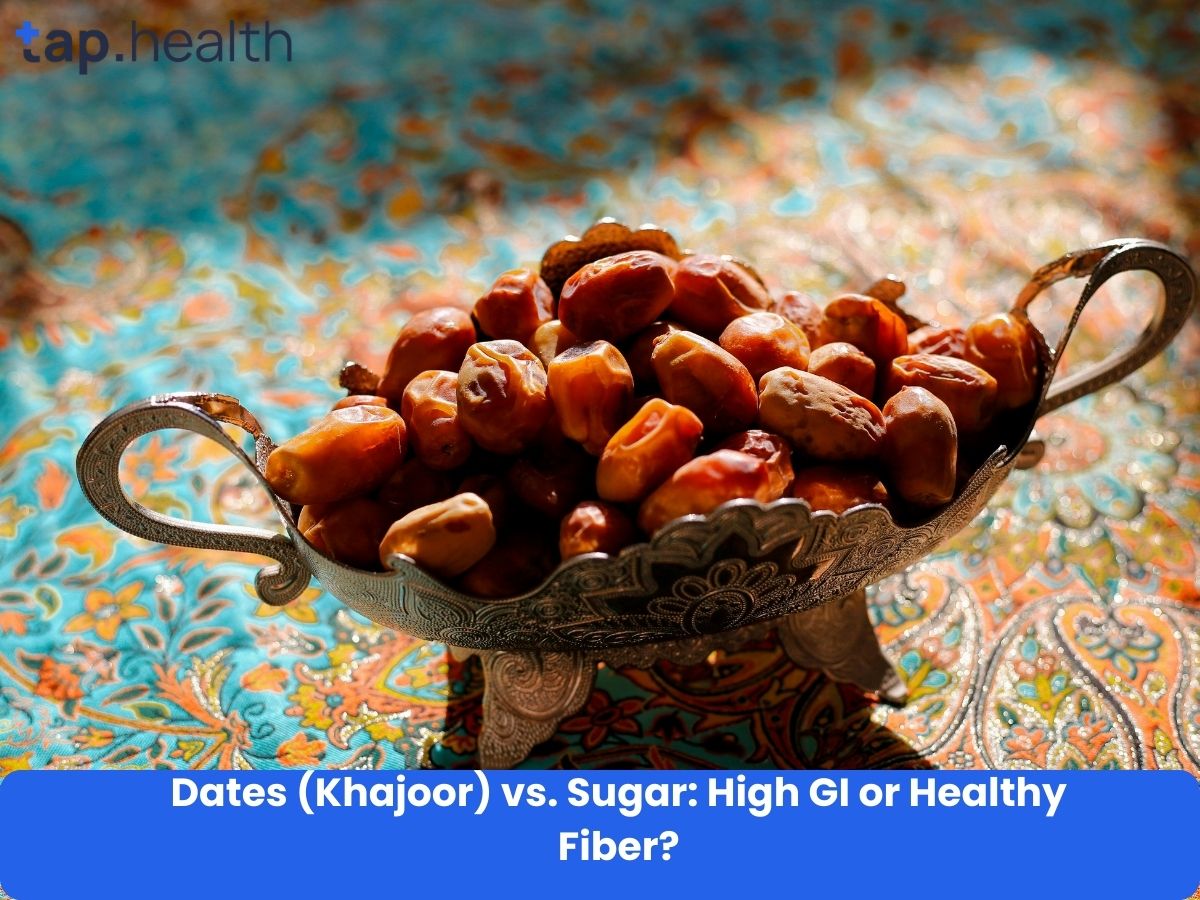
So, we look for alternatives. We look at nature. And we find Dates (Khajoor).
Dates are sweet, sticky, and delicious. They taste like caramel. Grandmothers have used them in Ladoos for centuries. Health influencers swear by “Date Syrup.” But a nagging question remains: Isn’t it still sugar?
If you eat a date, are you just eating a “natural” version of a sugar cube? Or does the fiber make it safe? Is the Dates vs. Sugar debate a clear win for the fruit, or is it a trap?
In this comprehensive guide, we are going to pit the ancient desert fruit against the modern industrial crystal. We will analyze the Glycemic Index, break down the nutritional differences, and find out if swapping sugar for dates is the health hack you’ve been looking for.
The Contenders: Nature vs. The Machine
To understand the biological impact, we must first understand the chemical makeup of our contestants.
1. White Sugar (Refined Sucrose)
- Source: Sugarcane or Sugar Beet.
- Processing: Heavily processed. The juice is extracted, boiled, crystallized, and bleached. All fiber, minerals, and vitamins are stripped away.
- Chemistry: It is 99.9% Sucrose. Sucrose is a disaccharide (50% Glucose + 50% Fructose).2
- Nutritional Value: Zero. It provides “Empty Calories.”
2. Dates (Khajoor)
- Source: The Date Palm tree (Phoenix dactylifera).
- Processing: Usually eaten whole (fresh or dried). Minimal processing.
- Chemistry: Mostly Glucose and Fructose, but packaged with water, fiber, and micronutrients.3
- Nutritional Value: High. Packed with Potassium, Magnesium, Vitamin B6, and antioxidants.4
Understanding Glycemic Index (GI)
To judge which sweetener is safer, we use the Glycemic Index (GI).
Think of GI as a speedometer for your blood sugar. It measures how fast a food converts into glucose and hits your bloodstream on a scale of 0 to 100.
- Low GI (0-55): Digests slowly. Releases energy steadily. (The Goal).
- Medium GI (56-69): Moderate rise. Safe in moderation.
- High GI (70+): Digests instantly. Causes a rapid “sugar spike” like rocket fuel.
We want to stay in the Low zone to protect our pancreas and insulin levels.
1. The Glycemic Index of White Sugar
You might think sugar has a GI of 100. Actually, it doesn’t.
The Glycemic Index of Table Sugar (Sucrose) is approximately 65.5
This places it in the Medium category.
- Why not 100? Because sugar is half fructose. Fructose must go to the liver before it enters the bloodstream, which slows down the GI reading slightly.
- The Trap: Even though the GI is 65, the Glycemic Load is massive because there is zero fiber to slow it down. It enters your system rapidly, causing an insulin spike followed by a crash.
2. The Glycemic Index of Dates (Khajoor)
Here is the surprise that shocks most diabetics.
The Glycemic Index of Dates ranges from 42 to 55 (depending on the variety).
This places most dates in the Low GI category.
Wait, really?
Yes. Despite being incredibly sweet, dates do not spike blood sugar as aggressively as white sugar or even white bread.6
Why is it Low?
- Fiber: This is the magic ingredient. Dates are rich in soluble and insoluble fiber.7 Fiber acts like a net in your stomach, trapping the sugar and releasing it slowly.
- Fructose: The primary sugar in dates is natural fruit sugar (fructose), which has a lower immediate impact on blood glucose readings than pure glucose.8
The Verdict: Biologically, a date is a “slow-release” sweet. Sugar is a “fast-release” sweet.
Nutritional Showdown: Empty Calories vs. Superfood
The GI tells us speed, but Nutrition tells us value. Let’s compare 100g of Sugar vs 100g of Dates.
| Feature | White Sugar (100g) | Dates / Khajoor (100g) | The Winner |
| Calories | ~387 kcal | ~277 kcal | Dates (Fewer calories) |
| Fiber | 0 g | ~7-8 g | Dates (Huge difference) |
| Potassium | 0 mg | ~696 mg | Dates (Heart health) |
| Magnesium | 0 mg | ~54 mg | Dates (Insulin sensitivity) |
| Antioxidants | None | High (Flavonoids) | Dates |
| Glycemic Index | ~65 (Medium) | ~42-55 (Low) | Dates |
The Analysis:
White sugar is biologically “expensive.” Your body has to use its own stored nutrients (like calcium and B vitamins) to process it.
Dates are biologically “generous.” They bring their own digestion kit (fiber) and extra gifts (minerals) with them.9
The Variety Factor: Not All Khajoor Are Equal
Just like apples, there are many types of dates. Their sugar content varies.
- Medjool Dates: These are the large, soft, caramel-like kings of dates.10 They are larger and sweeter.
- GI: Higher end (~55). Be careful with portion size (1 is enough).
- Kimia / Mazafati Dates: The soft, dark, wet dates popular in India.11
- GI: Moderate (~45-50).
- Dried Dates (Chuara): These are hard and dehydrated.12
- GI: Often higher because the sugar is concentrated and water is removed.
- Deglet Noor: Semi-dry and chewy.
- GI: Lower end (~42).
Rule of Thumb: The softer and stickier the date, the faster the sugar release might be, but they are all generally superior to refined sugar.
The Quantity Trap: The “Healthy” Mistake
This is where people get into trouble.
Because dates are “Low GI” and “Healthy,” people assume they can eat them like popcorn.
The Math:
- 1 Teaspoon of Sugar = 16 Calories | 4g Carbs.
- 1 Medjool Date = 66 Calories | 18g Carbs.
The Danger:
If you replace 1 teaspoon of sugar in your kheer with 4 dates, you have quadrupled the calorie count!
While the sugar enters your blood slower, the total load of carbohydrates is high. If you are diabetic, eating 5-6 dates in one sitting will definitely spike your sugar, fiber or not.
The Strategy: Treat dates as a Sweetener, not a snack. Use them to sweeten dishes, but be mindful of the count.
Real-Life Scenario
Let’s meet Mrs. Das, a 52-year-old teacher from Kolkata.
The Context:
Mrs. Das loves her Payesh (Rice Pudding). After her diabetes diagnosis, she stopped making it because she couldn’t use sugar. She tried artificial sweeteners, but hated the metallic aftertaste.
The Experiment:
She tried making Date Paste. She soaked 6 dates in warm water, blended them into a thick paste, and added this to her milk instead of sugar.
The Result:
- Taste: The Payesh tasted richer, with a hint of caramel.
- Blood Sugar: Her post-meal sugar was 160 mg/dL (acceptable).
- Why it worked: The date paste added bulk and fiber. She used only 6 dates for a pot that served 4 people. So per serving, she was only consuming 1.5 dates.
Expert Contribution
We consulted medical experts to get the professional stance.
Dr. S. Gupta, Endocrinologist:
“There is a misconception that ‘Natural Sugar’ is free food. It is not. Dates contain fructose.13 However, the fiber is a game changer. I allow my diabetic patients to eat 2 dates per day if their sugar is controlled. It satisfies the craving and provides potassium. But if they blend dates into a smoothie and drink it, the benefit is lost.”
Nutritionist Perspective:
“Beware of ‘Date Syrup’ sold in bottles. Read the label. If it is highly processed, the fiber might be removed. It is always better to make your own paste at home using whole dates. Also, never eat dates alone. Stuff a walnut or almond inside the date. The healthy fat from the nut further lowers the Glycemic Index.”
Recommendations Grounded in Proven Research and Facts
Based on data from the Nutrition Journal and National Institute of Nutrition, here are actionable tips:
- The “Nut-Stuffing” Hack:To make dates truly diabetic-friendly, slice them open, remove the seed, and insert a Walnut or Almond.
- Why: Protein and Fat slow down sugar absorption. This turns a simple carb into a complex snack.
- Date Syrup vs. Whole Dates:Avoid commercial syrups if possible. When you buy syrup, the fiber is often strained out. Use Whole Date Paste (skin included) for cooking.
- Portion Control:
- Diabetics: Limit to 1-2 dates per day.14
- Pre-diabetics: Limit to 2-3 dates per day.
- Weight Loss: Limit to 2 dates (energy booster pre-workout).
- Timing:Don’t eat dates immediately after a heavy meal (lunch/dinner). Your blood sugar is already rising from the meal. Eat them as a mid-morning snack or pre-workout fuel when your body needs energy.
Key Takeaways
- White Sugar provides zero nutrition and has a Medium GI (~65) but a massive Glycemic Load.
- Dates (Khajoor) provide fiber, potassium, and antioxidants and have a Low GI (~42-55).
- Fiber is the Hero: The fiber in dates prevents the rapid sugar crash associated with refined sugar.15
- Calories Count: Dates are calorie-dense.16 Replacing sugar with dates requires careful portion control.
- Best Practice: Eat dates whole or as a homemade paste, paired with nuts for the best blood sugar stability.
Conclusion
So, Dates vs. Sugar: High GI or Healthy Fiber?
The winner is clearly Dates (Khajoor).
While both are sources of sugar, they are not created equal. Sugar is an isolated chemical that taxes your body. A Date is a whole food that nourishes your body while sweetening it.
For anyone looking to quit white sugar, dates are the perfect bridge. They offer the sweetness you crave with the safety net of fiber. Just remember the golden rule of nutrition: Even superfoods have calories. Enjoy your Khajoor, but stop at two.
Frequently Asked Questions (FAQ)
Can diabetics eat dates daily?
Yes, in moderation. Most diabetologists agree that eating 1 to 2 dates per day is safe for diabetics with controlled blood sugar levels.17 The low Glycemic Index and high fiber content prevent dangerous spikes compared to refined sweets.
Is date sugar better than white sugar?
Yes. Date sugar is simply dried, ground whole dates.18 Unlike white sugar, it retains all the fiber, vitamins, and minerals of the fruit. However, it does not dissolve well in beverages like tea or coffee.
Do dates cause weight gain?
Only if overeaten. Dates are calorie-dense (approx 66 calories per Medjool date).19 If you eat a handful (5-6 dates) every day without adjusting your diet, you will consume excess calories, leading to weight gain.20 Used as a substitute for processed desserts, they can actually aid weight management.21+2
Which date variety is best for diabetics?
Deglet Noor or drier varieties often have a slightly lower Glycemic Index (~42) compared to the very soft, sweet Medjool dates (~55). However, the difference is minor. Portion size matters more than the variety.
Can I put dates in my tea?
It’s difficult. Whole dates or date sugar do not dissolve in tea like crystals. A better option is to drink tea unsweetened and take a small bite of a date with every sip to get the sweetness on your palate.
Is date syrup healthy?
Check the label. Homemade date syrup (blended dates and water) is healthy because it keeps the fiber. Commercial date syrups are often strained (juice only), which removes the fiber and increases the Glycemic Index.
Why are dates good for heart health?
Dates are rich in Potassium and Magnesium.22 Potassium helps lower blood pressure, and Magnesium relaxes blood vessels. Replacing inflammatory white sugar with heart-friendly dates is a great swap for cardiovascular health.23+1
References:
- Nutrition Journal: Glycemic indices of five varieties of dates in healthy and diabetic subjects. Link
- National Institute of Health (NIH): Date fruit consumption and diabetes. Link
- Harvard Health: Glycemic index for 60+ foods. Link
- Cleveland Clinic: The Benefits of Dates. Link
- Diabetes.co.uk: Fruits and Diabetes. Link
(Disclaimer: This content is for educational purposes only. Always consult your doctor or a certified dietitian before making significant changes to your diet, especially if you have diabetes.)