Imagine a steaming plate of hot white rice. It looks delicious, but for millions of Indians dealing with diabetes or weight gain, it looks like a danger zone. We’ve been told for years: “Rice is pure sugar. Stay away.”
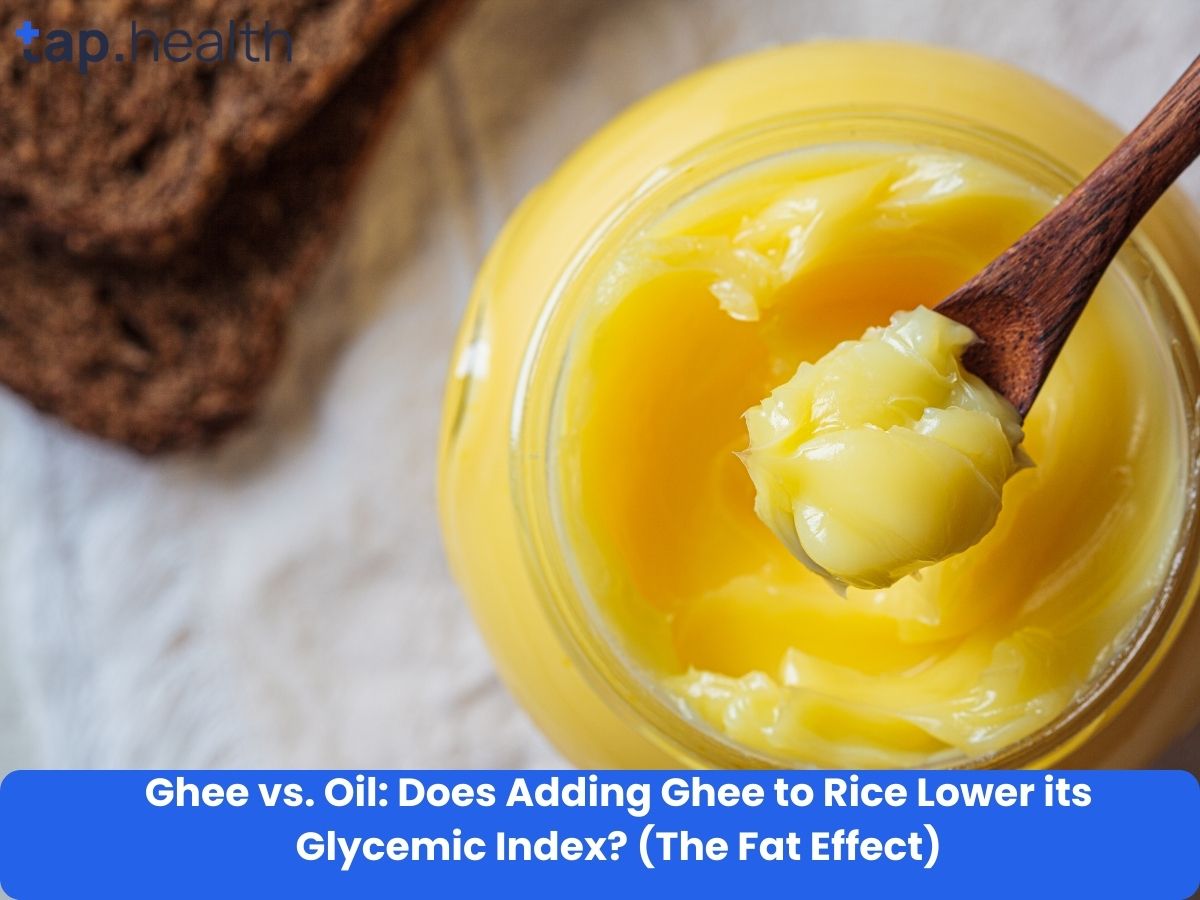
But then, our grandmother walks in with a small steel bowl of golden, melted liquid. She pours a spoonful of Ghee over that rice and says, “Eat it, beta. The ghee makes it healthy.”
Wait. Is she right? Or is she just trying to feed us more calories?
Logic tells us that fat is bad. Logic tells us that adding fat to carbs must be a nutritional disaster. But science has a surprise for you. It’s called the Fat Effect, and it might just change the way you look at your Dal-Chawal forever.
In this deep dive, we are going to explore the battle of Ghee vs. Oil. We will answer the burning question: Does adding ghee to rice lower its Glycemic Index? We will break down the science of how fat interacts with starch, compare the health benefits of our traditional ghee against modern oils, and help you decide if that dollop of golden goodness is a friend or a foe.
The Science of the “Fat Effect”
To understand if ghee helps, we first need to understand how our body digests rice.
When you eat plain white rice, your stomach attacks it with digestive enzymes. These enzymes break down the starch chains into simple glucose molecules. This glucose rushes into your bloodstream like a waterfall, causing a sudden spike in blood sugar. This is why white rice has a High Glycemic Index (GI) of roughly 73.
Enter Fat (The Speed Breaker).
When you add fat (like Ghee or Oil) to the rice, something magical happens.
- Gastric Emptying: Fat takes a long time to digest. It signals your stomach to slow down. The food stays in your stomach longer before moving to the intestine.
- Lipid Coating: The fat molecules coat the rice grains. This physical barrier makes it harder for the enzymes to reach the starch.
The Result: The “waterfall” of sugar turns into a “trickle.” The sugar enters your blood slowly. This process effectively lowers the Glycemic Index of the meal.
So, yes. Adding fat to rice does lower its GI. But does it matter which fat you use?
Ghee vs. Oil: The Nutritional Showdown
Now we know fat helps. But should you use your dadi’s Desi Ghee or that bottle of Refined Oil sitting on the counter?
1. Desi Ghee (Clarified Butter)
Ghee is not just fat; it is a cultural icon.
- Source: Animal Fat (Cow or Buffalo milk).
- Type: Saturated Fat (mostly).
- Key Nutrients: Vitamin A, D, E, K, and Butyric Acid.
- Stability: extremely heat stable. It doesn’t turn toxic when heated.
2. Refined Oil (Sunflower, Soybean, etc.)
- Source: Plant Seeds.
- Type: Polyunsaturated Fats (PUFA).
- Key Nutrients: Vitamin E (sometimes).
- Stability: Can oxidize and create inflammation if reheated.
The Glycemic Impact
Both Ghee and Oil are 100% fat. Therefore, both will lower the GI of rice equally. If you pour oil on rice, it slows digestion. If you pour ghee on rice, it slows digestion.
The Difference lies in what ELSE they do to your body.
Why Ghee Wins the Health Battle
If both lower the GI, why do experts recommend Ghee over Oil?
1. The Magic of Butyric Acid
Ghee is rich in Butyrate (Short Chain Fatty Acid).
- Gut Health: Butyrate feeds the cells of your colon. A healthy gut lining improves insulin sensitivity.
- Anti-Inflammatory: Diabetes is an inflammatory disease. Oil (especially refined seed oils) can increase inflammation due to high Omega-6 content. Ghee reduces inflammation.
2. Insulin Sensitivity
While oil lowers the immediate sugar spike, long-term consumption of refined vegetable oils has been linked to worsening insulin resistance. Ghee, saturated fat and all, does not seem to have this negative effect when consumed in moderation. It helps your hormones function better.
3. Satiety (Feeling Full)
Have you noticed that “Oily” food makes you feel heavy and sluggish, but “Ghee” food makes you feel satisfied? Ghee triggers the release of satiety hormones better than refined oils. This stops you from overeating rice in the first place.
How Much Does the GI Drop?
This is the number everyone wants to know.
- Plain White Rice: GI ~ 73 (High).
- Rice + 1 tsp Ghee: GI ~ 58-65 (Medium).
The Verdict: Adding ghee moves rice from the “High Danger” zone to the “Medium Safe” zone. It does not make it “Low GI” (like brown rice or dalia), but it significantly blunts the spike.
Is There a Catch? (The Calorie Trap)
Before you start drowning your rice in ghee, read this carefully.
Ghee is pure fat.
- 1 teaspoon of Ghee = 45 Calories.
- 1 tablespoon of Ghee = 115 Calories.
The Danger: If you add too much ghee, you might lower the sugar spike, but you will drastically increase the Calorie Count.
- Diabetes + Obesity: Most Type 2 diabetics are also overweight. Eating high-calorie meals leads to weight gain. Weight gain leads to higher insulin resistance.
The Strategy: It is a trade-off. You are trading a lower sugar spike for higher calories.
- The Golden Rule: Use 1 teaspoon per bowl. Do not use 1 ladle. The goal is to coat the grains, not to make them swim.
Real-Life Scenario
Let’s meet Mr. Patel, a 45-year-old businessman from Ahmedabad.
The Situation: Mr. Patel loves his Dal-Bhat (Rice and Lentils). When diagnosed with diabetes, he quit ghee completely, thinking it was “bad cholesterol.” He started eating dry, plain rice with watery dal.
The Problem:
- Taste: He hated his food.
- Sugar: Surprisingly, his post-lunch sugar was still hitting 180 mg/dL.
- Hunger: He felt hungry by 4 PM and ate biscuits.
The Experiment: His nutritionist told him: “Add 1 tsp of Cow Ghee to your hot rice.”
The Result:
- Week 1: He felt fuller. The dry rice became tasty and aromatic.
- Week 2: He stopped snacking at 4 PM because the fat kept him satisfied.
- The Numbers: His post-lunch sugar dropped to 155 mg/dL. The ghee slowed down the rice digestion, and the satiety stopped him from eating junk later.
Expert Contribution
We consulted medical experts to get the professional stance.
Dr. Ruta M., Ayurvedic Doctor: “In Ayurveda, Ghee is a ‘Yogavahi’—a catalyst. It carries the medicinal properties of food into the tissues. We have always known that dry grains aggravate ‘Vata’ and cause imbalances. Adding ghee lubricates the gut and ensures smooth digestion without the sudden shock to the system.”
Modern Dietitian Perspective: “The fear of fat is outdated. We now know that ‘naked carbs’ (eating just rice or bread) are the worst for blood sugar. You must dress your carbs. Ghee is an excellent dressing because it is natural and heat-stable. Compare this to refined oils which are chemically processed. Always choose Ghee, but treat it like a garnish, not a main ingredient.”
Recommendations Grounded in Proven Research and Facts
Based on data from the American Journal of Clinical Nutrition and Indian Council of Medical Research (ICMR), here are actionable tips:
- The “1 Teaspoon” Rule: Limit intake to 1 teaspoon (5ml) of ghee per major meal. This provides the GI-lowering benefit without overloading on calories.
- Mix with Fiber: Ghee lowers GI. Fiber lowers GI. Combine them!
- Don’t just eat Rice + Ghee.
- Eat Rice + Ghee + Dal + Salad. This “Triple Threat” (Fat + Protein + Fiber) ensures the flattest possible glucose curve.
- Avoid “Fried” Rice: Adding fresh ghee to boiled rice is healthy. Eating “Fried Rice” made in reused oil is unhealthy. The reused oil contains free radicals that damage your heart, even if it lowers the GI slightly.
- The “Cooling” Hack: If you really want to hack your blood sugar, cook the rice, add the ghee, and let it cool down. Reheat it before eating. This creates Resistant Starch plus the Fat Effect. It is the ultimate low-GI rice hack.
Key Takeaways
- Yes, Fat lowers GI: Adding fat (Ghee or Oil) to rice slows down gastric emptying and reduces the immediate blood sugar spike.
- Ghee > Oil: Ghee is superior because it contains Butyric Acid (good for the gut) and is not inflammatory like refined seed oils.
- Quantity Control: Use only 1 teaspoon. Ghee is high in calories. Excess ghee can lead to weight gain, which worsens diabetes in the long run.
- Naked Carbs are Bad: Never eat plain, dry white rice. Always add a fat source (Ghee) and a fiber source (Dal/Veg) to balance the meal.
- Satiety: Ghee helps you feel full longer, preventing unhealthy snacking between meals.
Conclusion
So, Ghee vs. Oil: Does adding Ghee to Rice Lower its Glycemic Index?
Yes, absolutely.
Your grandmother was right, even if she didn’t know the molecular science behind it. That spoonful of ghee isn’t just for taste; it is a functional tool to help your body handle carbohydrates better.
It transforms a high-speed sugar rocket (white rice) into a slower, more manageable energy source. By choosing Ghee over Oil, you are also choosing gut health and reduced inflammation over empty calories.
So go ahead. Add that golden dollop to your steaming hot rice. Just remember: it’s a medicine, not a soup. Use it wisely, and enjoy the taste of good health.
Frequently Asked Questions (FAQ)
Is ghee good for diabetics?
Yes, in moderation. Ghee helps lower the Glycemic Index of carbohydrate-rich foods like rice and roti. It also contains healthy fatty acids that support gut health. However, since it is high in calories, diabetics should limit intake to about 1-2 teaspoons per meal.
Does adding oil to rice reduce calories?
No, it increases calories. Adding oil or ghee adds fat, which is calorie-dense (9 calories per gram). While it lowers the speed of sugar absorption (Glycemic Index), it increases the total energy of the meal.
Which is better: Cow Ghee or Buffalo Ghee?
Cow Ghee is generally preferred. It is lighter, easier to digest, and contains fewer calories and cholesterol compared to Buffalo Ghee. For weight watchers and diabetics, A2 Cow Ghee is often considered the best choice.
Can I eat Jeera Rice instead of plain rice?
Yes. Jeera Rice is usually cooked with a small amount of ghee or oil and cumin seeds. This added fat lowers the GI compared to plain steamed rice. Just ensure it isn’t swimming in oil.
Does reheating rice lower blood sugar?
Yes. This is due to Resistant Starch. When rice is cooked, cooled, and reheated, a portion of the starch becomes resistant to digestion, acting like fiber. This lowers the Glycemic Index significantly. Adding ghee enhances this effect.
Is olive oil better than ghee for Indian cooking?
Not for high heat. Olive oil has a low smoke point and can degrade when used for deep frying or high-heat tadkas. Ghee has a very high smoke point, making it chemically stable and safer for traditional Indian cooking methods.
Does ghee increase cholesterol?
Only in excess. Research suggests that moderate consumption of ghee does not significantly raise LDL (bad) cholesterol and may even improve HDL (good) cholesterol. However, excessive intake can be harmful for heart patients.
References:
- Indian Journal of Medical Research: Fats and Glycemic Response. Link
- Harvard T.H. Chan School of Public Health: Fats and Cholesterol. Link
- National Institute of Nutrition (NIN): Dietary Guidelines for Indians. Link
- PubMed: Effect of fat on glycemic response. Link
- Ayurvedic Medicine: The role of Ghee (Ghrita). Link
(Disclaimer: This content is for educational purposes only. Always consult your doctor or a certified dietitian before making significant changes to your diet, especially if you have heart disease or high cholesterol.)