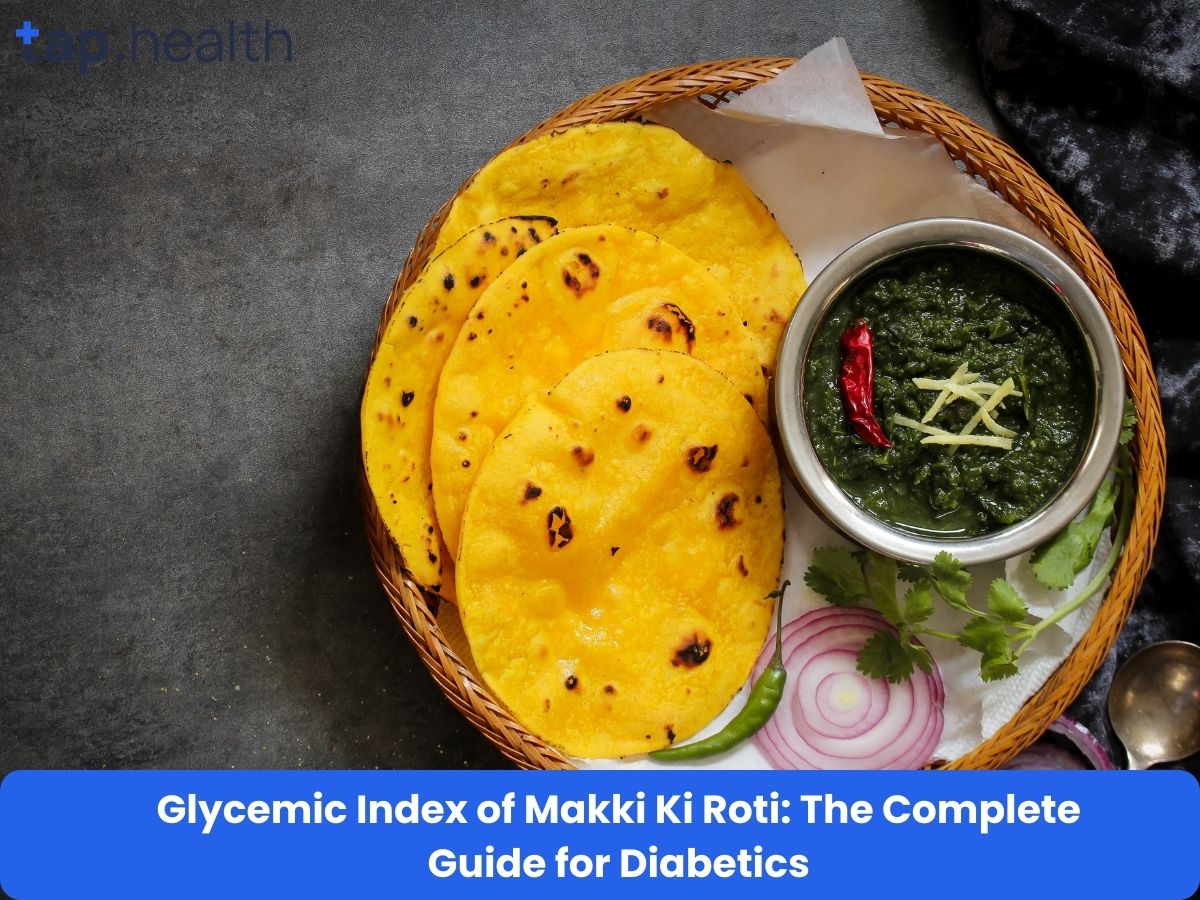
As soon as the winter chill hits North India, our kitchens undergo a delicious transformation. The wheat flour (atta) moves to the back of the shelf, and out comes the vibrant yellow Makki ka Atta (maize flour). The smell of Makki ki Roti cooking on a tawa, usually served with a bowl of rich Sarson ka Saag and a dollop of white butter, is the ultimate comfort food.
But if you are one of the millions of Indians managing diabetes or watching your weight, this golden roti brings a question to mind: Is it safe for me?
We know that corn is sweet. Does that mean Makki ki Roti is full of sugar? Will it spike your blood glucose levels?
In this deep-dive guide, we are going to explore the glycemic index of makki ki roti. We will break down the science, compare it with your regular wheat and bajra rotis, and give you expert tips on how to enjoy this winter treat without compromising your health.
What Is the Glycemic Index?
Before we put the roti on the plate, let’s quickly understand our measuring tool: the Glycemic Index (GI).
Think of the GI as a speedometer for food. It measures how fast the carbohydrates in a specific food turn into glucose (sugar) and enter your bloodstream.
- Low GI (0–55): These foods digest slowly. They are the best friends of a diabetic.
- Medium GI (56–69): These digest at a moderate speed.
- High GI (70–100): These digest rapidly, causing a sudden “sugar spike.”
For anyone with insulin resistance (Type 2 Diabetes), the goal is to eat foods that release energy slowly, avoiding that dangerous spike.
What Is the Glycemic Index of Makki Ki Roti?
So, where does our favourite winter bread stand?
The glycemic index of makki ki roti typically falls in the Medium to High range, usually between 60 and 70.
This might come as a surprise. Many people assume that because it is a “millet” or a coarse grain, it must be low GI. However, maize (makki) is naturally starchy.
- Whole Corn Kernels: Low GI (around 52).
- Makki ka Atta (Flour): When you grind the corn into flour, you break down the fibre and structure. This makes it easier for your body to digest, raising the GI to the 55–70 range depending on how finely it is ground.
Is Makki Roti High Glycemic?
It is not as high as white bread or maida (which are 75+), but it is higher than heavy millets like Bajra or Barley. It sits in the “Caution Zone.” You can eat it, but you have to be smart about how you eat it.
Makki Ki Roti vs. Corn Flour (The Confusion)
It is crucial to clarify a common confusion: glycemic index of makki ki roti vs corn flour.
In Indian kitchens, “Makki ka Atta” refers to yellow maize flour made from the whole grain. In Western terminology (and on some supermarket labels), “Corn Flour” or “Corn Starch” refers to the white, powdery starch used to thicken soups.
- Makki Atta (Yellow): Medium GI. Contains fibre, protein, and antioxidants. Healthy in moderation.
- Corn Flour/Starch (White): High GI (85+). It is pure starch with zero fibre. Diabetics should strictly avoid this.
When we talk about Makki ki Roti in this article, we mean the yellow, wholesome flour used in Punjabi homes.
Is Makki Roti Good for Diabetes?
The million-dollar question: Is makki roti good for diabetes?
The answer is Yes, but with conditions.
While the glycemic index of makki roti is moderate, it has significant benefits that make it worth including in your diet:
- Gluten-Free: Makki is naturally gluten-free. For diabetics who also have celiac disease or gluten sensitivity/bloating, this is a fantastic alternative to wheat.
- Resistant Starch: Maize contains a type of starch that ferments in the large intestine, feeding good gut bacteria rather than spiking blood sugar immediately.
- Satiety: It is a heavy grain. One Makki ki Roti keeps you fuller for longer compared to two thin wheat rotis, potentially reducing overall calorie intake.
The Verdict: You can eat it, but do not treat it like a free pass. Portion control is key.
Comparing Makki to Other Rotis
To make the best choice, we need to compare the glycemic index of different rotis. Let’s see how Makki stacks up against the rest of the bread basket.
1. Glycemic Index of Wheat Roti
- GI Score: Roughly 62 (Whole Wheat).
- Comparison: Makki ki roti and wheat roti are quite similar in GI. However, wheat contains gluten, while makki does not. If you are bored of wheat, makki is a comparable swap, but it won’t drastically lower your blood sugar on its own.
2. Glycemic Index of Bajra Roti
- GI Score: Roughly 48–54 (Low).
- Comparison: Bajra (Pearl Millet) is the clear winner for diabetes. It digests much slower than Makki. If your sugar levels are very high, Bajra is a safer choice than Makki.
3. Glycemic Index of Jowar Roti
- GI Score: Roughly 62 (Medium).
- Comparison: Jowar (Sorghum) is very similar to Makki in terms of GI, but it is lighter on the stomach.
4. Glycemic Index of Ragi Roti
- GI Score: Roughly 55–80 (Variable).
- Comparison: Ragi (Finger Millet) has a high variation depending on how it is cooked. Ragi balls (mudde) are low GI, but Ragi roti can be medium. However, Ragi has much higher calcium than Makki.
5. Glycemic Index of Besan Ki Roti
- GI Score: Roughly 35–40 (Very Low).
- Comparison: Besan (Chickpea Flour) is the absolute champion. It is mostly protein. Mixing Besan into your Makki atta is the best way to lower the GI of your meal.
How Much Sugar in Makki Roti?
Patients often ask, “How much sugar in makki roti?” because sweet corn tastes… well, sweet.
Here is the fact: There is no “added sugar” in plain Makki atta. However, chemically, all starches are chains of sugar molecules.
- One medium Makki ki Roti (approx 40g flour) contains about 25-30 grams of Carbohydrates.
- While it tastes slightly sweeter than wheat, this is due to the natural flavour profile of maize, not because it is packed with glucose syrup.
- Note: If you add jaggery (gud) to the dough—common in some households—the sugar content and GI will skyrocket.
Makki Ki Roti Benefits for Weight Loss
Can this heavy roti actually help you lose weight? Makki ki roti benefits for weight loss come from its density.
- Calorie Control: Because it is dense and difficult to roll thin, you usually end up eating just one or two. This “portion limiting” happens naturally.
- Fibre Boost: The high fibre content aids digestion and prevents constipation, which is essential for a healthy metabolism.
- Nutrient Density: It is rich in Vitamin A, C, and K, along with beta-carotene (good for eyes).
However, be careful with the “accompaniments.” If you drown your roti in white butter (makkhan) or ghee, the calorie count will destroy your weight loss plan.
Side Effects and Precautions
Even natural foods have downsides.
- Digestive Load: Makki takes longer to digest. If you have a sedentary lifestyle or weak digestion, eating it at dinner can cause bloating, gas, and heaviness.
- The “Winter Weight”: Because it is traditionally eaten with heavy fats (ghee/butter) and sweets (jaggery), people tend to gain weight in winter. It’s often the butter, not the roti, that is the culprit.
- Thyroid Issues: Some studies suggest maize can interfere with thyroid function if consumed in massive excess, though this is rare with normal dietary amounts.
Glycemic Index of Maize Roti vs. Corn Roti
You might see terms like “Maize Roti” and “Corn Roti” used interchangeably on the internet.
- Glycemic Index of Maize Roti: ~60-70.
- Glycemic Index of Corn Roti: ~60-70.
- Glycemic Index of Makki Atta: ~60-70.
They are all the same thing. The only outlier is Sweet Corn. If you blend boiled sweet corn kernels into a paste to make rotis, the sugar content will be higher than using dry mature maize flour. Stick to the dry flour (atta).
Real-Life Scenario
Let’s look at Simran, a 50-year-old diabetic from Chandigarh.
- The Situation: It is January. Simran loves Sarson ka Saag. In the past, she would eat 3 small wheat rotis with her saag. Her post-meal sugar would be 180 mg/dL.
- The Switch: She decides to switch to Makki ki Roti. She eats 2 medium Makki rotis.
- The Problem: Her sugar spikes to 190 mg/dL. Why? Because Makki has a slightly higher/similar GI to wheat, and she didn’t adjust the portion.
- The Solution: Her dietitian advises her to mix Methi (Fenugreek leaves) and a spoon of Besan into the Makki dough.
- The Result: She now eats 1 large Methi-Makki-Besan roti. Her stomach is full, and her sugar stays at a steady 140 mg/dL.
Expert Contribution
We consulted clinical nutritionists to get the final word.
Dt. N. Kaur, Certified Diabetes Educator: “In Punjab, we see a lot of patients whose sugar levels go up in winter. They blame the cold preventing exercise, but it is often the Makki ki Roti. I tell them: Makki is not bad. But do not eat it pure. Mix it. Add radish (mooli), add fenugreek (methi), or mix it 50:50 with Bajra. This lowers the glycemic index of makki atta instantly.”
Dr. R. Sharma, Endocrinologist: “The question ‘is roti low glycemic’ is tricky. No roti is truly ‘low’ GI unless it is made of bran or pure chickpea flour. Makki is fine for diabetics if you burn it off. Eat it for lunch, go for a walk. Do not eat it late at night.”
Recommendations Grounded in Proven Research and Facts
Based on the glycemic index of makki ki roti data, here is the smartest way to eat it:
- The 50% Rule: Never eat 100% Makki atta if you have high sugar. Mix 50% Makki with 50% low-GI flour like Besan (Chickpea) or Bajra.
- Add Fibre: Grate Mooli (Radish) or Gobi (Cauliflower) directly into the dough. This adds volume and fibre without adding carbs, lowering the overall GI.
- Eat with Greens: Always pair Makki roti with Saag (Leafy greens). The fibre in the Saag creates a mesh in your stomach that slows down the sugar absorption from the roti.
- Watch the Ghee: A teaspoon of ghee is good (it lowers GI slightly by adding fat), but two tablespoons is a calorie bomb.
- Timing Matters: Eat Makki roti for lunch when your metabolism is highest. Avoid it at dinner.
Conclusion
So, what is the verdict on the glycemic index of makki ki roti?
It sits in the Medium range (approx 60–70). It is not a super-low GI superfood like Bajra, but it is also not a villain. It is a nutritious, gluten-free grain that offers great satisfaction and health benefits during the winter months.
For a diabetic, the secret lies in modification. Don’t eat it plain. Fortify it with vegetables, greens, and protein-rich flours like besan. By doing this, you transform a medium-GI traditional dish into a diabetes-friendly power meal.
Go ahead and enjoy your winter warmth. Just remember: one nutritious, veggie-stuffed Makki roti is medicine; three plain ones are just sugar.
Key Takeaways:
- Makki GI: Medium (60–70).
- Best Mix: Combine with Besan or Methi.
- Best Pairing: Sarson ka Saag (High Fibre).
- Avoid: Dinner time consumption.
Frequently Asked Questions (FAQs) on Glycemic Index of Makki Ki Roti
What is the glycemic index of makki ki roti?
The glycemic index of makki ki roti generally falls in the medium range, typically between 60 and 70. While this is lower than refined flour (maida), it is higher than some other millets like bajra. The exact number depends on how coarsely the flour is ground and what it is eaten with.
Is makki roti good for diabetes patients?
Yes, makki roti can be good for diabetics if eaten in moderation. It is gluten-free and contains resistant starch. However, because it has a medium glycemic index, diabetics should ideally mix the flour with methi (fenugreek) leaves or besan (chickpea flour) to prevent blood sugar spikes.
Which has a lower GI: wheat roti or makki roti?
Whole wheat roti and makki roti have very similar glycemic index scores, both hovering around 60–65. However, wheat contains gluten, which some people find harder to digest. Neither is considered “Low GI,” so both should be eaten with plenty of fiber-rich vegetables.
Does makki ki roti help in weight loss?
Makki ki roti can aid weight loss because it is very filling. The high fiber content promotes satiety, meaning you may feel full after eating just one roti compared to two or three wheat rotis. However, it is calorie-dense, so adding too much butter or ghee will counteract the weight loss benefits.
What is the glycemic index of bajra roti vs makki roti?
Bajra (Pearl Millet) roti has a lower glycemic index (around 48–54) compared to makki roti (around 60–70). This makes bajra a superior choice for strict blood sugar control. Diabetics are often advised to choose bajra over makki or mix the two flours together.
How much sugar is in makki roti?
Plain makki roti does not contain added sugar, but it is made of complex carbohydrates that break down into glucose. A typical medium-sized makki roti provides about 25–30 grams of carbohydrates. It tastes sweet due to the natural flavor of maize, but this is not the same as refined sugar.
Is corn flour high glycemic?
Yes, white corn flour (corn starch) is high glycemic (GI 85+) and should be avoided by diabetics. However, yellow maize flour (makki ka atta) used for rotis is whole grain and has a medium GI (60–70). It is important not to confuse the two when shopping.
Can I eat makki roti at night?
It is generally recommended to avoid makki roti at night if you are diabetic or trying to lose weight. Makki is a complex carbohydrate that takes time to digest. Eating it for lunch allows your body to burn off the energy, whereas eating it at dinner may lead to bloating or higher morning blood sugar levels.