tap.health logo
  • Diabetes Management
  • Health Assistant
  • About Us
  • Blog
  • Contact Us
Get Plan
  • Diabetes Management
  • Health Assistant
  • About Us
  • Blog
  • Contact Us
  • All Blogs
  • Product
  • ICD Code for Type 2 Diabetes – Complete Coding Guide

ICD Code for Type 2 Diabetes – Complete Coding Guide

Product
March 10, 2026
• 10 min read
Yasaswini Vajupeyajula
Written by
Yasaswini Vajupeyajula
Nishat Anjum
Reviewed by:
Nishat Anjum
ChatGPT Perplexity WhatsApp LinkedIn X Grok Google AI
ICD Code for Type 2 Diabetes – Complete Coding Guide

Medical coding can often feel like learning a completely different language. When you are dealing with chronic conditions, accuracy is everything. A single wrong number can lead to rejected claims, delayed treatments, or an incomplete patient history.

One of the most common conditions coded in clinics and hospitals worldwide is type 2 diabetes. However, finding the correct ICD code for type 2 diabetes is rarely a simple one-step process. Diabetes affects almost every organ in the human body. Because of this, the coding system offers dozens of variations to capture exactly how the disease is impacting the patient.

Whether you are a medical coder, a billing specialist, or a doctor trying to improve your clinical documentation, understanding these codes is essential. It ensures that healthcare facilities are reimbursed correctly and that patients receive the exact care they need.

In this complete guide, we will break down the entire coding structure for type 2 diabetes. We will keep it simple, clear, and easy to understand. We will look at how to code diabetes with and without complications, how to handle insulin use, and the latest updates for 2026.

What Is the ICD-10-CM Code for Type 2 Diabetes?

If you are looking for a quick answer, type 2 diabetes falls under the E11 category in the ICD-10-CM manual.

The most common baseline code is E11.9, which stands for type 2 diabetes mellitus without complications.

However, if the patient has achieved remission, you would use the newer code, E11.A (type 2 diabetes mellitus in remission). If the patient has any related health issues, such as kidney or eye problems, the code will change to reflect those specific complications.

What Is the ICD-10-CM Category for Type 2 Diabetes?

The International Classification of Diseases, 10th Revision, Clinical Modification (ICD-10-CM) organises diseases into specific blocks.

Endocrine, nutritional, and metabolic diseases are grouped in the E00 to E89 block. Within this block, diabetes mellitus has its own dedicated section from E08 to E13.

The E11 category is exclusively reserved for type 2 diabetes mellitus. This category is used for patients whose bodies produce insulin but cannot use it effectively (insulin resistance). It is the most common form of diabetes globally, which is why the E11 category is one of the most frequently used sections in medical billing.

Read this: Metabolic Changes in Diabetes Mellitus

ICD Code for Type 2 Diabetes Without Complications

When a patient has stable, well-managed diabetes with no other related health issues, you use a specific code.

The correct code is E11.9. This indicates type 2 diabetes mellitus without complications.

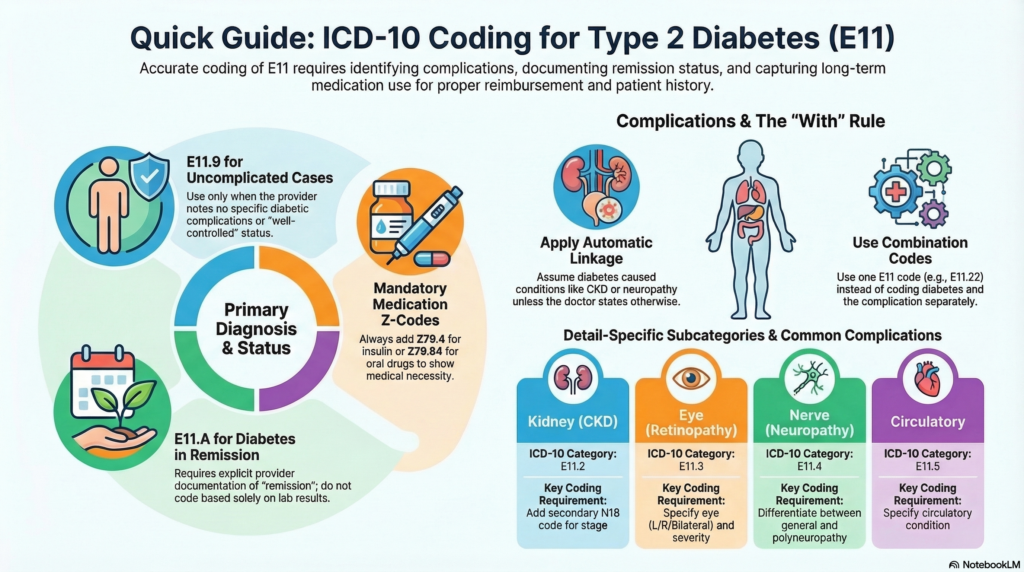
You will use this code when the provider’s documentation states that the patient has type 2 diabetes but does not list any diabetic complications. Common documentation points include “uncomplicated type 2 diabetes” or simply “type 2 DM, well-controlled.”

However, you must be careful. Do not use E11.9 if the doctor’s notes mention diabetic nerve pain, kidney issues, or eye damage. If complications exist, using E11.9 will lead to inaccurate medical records and underpayment for the complexity of care provided.
ICD Code for Type 2 Diabetes in Remission

A major update to the coding system recently introduced a way to document patients who have successfully reversed their condition.

The correct code is E11.A. This stands for type 2 diabetes mellitus in remission.

You use this code when a patient has achieved normal blood sugar levels without needing diabetes medication for an extended period, often due to significant weight loss or bariatric surgery.

However, there is a strict provider documentation requirement. A medical coder cannot simply look at a normal HbA1c lab result and guess that the patient is in remission. The doctor must explicitly write “type 2 diabetes in remission” in the patient’s chart. Remission means the disease is quiet, but it is not completely cured, which is why it is coded differently from active diabetes.

ICD Codes for Type 2 Diabetes With Complications

Diabetes is famous for causing secondary health problems. When this happens, the coding must capture the full story.

Complication-specific coding matters for two main reasons. First, it proves the medical necessity of specific tests or treatments (like an eye exam or kidney ultrasound). Second, it accurately reflects how sick the patient is, which affects the risk adjustment scores for the clinic.

The E11 category is divided into subcategories to specify which body system is failing. The fourth character in the code tells the insurance company exactly what type of complication the patient is facing.

ICD Code for Type 2 Diabetes With Hyperosmolarity

Hyperosmolarity is a severe, acute emergency usually seen in older adults with type 2 diabetes. It happens when blood sugar gets dangerously high, leading to severe dehydration.

This condition falls under the E11.0 category.

You must specify the patient’s level of consciousness. Use E11.00 for type 2 diabetes with hyperosmolarity without coma. Use E11.01 for type 2 diabetes with hyperosmolarity with coma. This is a critical care code that requires immediate hospitalisation.

ICD Code for Type 2 Diabetes With Ketoacidosis

Diabetic ketoacidosis (DKA) happens when the body starts breaking down fat too quickly, making the blood acidic. While it is more common in type 1 diabetes, it can still happen in type 2.

This emergency falls under the E11.1 category.

Just like hyperosmolarity, you must code the severity. Use E11.10 for type 2 diabetes with ketoacidosis without coma. Use E11.11 for type 2 diabetes with ketoacidosis with coma. Accurate documentation of this acute event is vital for emergency department billing.

ICD Code for Type 2 Diabetes With Kidney Complications

The kidneys act as the body’s filtration system. High blood sugar damages these filters over time, leading to diabetic nephropathy.

Kidney issues are coded under the E11.2 category. The most common code here is E11.22, which stands for type 2 diabetes with diabetic chronic kidney disease (CKD).

There is a special rule in ICD-10 guidelines for this. The system assumes a direct CKD linkage. If a patient has diabetes and chronic kidney disease, you must assume the diabetes caused the CKD, unless the doctor specifically states another cause.

Always remember to use an additional CKD code (from the N18 category) to identify the exact stage of the kidney disease.

ICD Code for Type 2 Diabetes With Eye Complications

Diabetes can severely damage the tiny blood vessels in the retina, leading to blindness if left untreated.

Eye complications fall under the E11.3 category. This is one of the most detailed sections in the ICD-10 manual.

You must code for the exact type of retinopathy (non-proliferative or proliferative). You also need blindness/severity documentation. For example, E11.311 indicates type 2 diabetes with unspecified diabetic retinopathy and macular oedema. The codes expand further to specify whether the damage is in the right eye, left eye, or both eyes (bilateral).

ICD Code for Type 2 Diabetes With Neurological Complications

High blood sugar frequently damages nerve fibres, particularly in the legs and feet. This causes numbness, tingling, or intense pain.

Nerve damage is coded under the E11.4 category.

The most frequently used code is E11.40 for type 2 diabetes with diabetic neuropathy, unspecified. If the doctor specifies that multiple nerves are affected, you would use E11.42 for diabetic polyneuropathy. You can also use E11.43 for autonomic (gastroparesis) neuropathy, which affects internal organs like the stomach.

ICD Code for Type 2 Diabetes With Circulatory Complications

Diabetes speeds up the hardening of the arteries, reducing blood flow to the limbs. This is known as peripheral vascular disease.

Circulatory issues are found under the E11.5 category.

Use E11.51 for type 2 diabetes with diabetic peripheral angiopathy without gangrene. If the poor circulation has caused tissue death, you must use E11.52 (with gangrene). These codes are highly critical for vascular surgeons and wound care specialists.

ICD Code for Type 2 Diabetes With Oral, Skin, or Foot Complications

Diabetics are highly prone to skin infections, slow-healing foot ulcers, and severe gum disease due to poor immunity and circulation.

These issues are grouped under the E11.6 category.

For skin ulcers, use E11.621 (type 2 diabetes with foot ulcer) or E11.622 (with other skin ulcer). When using these diabetic foot-related coding angles, you must also add a secondary code from the L97 category to specify how deep the ulcer goes.

You can also code for diabetic dermatitis (E11.620) and periodontal disease (E11.63).

ICD Code for Type 2 Diabetes With Other Specified Complications

Sometimes, a patient has a diabetic complication that does not neatly fit into the eye, kidney, or nerve categories.

In these cases, E11.69 is used. This code stands for type 2 diabetes mellitus with other specified complications.

Examples of “other specified” conditions include diabetic arthropathy (joint damage) or diabetes-induced hypoglycaemia (low blood sugar) that is not caused by an accidental medication overdose. It is a catch-all code for specific, documented issues tied to the disease.

ICD Code for Type 2 Diabetes With Unspecified Complications

Occasionally, a doctor will note that the patient has a diabetic complication but will fail to write down exactly what it is.

When this happens, coders are forced to use E11.8, which means type 2 diabetes mellitus with unspecified complications.

This code is a red flag for insurance auditors. It shows that the medical documentation is incomplete. Better documentation helps the clinic get paid correctly and ensures the patient’s medical history is accurate. Coders should always ask the doctor to clarify the complication before using an unspecified code.

Type 2 Diabetes ICD Code With Long-Term Insulin Use

Many type 2 diabetics eventually need medication to control their blood sugar. The coding system tracks what kind of medication they are taking.

When a type 2 diabetic requires daily insulin injections to survive, you must add the secondary code Z79.4 (long-term current use of insulin).

If the patient controls their diabetes with oral pills (like Metformin), you use the code Z79.84 for oral hypoglycaemics.

Recently, injectable non-insulin medicines (like Ozempic or Trulicity) have become very popular. If the patient uses these, you must add the code Z79.85 to indicate the long-term use of injectable non-insulin antidiabetic drugs.

How to Choose the Correct ICD Code for Type 2 Diabetes

Choosing the right code requires a methodical approach. Do not just guess based on the patient’s age.

First, check provider documentation. Read the clinical notes carefully to confirm the diagnosis is definitely type 2 diabetes.

Second, identify the complication. Look for words like neuropathy, nephropathy, or retinopathy in the assessment plan.

Third, confirm linkage. Use the word “with” in the ICD-10 alphabetic index. The index assumes a connection between diabetes and certain conditions (like osteomyelitis).

Finally, add secondary codes if needed. Never forget to add the Z codes for insulin use or the L codes for ulcer severity to complete the clinical picture.

Common Coding Mistakes With Type 2 Diabetes

Even experienced medical coders can trip up on diabetes guidelines. Here are the pitfalls to avoid.

The most common mistake is using E11.9 when complications exist. If a patient has diabetes and chronic kidney disease, coding E11.9 and N18.9 separately is wrong. They must be linked as a combination code (E11.22).

Another error is missing the remission code. If a doctor states the patient reversed their diabetes through diet, you must use E11.A, not E11.9.

Coders also frequently forget missing add-on codes, like forgetting to report the stage of chronic kidney disease or failing to document insulin use. Poor documentation from the doctor is the root cause of most of these errors.

ICD Code for Type 2 Diabetes vs Type 1 Diabetes – Key Difference

It is crucial not to mix up the two main types of diabetes. They have completely different biological causes.

Type 1 diabetes is an autoimmune disease where the body produces no insulin. It is coded under the E10 category.

Type 2 diabetes is an insulin resistance issue, coded under the E11 category.

Why does correct diabetes type matter? Mixing them up can lead to rejected pharmacy claims. For example, if you code a patient as having type 2 diabetes (E11), but they are prescribed an insulin pump usually reserved for type 1 (E10), the insurance company will likely deny the claim. Always ensure the “type” matches the doctor’s exact words.

2026 Update in Type 2 Diabetes ICD Coding

The medical coding world is constantly evolving to reflect new medical realities.

The biggest recent change, which remains a focal point in the current FY 2026 guideline relevance, is the new remission coding point. The addition of the E11.A code was a massive win for preventative medicine.

It allows doctors and researchers to accurately track patients who successfully manage their disease through lifestyle changes. Coders must stay updated on these annual guideline changes to ensure compliance with the latest World Health Organization (WHO) and regional billing standards.


Real-Life Scenario

Consider a busy medical clinic in Delhi. Dr. Sharma sees a 60-year-old patient named Anil. In his notes, Dr. Sharma writes: “Patient presents for routine follow-up. Type 2 diabetes. Patient complains of severe burning pain in both feet. Diagnosed with peripheral neuropathy. Current medications: Metformin.”

A junior medical coder reviews the chart and assigns two codes: E11.9 (Type 2 diabetes without complications) and G62.9 (Unspecified polyneuropathy).

The senior coder catches the mistake before billing. She explains the ICD-10 “with” rule. Because diabetes and neuropathy are linked in the coding index, they must be combined. The senior coder corrects the claim to E11.40 (Type 2 diabetes with diabetic neuropathy, unspecified) and adds Z79.84 to show Anil is on oral diabetic medication. This simple correction ensures the clinic is paid correctly for treating a complex diabetic complication.


Expert Contribution

We consulted a Senior Clinical Documentation Improvement (CDI) Specialist to share insights on the challenges of coding this disease:

“The magic word in diabetic coding is ‘with.’ The ICD-10 guidelines specifically state that if a patient has diabetes and a condition like chronic kidney disease, the coder must assume a cause-and-effect relationship. You do not need the doctor to explicitly write ‘kidney disease caused by diabetes.’ The coding manual links them automatically.

However, doctors still need to be specific about the severity. A coder cannot guess the stage of an ulcer or the stage of kidney failure. Clear, detailed clinical notes are the absolute foundation of accurate diabetic coding.”


Recommendations Grounded in Proven Research and Facts

When coding for metabolic diseases, you must rely on official guidelines.

  1. Official Guidelines: Always refer to the ICD-10-CM Official Guidelines for Coding and Reporting. Section I.C.4 explicitly outlines the rules for coding diabetes and its assumed linkages to other systemic conditions.
  2. Combination Codes: The World Health Organization (WHO) designed the E11 category to use combination codes. This reduces the number of codes needed on a claim by bundling the disease and the complication into one neat alphanumeric string.
  3. Z-Code Mandate: According to current billing standards, reporting long-term drug therapy (like Z79.4 for insulin) is mandatory. It directly influences medical necessity checks for diabetic supplies like test strips and continuous glucose monitors (CGMs).

Frequently Asked Questions on ICD Code for Type 2 Diabetes

What is the ICD-10 code for type II diabetes?

The general baseline ICD-10 code for type II (type 2) diabetes mellitus without complications is E11.9. The entire category for type 2 diabetes falls under the E11 block.

What is the difference between E11-40 and E11-42?

E11.40 stands for type 2 diabetes mellitus with diabetic neuropathy, unspecified. It is a general code for nerve damage. E11.42 stands for type 2 diabetes mellitus with diabetic polyneuropathy. It is more specific, indicating that multiple peripheral nerves are damaged, which is very common in advanced diabetes.

What is the ICD-11 code for diabetes mellitus type 2?

In the newly implemented ICD-11 classification system (which is slowly replacing ICD-10 globally), type 2 diabetes mellitus is coded as 5A11. Just like ICD-10, it uses extension codes to detail specific complications.

What is E11.9 Type 2 diabetes mellitus?

E11.9 is the billing code used when a patient has type 2 diabetes, but they do not have any documented complications related to the disease, such as kidney failure, eye damage, or nerve pain. It implies the disease is currently uncomplicated.

Should I code E11.9 if the patient takes insulin?

If the patient has no complications, you will use E11.9. However, you must add an additional code to show they take insulin. You would code E11.9 as the primary diagnosis, and add Z79.4 (long-term current use of insulin) as a secondary code.

What code do I use if the doctor doesn’t specify the type of diabetes?

If the medical documentation simply says “diabetes mellitus” and does not specify whether it is type 1 or type 2, the ICD-10 guidelines state that the default code should be for type 2 diabetes (the E11 category).

References

  • World Health Organization (WHO) – ICD-10 Classification
  • Centers for Medicare & Medicaid Services (CMS) – ICD-10 Guidelines
  • National Institutes of Health (NIH) – Diabetes Complications
Tags
diabetes food cravings whey protein diabetes diabetes thirst fluids skipping breakfast diabetes diabetes and blurred vision breathlessness diabetes diabetes nausea causes dry mouth high blood sugar diabetes and shoulder pain diabetes and palpitations diabetes symptoms and tests diabetes and hand tremors causes diabetes prevention foot health diabetes and sleep fasting blood sugar diabetes misconceptions diabetes medicine safety diabetic neuropathy symptoms diabetic foot ulcer warning signs can diabetics eat mango diabetes itching urinary infection diabetes diabetes slow wound healing metformin side effects diabetes numbness in hands banana for diabetes dates blood sugar jaggery for diabetes is poha good for diabetes guava blood sugar India diabetes pregnancy blood sugar targets diabetes medicine India blood sugar vs blood pressure LADA diabetes symptoms ED in diabetic men how to store insulin cataract surgery diabetes diabetes cholesterol levels Ramadan diabetes medicine timing walking after meals diabetes flu vaccine diabetes sugar cravings diabetes protein powder kidney diabetes diabetes diarrhoea vomiting diabetes breakfast skipping diabetic eye symptoms high sugar breathing problems diabetes and vomiting diabetes mouth symptoms diabetes frozen shoulder racing heart low sugar diabetes and tingling feet diabetes and appetite loss A1C gestational diabetes poor sleep blood sugar HbA1c diabetes symptoms in women diabetes medicines diabetes nerve damage diabetes and blood pressure mango and diabetes dark patches diabetes diabetes stomach problems diabetes wounds metformin safety diabetes tingling hands banana blood sugar papaya for diabetes is jaggery good for diabetes poha blood sugar orange for diabetes sugar spike after rice postpartum diabetes risk type 1 vs type 2 diabetes diabetes vs high cholesterol latent autoimmune diabetes in adults diabetes and menopause insulin storage at home diabetes and muscle loss diabetes triglycerides diabetes and shift work diabetes and smoking GLP-1 diabetes medicines diabetes hunger cravings CGM skin irritation diabetes diabetes sick day vomiting morning sugar skipping breakfast diabetes and sweating diabetes and shaking vomiting with diabetes diabetes and itchy skin shoulder stiffness diabetes heart pounding diabetes diabetes and tingling feet causes diabetes and appetite loss causes Medicine blood sugar pregnancy diabetes sleep and diabetes diabetes in India women diabetes signs diabetes treatment advice tingling feet diabetes high blood pressure diabetes mango sugar diabetes walking after meals for diabetes diabetic gastroparesis diabetic wound care diabetes ketoacidosis warning signs diabetic neuropathy hands coconut water and diabetes is papaya good for diabetes gur for diabetes sprouts for diabetes can diabetics eat oranges Indian diet diabetes diabetes after pregnancy type 1 and type 2 diabetes difference lipid profile diabetes diabetes vs MODY menopause blood sugar insulin fridge temperature diabetes muscle weakness diabetes and high blood pressure night shift diabetes smoking diabetes risk GLP-1 weight loss diabetes diabetes and fever CGM sensor rash diabetes loose motions late dinner diabetes sweating low blood sugar tremors low blood sugar diabetes and cold feet itching high blood sugar diabetes and loss of appetite diabetes and muscle weakness diabetes and sweaty feet diabetes and burning feet Health fasting glucose blood sugar pregnancy diabetes and stress diabetes risk factors India diabetes risk women Indian diabetic diet chart diabetes eye disease diabetes heart kidney risk diabetes reversal vs remission post meal walk diabetes diabetes bloating nausea diabetes yeast infection DKA symptoms fasting with diabetes coconut water for diabetes papaya blood sugar watermelon for diabetes are sprouts good for diabetes orange blood sugar glucose spike symptoms gestational diabetes India difference between type 1 and type 2 diabetes diabetes vs neuropathy MODY diabetes symptoms type 2 diabetes menopause glucometer errors sarcopenia diabetes diabetes hypertension diabetes meal timing shift work diabetes quit smoking semaglutide diabetes best shoes for diabetic feet diabetes adhesive allergy CGM diabetes and kidney stones diabetes dinner timing diabetes and leg cramps shaky feeling diabetes cold feet diabetes diabetes fungal itching loss appetite diabetes weakness high blood sugar diabetes and sweaty feet causes diabetes and burning feet causes Lifestyle A1C test low blood sugar stress blood sugar diabetes prevention India diabetes symptoms in men diabetic meal plan diabetic eye test borderline HbA1c diabetes remission walking lowers blood sugar diabetes sick day rules diabetes fungal infection ketones diabetes diabetes fasting safety can diabetics drink coconut water oats for diabetes can diabetics eat watermelon sprouts blood sugar brown bread for diabetes post meal blood sugar continuous glucose monitor India diabetes vs diabetes insipidus diabetes vs heart disease maturity onset diabetes of the young diabetes and frozen shoulder wrong blood sugar reading diabetes and anaemia BP in diabetes diabetes and vitamin D diabetes neuropathy pain relief diabetes and migraine diabetic socks foot ulcer prevention diabetes monsoon care kidney stones diabetes night sugar late dinner leg cramps diabetes diabetes and periods diabetes poor circulation feet diabetes and swollen ankles diabetes not feeling hungry diabetes leg weakness diabetes and neck pain diabetes and slow digestion Home remedies diabetes diet hypoglycemia cortisol diabetes best fruits for diabetes men diabetes signs HbA1c test high protein breakfast for diabetes HbA1c 5.7 to 6.4 reverse type 2 diabetes diabetes grocery list India diabetes during illness diabetes vaginal itching diabetes blurry vision can diabetics fast curd for diabetes oatmeal diabetes watermelon blood sugar methi seeds for diabetes bread for diabetes insulin resistance symptoms CGM cost India diabetes mellitus vs diabetes insipidus diabetes heart disease risk continuous glucose monitor diabetes frozen shoulder diabetes reactive hypoglycaemia anaemia diabetes HbA1c diabetes and liver enzymes vitamin D deficiency diabetes diabetic neuropathy burning feet diabetes headache triggers diabetes and driving diabetes rainy season foot infection diabetes urine pain diabetes medicine timing diabetes muscle cramps periods affect blood sugar hair loss diabetes ankle swelling diabetes diabetes and restless legs diabetes and memory problems diabetes and neck pain causes diabetes and slow digestion causes Fitness balanced meals diabetes safety diabetes eye care diabetes fruits diabetes risk men HbA1c normal range diabetes breakfast India prediabetes HbA1c diabetes plate method diabetic food list India blood sugar fever infection diabetes night sweats high blood sugar blurry vision insulin injection sites is curd good for diabetes are oats good for diabetes apple for diabetes fenugreek for diabetes whole wheat bread diabetes diabetes blood pressure time in range diabetes insipidus symptoms diabetes and heart attack CGM diabetes diabetic shoulder pain low blood sugar after eating low haemoglobin diabetes high SGPT diabetes vitamin D insulin resistance diabetes gastroparesis blood sugar migraine driving with diabetes monsoon diabetes tips diabetes foot nail care diabetes medicine before or after food diabetes and frequent infections menstrual cycle diabetes diabetes hair fall causes diabetes leg swelling causes restless leg syndrome diabetes diabetes brain fog diabetes and chest pain Prevention healthy eating diabetes heart health diabetic retinopathy fruit and blood sugar type 1 diabetes how to lower HbA1c diabetic breakfast ideas post-meal blood sugar Indian diabetes plate foods for diabetes shopping diabetes and alcohol low blood sugar at night diabetes excessive thirst insulin site rotation diabetes curd milk for diabetes can diabetics eat apple methi diabetes avocado for diabetes diabetes heart risk glucometer accuracy diabetes vs metabolic syndrome gestational diabetes vs type 2 diabetes continuous glucose monitoring metformin vitamin B12 deficiency postprandial hypoglycaemia diabetes and uric acid SGOT SGPT diabetes diabetes and magnesium diabetic gastroparesis symptoms diabetes and thyroid medication low blood sugar driving diabetes and antibiotics diabetic nail cutting missed diabetes medicine dose recurrent infections diabetes time in range diabetes diabetes wounds not healing diabetes and headache diabetes leg discomfort night memory loss blood sugar diabetes and chest pain causes Hygiene why diabetes is considered as a lifestyle disease blood pressure diabetes eye test rice and diabetes type 1 diabetes symptoms fasting sugar normal range PCOS and diabetes blood sugar after food diabetes portion control diabetes kidney tests alcohol blood sugar diabetes diabetes sweating at night diabetes dry mouth insulin lumps tea and coffee in diabetes can diabetics drink milk apple blood sugar cinnamon for diabetes is avocado good for diabetes ABC diabetes diabetes technology metabolic syndrome and diabetes pregnancy diabetes and type 2 diabetes steroid induced diabetes metformin B12 symptoms type 3c diabetes high uric acid diabetes diabetes and dental health magnesium deficiency diabetes delayed stomach emptying diabetes levothyroxine diabetes diabetes in older adults antibiotics blood sugar diabetes diabetes fungal nail infection diabetes airport travel diabetes infection symptoms CGM time in range diabetes and increased appetite headache low blood sugar fever high blood sugar diabetes and skin discolouration diabetes and cough Ailments lifestyle diabetes cholesterol diabetes kidney care can diabetics eat rice insulin diabetes high fasting blood sugar PCOS insulin resistance postprandial glucose low glycaemic index foods for diabetes urine albumin diabetes can diabetics drink alcohol diabetes headache frequent urination diabetes diabetes weight gain coffee diabetes best milk for diabetes eggs for diabetes cinnamon blood sugar avocado blood sugar kidney risk diabetes CGM vs glucometer India metabolic syndrome symptoms gestational diabetes future risk steroid diabetes symptoms vitamin B12 test metformin pancreatogenic diabetes diabetes gout risk tooth infection diabetes magnesium insulin sensitivity diabetes and UTI thyroid medicine blood sugar elderly diabetes care infection treatment diabetes antibiotics CGM vs glucometer insulin airport security dizziness low blood sugar time in range targets constant hunger diabetes high sugar headache sick day diabetes yellow skin diabetes diabetes and cough causes Hindi type 2 diabetes lifestyle disease living with diabetes diabetic kidney disease diabetes diet India prediabetes diet reverse prediabetes naturally PCOS diabetes risk dawn phenomenon diabetes low GI foods India eGFR diabetes diabetes and dizziness high blood sugar headache diabetes fatigue diabetes and weight gain tea diabetes peanuts for diabetes are eggs good for diabetes dalchini for diabetes travelling with diabetes diabetes footwear diabetes reversal myths diabetes vs thyroid diabetes vs anaemia steroids high blood sugar diabetes distress diabetes caused by pancreas disease diabetes and PCOS diabetes and skin infections protein intake diabetes urinary tract infection diabetes diabetes fatigue after eating diabetes low sugar older adults diabetes workplace health CGM vs finger prick diabetes travel documents dizziness high blood sugar millets for diabetes diabetes hunger causes diabetes and bladder problems diabetes and daytime sleepiness diabetes and night urination diabetes and snoring skin diseases exercise and diabetes diabetes habits kidney tests diabetes morning blood sugar prediabetes food prediabetes reversal gestational diabetes diet Indian morning sugar high diabetes low GI diet diabetes and dental problems dizziness diabetes low blood sugar headache diabetes tiredness insulin weight gain roti for diabetes are peanuts good for diabetes egg diabetes amla for diabetes diabetes travel checklist blurred vision diabetes HbA1c remission diabetes and thyroid disease diabetes fatigue or anaemia diabetes and hair loss diabetes burnout diabetes and bone health PCOS insulin resistance diabetes boils diabetes diabetes protein diet diabetes women's sexual health sleepy after meals diabetes diabetes blood tests diabetes desk job diabetes CGM accuracy night hypoglycaemia symptoms diabetes and skin tags ragi jowar bajra diabetes diabetes and morning constipation diabetes urinary symptoms diabetes fatigue sleepiness urinating at night diabetes diabetes and snoring causes acne vulgaris symptoms blood sugar control diabetes management high blood sugar symptoms fasting sugar high lower diabetes risk how to prevent type 2 diabetes pregnancy diabetes diet high fasting sugar in morning diabetes and fatty liver diabetes gum disease low sugar dizziness blood sugar monitoring at home high blood sugar tiredness diabetes swollen feet best roti for diabetes peanuts blood sugar paneer for diabetes amla juice diabetes insulin travel storage fundus exam diabetes remission vs reversal thyroid blood sugar anaemia diabetes symptoms diabetes hair loss causes diabetes burnout symptoms diabetes osteoporosis diabetes and sleep apnoea diabetes and travel protein foods for diabetes diabetes vaginal dryness post meal sugar spike tiredness diabetes test list office snacks diabetes early signs of insulin resistance diabetes low sugar during sleep dark neck insulin resistance best millet for blood sugar constipation diabetes morning diabetes and body odour diabetes and bloating nocturia diabetes diabetes and morning fatigue AI Search physical activity insulin resistance hyperglycemia symptoms dawn phenomenon diabetes and weight loss insulin resistance diet gestational diabetes meal plan diabetes and cholesterol fatty liver diabetes dry mouth diabetes diabetes leg pain when to check blood sugar diabetes constipation swollen feet diabetes chapati diabetes sweet potato for diabetes is paneer good for diabetes amla blood sugar diabetes hot weather eye care diabetes vildagliptin diabetes vs PCOS diabetes vs Cushing syndrome hair fall in diabetes diabetes depression anxiety diabetes fracture risk sleep apnea diabetes travel with diabetes diabetes and fibre diabetes sexual problems women diabetes meal timing blood tests for diabetes checkup diabetes and dehydration insulin resistance tests constipation in diabetes acanthosis nigricans diabetes diabetes and nausea morning bowel movement diabetes diabetes smell sweat bloating with diabetes diabetes and numbness in hands diabetes and morning fatigue causes type 2 diabetes diabetes foot care insulin sensitivity diabetes warning signs diabetes myths weight loss diabetes Indian foods for insulin resistance diabetic foot ulcer diabetes lipid profile insulin resistance fatty liver diabetes urine infection diabetic leg cramps blood glucose monitoring diabetes and constipation diabetes foot swelling can diabetics eat dates can diabetics eat sweet potato paneer diabetes guava for diabetes diabetes dehydration diabetic retinopathy symptoms vildagliptin benefits in type 2 diabetes patients diabetes vs hypertension Cushing syndrome blood sugar diabetes and erectile dysfunction diabetes and depression diabetes and cataracts snoring diabetes insulin resistance diabetes Ramadan fasting fibre foods for diabetes diabetes and vaccines best time to eat for diabetes protein powder diabetes dehydration blood sugar walk after dinner blood sugar diabetes constipation relief diabetes and shortness of breath nausea with diabetes diabetes and dry mouth fruity breath diabetes diabetes stomach gas diabetes and numbness in hands causes diabetes and hand tremors prediabetes diabetic foot type 2 diabetes risk normal blood sugar levels diabetes facts insulin resistance weight loss improve insulin sensitivity diabetes foot wound cholesterol in diabetes diabetes skin problems frequent UTI diabetes diabetes nerve pain legs metformin for diabetes constipation diabetes can diabetics eat banana dates for diabetes sweet potato blood sugar poha for diabetes can diabetics eat guava heat and blood sugar GDM screening DPP-4 inhibitor diabetes and hypertension diabetes vs LADA erectile dysfunction diabetes diabetes anxiety symptoms diabetic cataract symptoms diabetes and high cholesterol diabetes fasting Ramadan soluble fibre blood sugar vaccines for diabetes late night eating diabetes
More blogs
Kazima Qureshi
Kazima Qureshi
• July 17, 2026
• 19 min read

Diabetes and Hand Tremors: Low Sugar, Medicines, Anxiety, and What to Do

A detailed, research-based guide to diabetes and hand tremors, including causes, tests, safe care, and warning signs.

Diabetes
ICD Code for Type 2 Diabetes – Complete Coding Guide
K. Siva Jyothi
K. Siva Jyothi
• July 17, 2026
• 19 min read

Diabetes and Morning Fatigue: Sleep, High Sugar, Anaemia, Thyroid, and Tests

A detailed, research-based guide to diabetes and morning fatigue, including causes, tests, safe care, and warning signs.

Diabetes
ICD Code for Type 2 Diabetes – Complete Coding Guide
Isha Yadav
Isha Yadav
• July 17, 2026
• 19 min read

Diabetes and Snoring: Sleep Apnoea, Weight, Blood Sugar, and Testing

A detailed, research-based guide to diabetes and snoring, including causes, tests, safe care, and warning signs.

Diabetes
ICD Code for Type 2 Diabetes – Complete Coding Guide
Do you remember your last sugar reading?
Log and Track your glucose on the Tap Health App
All logs in one place
Smart trend graphs
Medicine Reminder
100% Ad Free
Start Now

Missed your diabetes meds

again? Not anymore.

Get medicine reminders on your phone.

✓ Glucose diary and Insights
✓ Smart Nudges
✓ All logs at one place
✓ 100% Ad free
Start for free
tap health
tap.health logo
copyright © 2025
2nd Floor,Plot No 4, Minarch Tower,
Sector 44,Gurugram, 122003,
Haryana, India
  • About Us
  • Blog
  • Doctor login
  • Contact Us
  • Privacy Policy
  • Return / Shipping Policy
  • Terms and Conditions
Get Your Free AI Diabetes Coach