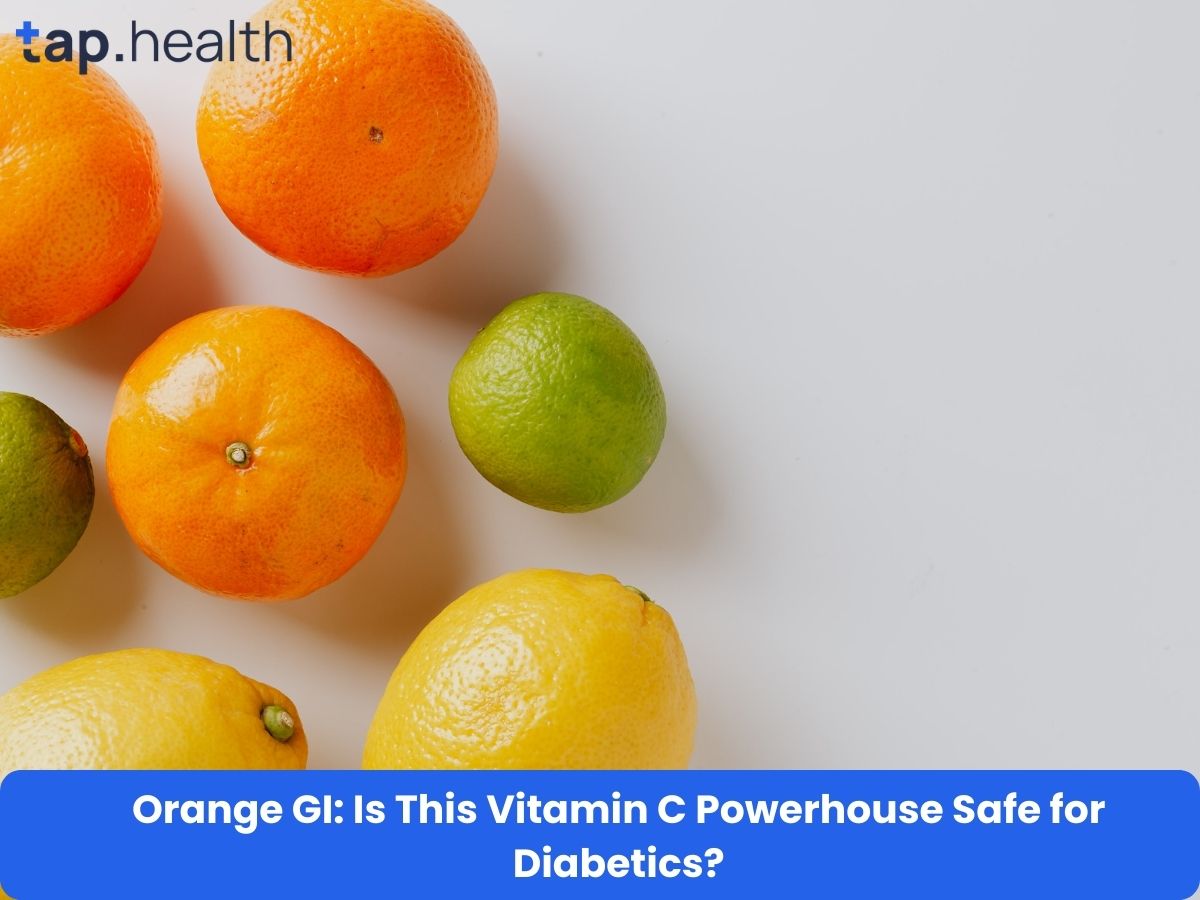
It is winter in India. The markets are flooded with bright, fresh Nagpur oranges. The smell of peeling citrus is in the air. You want to grab one, peel it, and enjoy that burst of tangy sweetness. But if you are managing diabetes or watching your weight, a little voice in your head stops you.
“It is sweet,” you think. “Will it spike my sugar?”
We have been taught to fear sweetness. We assume that if a fruit tastes like candy, it must act like candy inside our bodies. But nature is smarter than that. Not all sweet things are created equal.
If you have been searching for the orange GI (Glycemic Index) or wondering if you should swap your morning glass of juice for a whole fruit, you have come to the right place. In this detailed guide, we are going to peel back the layers of confusion. We will look at the science, compare the fruit to the juice, and give you clear, honest advice in plain Indian English.
What Is the Glycemic Index (GI)?
Before we look at the orange specifically, let’s quickly understand the tool we are using. The Glycemic Index (GI) is like a traffic signal for carbohydrates. It measures how fast a food raises your blood sugar levels on a scale of 0 to 100.
- High GI (70–100): These are the red lights. They stop digestion from happening slowly. Sugar rushes into your blood instantly. (Example: White bread, glucose, watermelon).
- Medium GI (56–69): The amber light. Moderate speed.
- Low GI (0–55): The green light. These foods digest slowly, releasing energy drop by drop. This keeps your insulin levels stable.
For a diabetic, the goal is to drive in the “Green Zone” as much as possible.
What Is the Orange GI?
Here is the good news: Oranges are a Green Light food.
The orange GI generally sits between 40 and 43.
This is considered Low. Even though oranges taste sweet, they do not cause a sudden explosion of sugar in your bloodstream. They release their natural sugar slowly and steadily.
Why is the GI so low?
- Fibre (Pectin): Oranges are packed with soluble fibre. If you eat the white stuff under the peel (the pith), you get even more. This fibre forms a gel in your stomach, slowing down the absorption of sugar.
- Acid: The natural citric acid in oranges also slows down stomach emptying.
- Polyphenols: These plant compounds help improve how your body handles insulin.
So, when you eat a whole orange, you aren’t just eating sugar; you are eating a complex package of nutrients that regulate how that sugar is used.
The Big Trap: Whole Orange vs. Orange Juice
This is the most critical part of this article. If you take away only one thing, let it be this: The orange GI changes completely when you juice it.
We often think juice is healthy. We see ads showing healthy people drinking tall glasses of OJ for breakfast. But let’s look at the numbers.
1. Whole Orange
- GI: 40–43 (Low)
- Fibre: High
- Satiety: High (You feel full)
- Verdict: Excellent Choice
2. Orange Juice (Fresh or Packaged)
- GI: 50–55 (Borderline Medium)
- Fibre: Zero (It is filtered out)
- Satiety: Zero (You drink it in seconds)
- Verdict: Be Careful
Why is juice dangerous?
When you juice an orange, you throw away the fibre—the “brake” that slows down the sugar. You are left with liquid sugar. Furthermore, it takes 3–4 oranges to make one glass of juice. Would you eat 4 oranges in 1 minute? Probably not. But you can drink the sugar of 4 oranges in 1 minute easily. This causes a rapid glucose spike.
Glycemic Load: The Quantity Factor
We cannot talk about orange GI without mentioning Glycemic Load (GL). While GI tells you the speed of the sugar, GL tells you the quantity.
Formula: (GI x Carbs in a serving) / 100
For one medium orange:
- GI: 40
- Carbs: Approx 12g
- Calculation: (40 x 12) / 100 = 4.8
Result: The Glycemic Load is roughly 5.
- Low GL: 0–10
- Medium GL: 11–19
- High GL: 20+
A score of 5 is incredibly low. This confirms that eating a normal-sized orange puts very little stress on your pancreas.
Comparison: Orange vs. Other Fruits
To help you shop better, let’s compare the orange GI with other common fruits found in Indian markets.
| Fruit | Glycemic Index (GI) | Glycemic Load (GL) | Safe for Diabetics? |
| Orange | 40–43 | 5 | Yes |
| Apple | 36–39 | 6 | Yes |
| Banana (Ripe) | 51–60 | 11 | Moderate |
| Mango | 51–56 | 8 | Moderate |
| Watermelon | 72–76 | 4 | High GI (Limit portion) |
| Guava | 12–24 | 2 | Yes (Best choice) |
| Papaya | 56–60 | 9 | Moderate |
Key Takeaway:
Oranges sit in the same healthy category as apples and pears. They are much safer than watermelons or over-ripe bananas when it comes to blood sugar speed.
Varieties of Oranges: Does It Matter?
You might wonder if a Kinnow (Mandarin) has a different GI than a Nagpur Orange or a Valencia.
- Sweet Orange (Mosambi/Nagpur): GI ~40–43.
- Mandarin (Kinnow/Tangerine): GI ~47.
- Grapefruit: GI ~25.
While Mandarins (easy-peelers) are slightly higher because they are often sweeter and have less pith, they are still considered a Low GI fruit (under 55). You can enjoy any variety of whole citrus fruit safely in moderation.
Health Benefits Beyond the Sugar
Diabetics often obsess over the orange GI, forgetting that food is more than just a number. Oranges offer vital protection for your body:
- Vitamin C: One orange provides 100% of your daily requirement. This boosts immunity and helps heal wounds—a common issue for diabetics.
- Potassium: Helps lower blood pressure, protecting your heart.
- Folate: Crucial for cell health.
- Flavonoids: These antioxidants reduce inflammation in the arteries.
Real-Life Scenario: The Breakfast Choice
Let’s look at a typical morning for Mr. Singh, a 55-year-old with Type 2 Diabetes.
The Old Habit:
Mr. Singh used to have two slices of white toast and a glass of packaged orange juice for breakfast.
- The Effect: The toast (High GI) + Juice (Medium GI/High Sugar) caused a massive spike. By 11 AM, he felt tired and shaky (the crash).
The Change:
He read about the orange GI. He swapped his breakfast. Now he has:
- A bowl of oatmeal (Low GI).
- A whole fresh orange (Low GI).
- A handful of almonds.
The Result:
- Digestion: The fibre from the oats and the whole orange keeps him full.
- Energy: The almonds slow down absorption even more.
- Blood Sugar: His post-breakfast reading is stable at 140 mg/dL instead of spiking to 200 mg/dL.
The Lesson: It wasn’t the orange flavour that was bad; it was the form (juice) he was consuming.
Expert Contribution
We consulted with certified nutritionists to get their professional take on citrus fruits.
Dr. R. Kapoor, Clinical Dietician:
“The biggest myth I fight is that diabetics cannot eat sweet fruits. Patients often ask me about the orange GI. I tell them: Nature packages the poison (sugar) with the antidote (fibre). When you peel an orange, do not spend hours picking off every white string. That white part—the pith—is rich in pectin. It lowers cholesterol and blunts the glucose spike. Eat the whole fruit, pith and all.”
Recommendations Grounded in Proven Research and Facts
Based on guidelines from the American Diabetes Association and nutritional research, here is how to safely include oranges in your diet:
- The Timing: Eat fruit as a snack between meals or post-workout. Avoid eating fruit immediately after a heavy carbohydrate meal (like rice or roti) if your sugar is already high.
- The Pairing: “Never eat a naked carb.” Pair your orange with a source of fat or protein.
- Orange slices + Walnuts.
- Orange segments in plain Dahi (Yoghurt).
- Orange with a slice of cheese.The fat slows down the stomach, lowering the effective GI of the snack.
- The Portion: One medium orange is a serving. Do not eat three in one sitting.
- The Pith: As mentioned by the expert, leave the white spongy layer on. It is tasteless but nutritionally gold.
Myths vs. Facts
Myth: “Oranges are sweet, so they must be High GI.”
Fact: False. The orange GI is roughly 40 (Low). Sweetness is due to fructose, which has a lower GI impact than glucose.
Myth: “Drinking orange juice is the same as eating the fruit.”
Fact: False. Juice lacks fibre and concentrates sugar. It spikes blood sugar much faster than the whole fruit.
Myth: “Diabetics should avoid fruits completely.”
Fact: False. Eliminating fruit deprives you of essential vitamins. The key is choosing Low GI fruits like oranges and practicing portion control.
Conclusion
So, is the orange a friend or a foe?
It is definitely a friend.
With an orange GI of roughly 40–43, this vibrant fruit is a safe, refreshing, and nutritious choice for almost everyone, including people with diabetes. It offers a sweet treat without the metabolic chaos caused by processed desserts or high-GI snacks.
However, remember the golden rule: Eat it, don’t drink it.
The magic lies in the structure of the fruit—the fibre, the pith, and the pulp. When you keep the fruit whole, you keep your blood sugar safe. So next time you see that basket of fresh oranges, grab one. Peel it, eat the pith, and enjoy the zest of good health.
Key Takeaways:
- The Number: Whole oranges have a Low GI (40–43).
- The Load: The Glycemic Load is very low (~5).
- The Danger: Orange Juice has a higher glycemic impact and lacks fibre. Avoid it.
- The Trick: Eat the white pith for extra fibre to slow down sugar absorption.
- The Verdict: Oranges are safe for diabetics in moderation (1 per day).
Frequently Asked Questions (FAQ) on Orange GI
What is the orange GI (Glycemic Index)?
The orange GI is typically between 40 and 43 for a whole, raw orange. This falls into the Low GI category (0–55), making it a slow-digesting food that does not cause rapid spikes in blood sugar levels.
Is orange juice safe for diabetics?
Generally, no. Orange juice has had the beneficial fibre removed. This means the sugar enters the bloodstream very quickly, causing a spike. It is much better to eat the whole fruit than to drink the juice.
How many oranges can a diabetic eat per day?
Most nutritionists recommend one medium-sized orange per day as a safe serving. This provides ample Vitamin C and fibre without overloading the body with carbohydrates (approx 12–15g of carbs).
Does the type of orange matter for GI?
There are slight variations. Mandarins (Kinnow) might be slightly higher (GI ~47) than regular sweet oranges (GI ~42) because they are easier to digest, but both are still considered Low GI fruits and are safe to eat.
Is it better to eat oranges before or after a meal?
It is often best to eat oranges as a mid-meal snack (e.g., 11 AM or 4 PM) combined with a few nuts. Eating fruit immediately after a heavy meal adds to the total carbohydrate load, which might raise post-meal blood sugar levels too high.
Does the white stuff (pith) on the orange lower the GI?
Yes. The white spongy layer is rich in pectin, a soluble fibre. This fibre increases the viscosity of the stomach contents, slowing down digestion and reducing the rate at which sugar enters the blood.
How does the orange GI compare to bananas?
The orange GI (40) is significantly lower than a ripe banana (51–60). Oranges are a safer bet for blood sugar control than bananas, especially if the banana is very ripe and soft.
References
- Harvard Health Publishing: Glycemic index for 60+ foods
- American Diabetes Association: Fruit and Diabetes
- The University of Sydney: GI Search Database
- Mayo Clinic: Diabetes diet: Should I avoid sweet fruits?
- USDA FoodData Central: Oranges, Raw Nutrition Facts