It is the most common scene in any Indian kitchen. The tea is boiling. The cardamom and ginger are dancing in the pot. But as you reach for the jar of white sugar, you hesitate.
The doctor’s words ring in your ears: “Cut down on sugar.”
The weight loss app on your phone flashes a warning: “High Calorie Alert.”
You look at the shelf. Next to the sugar, there is a yellow packet (Splenda/Sucralose) and a green jar (Stevia).
You wonder: “Are these chemicals safe?” “Will they taste weird?” “Do they actually work for diabetes, or is it just marketing?”
We all want the sweetness of life without the bitterness of disease. But navigating the world of sweeteners is confusing. Is the natural green leaf better than the laboratory-made powder? Is regular sugar really that bad if you only have one spoon?
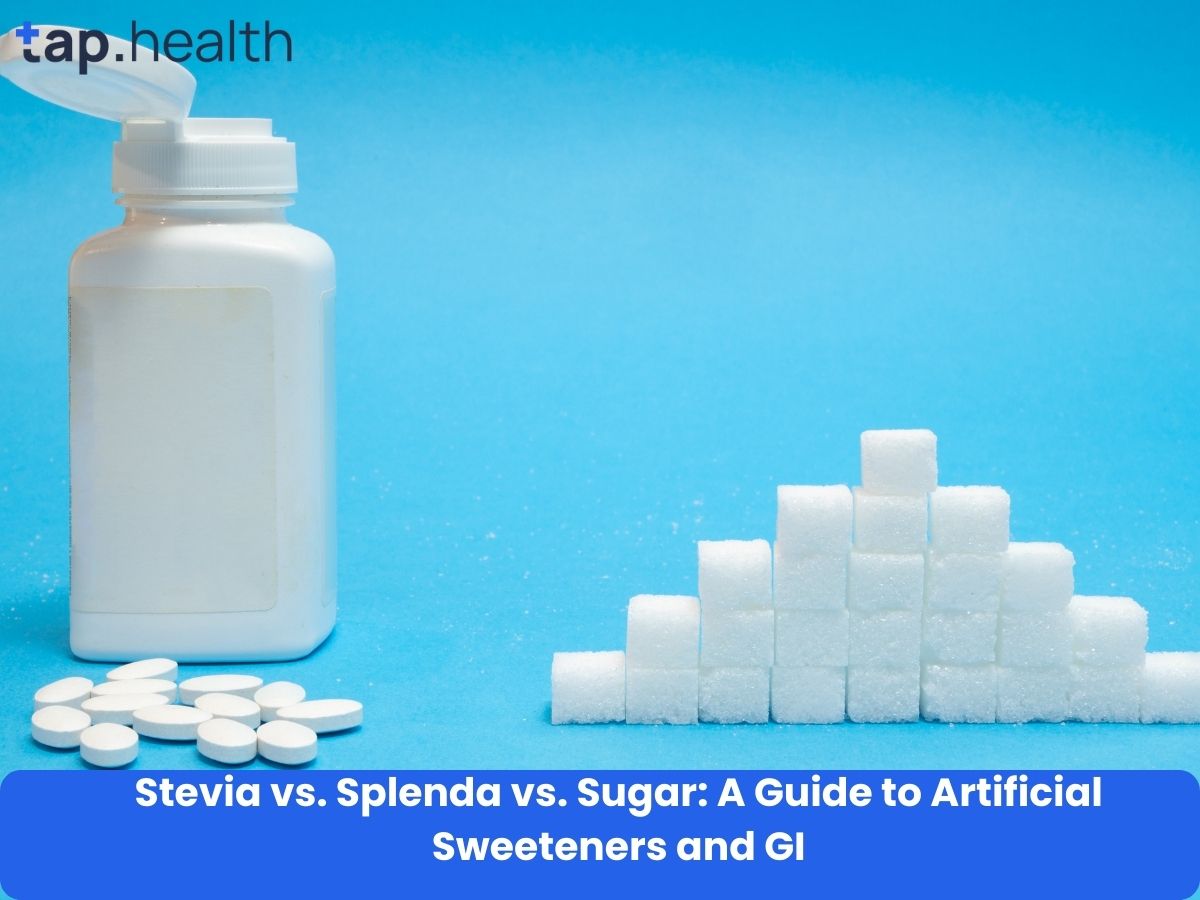
In this comprehensive guide, we are going to break down the battle of Stevia vs. Splenda vs. Sugar. We will analyze their Glycemic Index (GI), look at their safety profiles, and help you decide exactly what should go into your morning chai.
The Contenders: Nature, Science, and Tradition
Before we look at blood sugar, let’s understand what these white powders actually are.
1. Sugar (The Traditional Enemy)
- Scientific Name: Sucrose.
- Origin: Extracted from Sugarcane or Sugar Beets.
- Calorie Count: 1 teaspoon = 16 Calories.1
- The Issue: It provides “empty calories”—energy with zero nutrition.2 It spikes blood sugar and insulin rapidly.
2. Splenda (The Scientific Solution)
- Scientific Name: Sucralose.
- Origin: Made in a laboratory. It starts as sugar molecules, but scientists tweak the chemical structure so your body cannot digest it.
- Calorie Count: Zero.
- The Brand: “Splenda” is the most famous brand of sucralose.3 It is 600 times sweeter than sugar.
3. Stevia (The Herbal Hero)
- Scientific Name: Steviol Glycosides.
- Origin: Extracted from the leaves of the Stevia rebaudiana plant (Meethi Tulsi).4
- Calorie Count: Zero.
- The Difference: It is a “Natural” zero-calorie sweetener, unlike Splenda which is “Artificial.”5
Understanding Glycemic Index (GI)
To judge the winner, we use the Glycemic Index (GI).
Think of GI as a speedometer for your blood sugar. It measures how fast a food converts into glucose and hits your bloodstream on a scale of 0 to 100.
- Low GI (0-55): Digests slowly. Safe.
- Medium GI (56-69): Moderate rise.
- High GI (70+): Dangerous spike.
1. The Glycemic Index of Sugar
We start with the baseline.
The Glycemic Index of Table Sugar is roughly 65.
This places it in the Medium category.
However, this number is misleading. Because sugar has zero fiber and zero protein, the Glycemic Load is huge. Even a small amount sends a signal to your pancreas to dump insulin into your blood. Over time, this constant demand leads to Insulin Resistance and Type 2 Diabetes.
2. The Glycemic Index of Splenda (Sucralose)
Now, the yellow packet.
The Glycemic Index of Splenda is 0.
Yes, Zero.
Because your body does not recognize sucralose as a carbohydrate, it passes right through you without being broken down for energy.6 It does not raise blood sugar levels directly.
The “Filler” Trap:
Pure sucralose is so powerful that you only need a microscopic dust speck to sweeten a cup of tea. To make it usable (spoonable), manufacturers mix it with fillers like Maltodextrin or Dextrose.
- Maltodextrin has a High GI.7
- So, while Sucralose is GI 0, the powder in the packet might have a tiny glycemic impact. However, since you use such a small amount, the effect on blood sugar is usually negligible.
3. The Glycemic Index of Stevia
Finally, the green leaf.
The Glycemic Index of Stevia is 0.
Just like Splenda, Stevia has no impact on blood sugar.8 It is non-nutritive. The sweet compounds (glycosides) stimulate the sweet receptors on your tongue but are not metabolized as sugar in your stomach.
The Verdict: Both Splenda and Stevia are mathematically superior to Sugar for blood glucose control. But numbers aren’t everything.
The Taste Test: The Bitter Truth
If both are Zero GI, why don’t we all use them? The answer is Taste.
Sugar:
- Taste: Clean, pure sweetness. It adds “body” and mouthfeel to tea/coffee.
- Aftertaste: None.
Splenda (Sucralose):
- Taste: Very close to sugar. It is often considered the best-tasting artificial sweetener.
- Aftertaste: Very mild, sometimes slightly chemical, but mostly unnoticeable in coffee.
- Usage: It is heat stable. You can bake cakes or make Gajar ka Halwa with it (Sucralose variants designed for baking).
Stevia:
- Taste: Sweet, but with a catch.
- Aftertaste: Distinctly Bitter or metallic (like licorice/mulethi).
- Usage: Many people find it ruins the taste of Indian Chai because the bitterness clashes with the tea tannins. It works better in smoothies or lemon water.
The Safety Debate: Natural vs. Artificial
This is where the battle heats up.
The Case Against Splenda (Gut Health)
Splenda is safe according to the FDA and FSSAI.9 However, emerging research suggests a hidden downside.
- Microbiome: Some studies indicate that artificial sweeteners like Sucralose might reduce the number of good bacteria in your gut.10 A poor gut microbiome can ironically lead to weight gain and inflammation.11+1
- Heat Stability: While stable, heating sucralose to very high temperatures (like deep frying) can potentially create harmful compounds. Baking is generally considered safe.
The Case For Stevia (The Natural Advantage)
Stevia wins the safety perception battle because it comes from a leaf.12
- No Gut Damage: Current research suggests Stevia does not harm gut bacteria.13
- Blood Pressure: Some studies suggest Stevia might even help lower high blood pressure slightly.14
- The “Natural” Tag: For those who hate the idea of putting “chemicals” in their body, Stevia is the clear psychological winner.
The “Cephalic Phase” Insulin Response
Here is a scientific plot twist. Can a sweetener spike insulin without sugar?
The Theory:
When you taste something sweet (even Stevia or Splenda), your brain thinks sugar is coming. It tells the pancreas: “Get ready! Sugar is here!”
The pancreas releases a small amount of insulin. This is called the Cephalic Phase Insulin Release.
If no actual sugar arrives (because it was zero-calorie Stevia), the insulin has nothing to work on. This might lead to increased hunger or cravings later.
The Reality:
While this happens in studies, for most diabetics, the benefit of avoiding actual sugar far outweighs this minor theoretical risk.
Comparison Table: The Ultimate Sweetener Cheat Sheet
| Feature | Sugar | Splenda (Sucralose) | Stevia |
| Origin | Natural (Plant) | Artificial (Lab) | Natural (Plant) |
| Glycemic Index | ~65 (Medium) | 0 (None) | 0 (None) |
| Calories | 16 per tsp | 0 | 0 |
| Taste Profile | Perfect | Excellent (Close to sugar) | Slight Bitter Aftertaste |
| Gut Health | Feeds bad bacteria | May harm good bacteria | Neutral / Safe |
| Best For | Occasional Treats | Baking / Coffee | Smoothies / Health Drinks |
Real-Life Scenario
Let’s meet Mr. Verma, a 48-year-old accountant from Delhi.
The Context:
Mr. Verma loves his Masala Chai. He drinks 4 cups a day. Each cup had 2 spoons of sugar. That’s 8 spoons (128 calories) of just sugar daily. His HbA1c was 8.1%.
The Switch (Phase 1):
He tried Stevia. He hated it. “It makes my chai taste like medicine,” he complained. He went back to sugar.
The Switch (Phase 2):
His doctor suggested Splenda (Sucralose).
- The Taste: He found it 95% similar to sugar. He switched successfully.
- The Result: He cut 128 empty calories from his day. Over 3 months, he lost 2 kgs and his sugar levels stabilized.
The Lesson:
The “healthiest” sweetener is the one you will actually use. If Stevia tastes too bad to use, it helps no one.
Expert Contribution
We consulted medical experts to get the professional stance.
Dr. J. Singh, Diabetologist:
“I categorize sweeteners into three tiers. Tier 1 is Stevia (safest). Tier 2 is Sucralose/Splenda (safe and tasty). Tier 3 is Sugar (avoid). If a patient can tolerate the taste of Stevia, that is my first choice. If not, Sucralose is a perfectly acceptable tool to get off sugar. The danger of high blood sugar is far greater than the theoretical risks of artificial sweeteners.”
Nutritionist Perspective:
“Be careful with ‘Sugar-Free’ mithai. Just because it uses Stevia or Splenda doesn’t mean it’s calorie-free. The khoya, ghee, and flour still have calories.15 A sugar-free ladoo can still spike your sugar if you eat four of them.”
Recommendations Grounded in Proven Research and Facts
Based on data from the FDA and American Diabetes Association, here are actionable tips:
- For Tea/Coffee Lovers:Try Sucralose (Splenda) first if you are picky about taste. It blends best with hot beverages. If you can handle the herbal taste, Stevia is healthier for your gut.
- For Baking:Use Sucralose blends designed for baking. Stevia doesn’t caramelize or provide the bulk that sugar does, often leading to flat, dry cakes.16
- For Cold Drinks:Stevia works wonderfully in Lemonade (Nimbu Pani), Iced Tea, or Smoothies.17 The acidity of lemon masks the bitter aftertaste of Stevia perfectly.
- The “Blend” Trick:Use 50% Sugar and 50% Stevia. This cuts your sugar intake by half but keeps the taste authentic. It is a great way to wean yourself off sugar slowly.
Key Takeaways
- Sugar has a significant glycemic impact and adds empty calories. Diabetics should minimize it.
- Stevia is the “Holistic Winner.” It is natural, Zero GI, and gut-safe, but it has a bitter aftertaste.
- Splenda (Sucralose) is the “Taste Winner.” It tastes like sugar and is Zero GI, but some concerns exist about gut health with heavy use.
- Zero GI ≠ Free Food: Both sweeteners are tools to reduce sugar, not magic wands.18
- Personal Choice: Use the one that helps you stay compliant with your diet.
Conclusion
So, Stevia vs. Splenda vs. Sugar: Which one wins?
If you prioritize Health and Nature, Stevia takes the crown. It is a plant-based, zero-calorie miracle, provided you can learn to love its unique taste.
If you prioritize Taste and Convenience, Splenda is the champion. It is the easiest way for a sugar-lover to transition to a sugar-free life without misery.
Sugar is the nostalgic friend who is bad for you. It’s okay to visit him on birthdays and festivals, but don’t let him move into your house permanently.
Frequently Asked Questions (FAQ)
Is Stevia safe for kidneys?
Yes. Current research indicates that Stevia is safe for people with kidney disease and does not cause kidney damage. In fact, by helping control blood sugar and blood pressure, it may indirectly protect kidney health.
Does Splenda cause weight gain?
Indirectly, it might. While Splenda has zero calories, some studies suggest that artificial sweeteners can increase cravings for sweet food, leading people to overeat other things. However, if used strictly as a sugar replacement without increasing other food intake, it aids weight loss.
Can I cook with Stevia?
Yes, but it’s tricky. Stevia is heat stable, but it doesn’t caramelize or add volume like sugar.19 Cakes made with Stevia can turn out dense.20 It works best in puddings, kheer, or sauces where texture isn’t dependent on sugar.+1
Is brown sugar better than white sugar?
No. This is a major myth. Brown sugar is simply white sugar with some molasses added.21 It has the same calorie count and almost the same Glycemic Index as white sugar. For a diabetic, brown sugar is just as dangerous as white sugar.
What is “Monk Fruit” sweetener?
Monk Fruit is a newer natural sweetener similar to Stevia.22 It has zero calories and zero GI but lacks the bitter aftertaste of Stevia. It is gaining popularity but is currently more expensive and harder to find in India than Stevia.
Is honey better than sugar?
Slightly. Honey has a slightly lower GI (around 58) and contains trace minerals.23 However, it is still 80% sugar. For a diabetic, honey will still spike blood sugar significantly and should be treated almost like regular sugar.
References:
- American Diabetes Association: Artificial Sweeteners. Link
- Food Safety and Standards Authority of India (FSSAI): Approved Sweeteners. Link
- Harvard Health: Artificial Sweeteners – sugar-free, but at what cost? Link
- PubMed: Effects of Stevia on Blood Pressure. Link
- Mayo Clinic: Artificial sweeteners and other sugar substitutes. Link
(Disclaimer: This content is for educational purposes only. Always consult your doctor or a certified dietitian before making significant changes to your diet, especially if you have diabetes or are pregnant.)