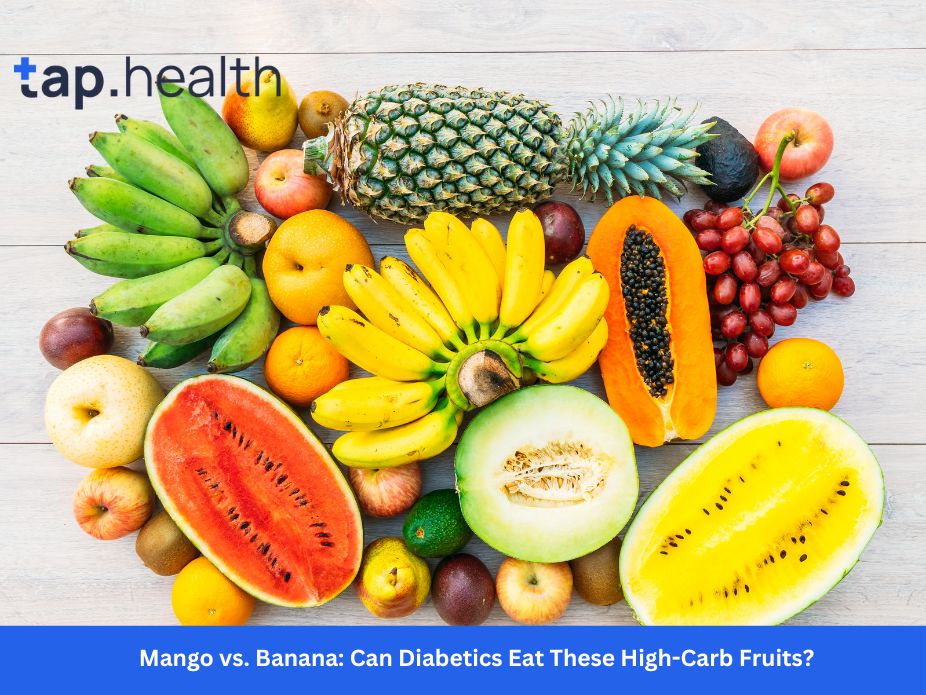
In India, fruit is not just food; it is an emotion.
The arrival of summer means one thing: Mangoes. The smell of Alphonso, Dasheri, or Langra fills the markets, and resisting them feels like a punishment. On the other hand, the Banana is the common man’s superfood. It is cheap, available 365 days a year, and is the go-to snack for instant energy.
But for the millions of Indians living with diabetes, these two fruits are often labeled “Forbidden.”
Family doctors usually have a standard script: “Cut down on rice, stop sugar, and don’t touch mangoes or bananas.”
It is heartbreaking. But is it scientifically accurate? Are these fruits really “sugar bombs” that will explode your glucose levels, or are they misunderstood nutrient powerhouses?
In this comprehensive guide, we are going to peel back the myths. We will analyze the Mango vs. Banana Glycemic Index, look at how ripeness changes everything, and answer the burning question: Can a diabetic actually enjoy the King of Fruits?
The Contenders: The King vs. The Staple
Before we look at the sugar, let’s look at the profile of these heavyweights.
1. The Mango (King of Fruits)
- Taste: Intensely sweet, floral, and rich.
- Sugar Type: High in Fructose (fruit sugar).
- Season: Summer (April to July).
- Reputation: The “Villain” for diabetics.
2. The Banana (The Instant Energy)
- Taste: Creamy and sweet.
- Sugar Type: Glucose and Fructose.
- Season: All year round.
- Reputation: High carb, high calorie.
Understanding Glycemic Index (GI)
To judge if they are safe, we use the Glycemic Index (GI).
Think of GI as a speedometer for your blood sugar. It measures how fast a food converts into glucose and hits your bloodstream on a scale of 0 to 100.
- Low GI (0-55): Digests slowly. Safe.
- Medium GI (56-69): Moderate rise. Be careful.
- High GI (70+): Digests instantly. Dangerous spike.
Our goal is to stay in the Low to Medium range.
1. Mango Glycemic Index: The Surprise Reveal
Here is the fact that shocks most people.
The Glycemic Index of a Ripe Mango is approximately 51 to 56.
Wait. That places Mango in the Low to Medium GI category.
“If it’s Low GI, why is it forbidden?”
The problem isn’t the speed (GI); it’s the amount (Glycemic Load).
- Density: Mango is dense. A single large mango can have 40-50g of carbohydrates. That is equal to 3 chapattis!
- The Binge Factor: Nobody eats just one slice. We tend to suck the guthli (seed) dry and eat the whole fruit.
The Verdict: The GI is safe, but the portion size is usually dangerous. If you eat one slice, you are fine. If you eat one kilo, you are in trouble.
2. Banana Glycemic Index: The Chameleon
Bananas are tricky because they change their chemical structure every day they sit on your counter.
The Glycemic Index of Banana depends entirely on its COLOUR.
- Green (Unripe): GI is ~42 (Low). Full of Resistant Starch (acts like fiber). Excellent for diabetics.
- Yellow (Ripe): GI is ~51 (Low/Medium). Starch has turned to sugar. Safe in moderation.
- Brown Spots (Overripe): GI is ~62+ (Medium/High). The starch is almost 100% sugar. Avoid.
The Verdict: A firm, yellow banana is fine. A mushy, brown-spotted banana is a sugar spike waiting to happen.
Head-to-Head Comparison
Let’s put them side-by-side.
| Feature | Mango (Ripe) | Banana (Yellow) | Banana (Overripe) |
| Glycemic Index | ~51-56 (Low/Med) | ~51 (Low) | ~62+ (Med/High) |
| Carbs (per 100g) | ~15g | ~23g | ~23g |
| Fiber | ~1.6g | ~2.6g | ~2g |
| Calories | ~60 cal | ~89 cal | ~89 cal |
| Key Nutrient | Vitamin A & C | Potassium | Potassium |
The Analysis:
- Carbs: Banana is actually denser in carbs than Mango. (23g vs 15g).
- GI: Both are surprisingly similar when perfectly ripe.
- Calories: Mango has fewer calories gram-for-gram than Banana.
The Ripeness Factor: When Healthy Turns Unhealthy
This is the most critical concept for diabetics. Fruits are living things. Even after plucking, they continue to ripen.
- In Bananas: As the skin turns brown, the starch breaks down into simple glucose and fructose. An overripe banana enters your bloodstream almost as fast as juice.
- In Mangoes: A very soft, squishy mango is far higher in free sugars than a firm, just-ripe mango.
Rule of Thumb: Eat fruit that requires chewing. If it melts in your mouth (like mushy banana or mango pulp), the GI is likely higher.
Why You Should NOT Avoid Them Completely
If you ban these fruits, you miss out on critical medicines provided by nature.
Why Eat Mango?
- Mangiferin: A powerful antioxidant found in mangoes that actually lowers inflammation and protects the heart.
- Vitamin A: Crucial for eye health, which diabetics need to protect.
Why Eat Banana?
- Potassium: Essential for blood pressure control. Most diabetics also suffer from hypertension. Banana is nature’s BP medicine.
- Fiber: A medium banana has 3g of fiber, which aids digestion.
Real-Life Scenario
Let’s meet Mr. Sharma, a 65-year-old from Mumbai.
The Temptation:
It was May. Mr. Sharma’s sugar (HbA1c) was 7.2%. He loved Aamras (Mango pulp). He would eat a bowl of Aamras with Poori for lunch. His post-lunch sugar would skyrocket to 250 mg/dL.
The Adjustment:
His doctor didn’t ban mangoes. He changed the Timing and Method.
- No Aamras: Juicing/pulping breaks the fiber. He was allowed only sliced mango.
- No Dessert: He couldn’t eat it after lunch. He had to eat it as a Mid-Morning Snack (11 AM).
- The Companion: He had to eat 5 soaked almonds before the mango.
The Result:
Mr. Sharma enjoyed one slice of Alphonso every alternate day. His sugar remained stable at 150 mg/dL. The almonds provided protein/fat to slow down the sugar absorption.
Expert Contribution
We consulted medical experts to get the professional stance.
Dr. P. Tandon, Diabetologist:“I tell my patients: You are not forbidden from eating fruit. You are forbidden from eating EXCESS fruit. A banana is fine, but pick the small ‘Elaichi’ banana, not the giant Robusta ones. Mango is fine, but treat it like a carb. If you eat a mango, skip one chapatti.”
Nutritionist Perspective:“Never eat these high-carb fruits on an empty stomach first thing in the morning, and never late at night. The body’s insulin sensitivity is best during the day. Eat them as a snack between breakfast and lunch, paired with walnuts or seeds.”
Recommendations Grounded in Proven Research and Facts
Based on data from the American Diabetes Association and National Institute of Nutrition (NIN), here are actionable tips:
- Portion Control:
- Mango: 1/2 cup (sliced) or 1 slice of the “cheek.”
- Banana: 1 small banana or half a large banana.
- The “Green” Banana Trick:Try eating slightly green bananas. They contain Resistant Starch, which functions like fiber and feeds your gut bacteria without spiking sugar.
- Pairing is Key:Never eat “naked carbs.”
- Eat Mango with a handful of walnuts.
- Eat Banana with a spoon of peanut butter.The fat and protein act as a speed-breaker for the sugar.
- Avoid the Juice:Never drink Mango Shake or Banana Smoothie. The blender destroys the fiber, turning the fruit into a high-GI liquid sugar bomb.
Key Takeaways
- Mango (GI ~51) and Banana (GI ~51) are technically Low/Medium GI fruits.
- Ripeness Matters: Overripe (brown) bananas and squishy mangoes have higher sugar spikes. Eat them firm.
- Quantity is the Killer: The problem isn’t the fruit; it’s eating too much of it.
- Nutrients: Both provide essential Potassium and Vitamins that diabetics need.
- Strategy: Eat them as snacks, not desserts. Always pair with nuts/seeds.
Conclusion
So, Mango vs. Banana: Can Diabetics Eat Them?
Yes.
You do not have to live a life deprived of nature’s sweetness. Both fruits are safe if you respect the rules of Portion, Ripeness, and Pairing.
A slice of firm Mango in the summer or a small yellow Banana before a walk can actually be part of a healthy diabetic diet. The danger lies in the Aamras, the smoothies, and the dozen bananas sitting in the fruit bowl. Treat them as a special treat, not an all-you-can-eat buffet, and your blood sugar will remain happy.
Frequently Asked Questions (FAQ)
Which variety of banana is best for diabetics?
Small bananas (Elaichi/Yelakki) or Green bananas. The giant yellow (Robusta) bananas have a higher glycemic load simply because they are bigger. Green bananas are best because they contain resistant starch which does not spike blood sugar.
Can I eat mango at night?
Avoid it. Your body’s metabolism slows down at night, and insulin sensitivity drops. Eating high-carb fruits like mango post-dinner can lead to high fasting sugar levels the next morning. Eat it as a mid-morning snack instead.
Is papaya better than mango and banana?
Yes. Papaya has a Glycemic Index of roughly 60 (Medium), but its Glycemic Load is very low because it is mostly water. It contains very little carbohydrate per 100g compared to the dense banana or mango. It is a safer “volume” fruit.
Does soaking mangoes reduce sugar?
No. Soaking mangoes in water removes the “heat” (phytic acid) and sap, which helps digestion and prevents acne. It does not remove the sugar inside the fruit. You still need to practice portion control.
Can I eat banana if I have high potassium?
Consult your doctor. While bananas are good for blood pressure, if you have advanced Diabetic Kidney Disease (Nephropathy), your kidneys may struggle to filter potassium. In that specific case, you may need to limit high-potassium fruits like bananas.
How many mango slices can a diabetic eat?
A safe limit is typically one to two slices (approx. 70-80g) per day, provided your blood sugar levels are generally under control. It is best to check your sugar 2 hours after eating it to see how your specific body reacts.
Is frozen mango healthy?
Yes, if no sugar is added. Frozen mango is just mango. However, be careful with “Dried Mango” or “Aam Papad,” as these are concentrated sugar bombs and often have added preservatives. Stick to fresh or frozen.
References:
- American Diabetes Association: Fruit and Diabetes. Link
- Glycemic Index Foundation: Fruit GI Database. Link
- National Institute of Nutrition (NIN): Dietary Guidelines. Link
- Healthline: Can Diabetics Eat Bananas? Link
- Medical News Today: Mangoes and Diabetes. Link
(Disclaimer: This content is for educational purposes only. Always consult your doctor or a certified dietitian before making significant changes to your diet, especially if you have fluctuating blood sugar levels.)