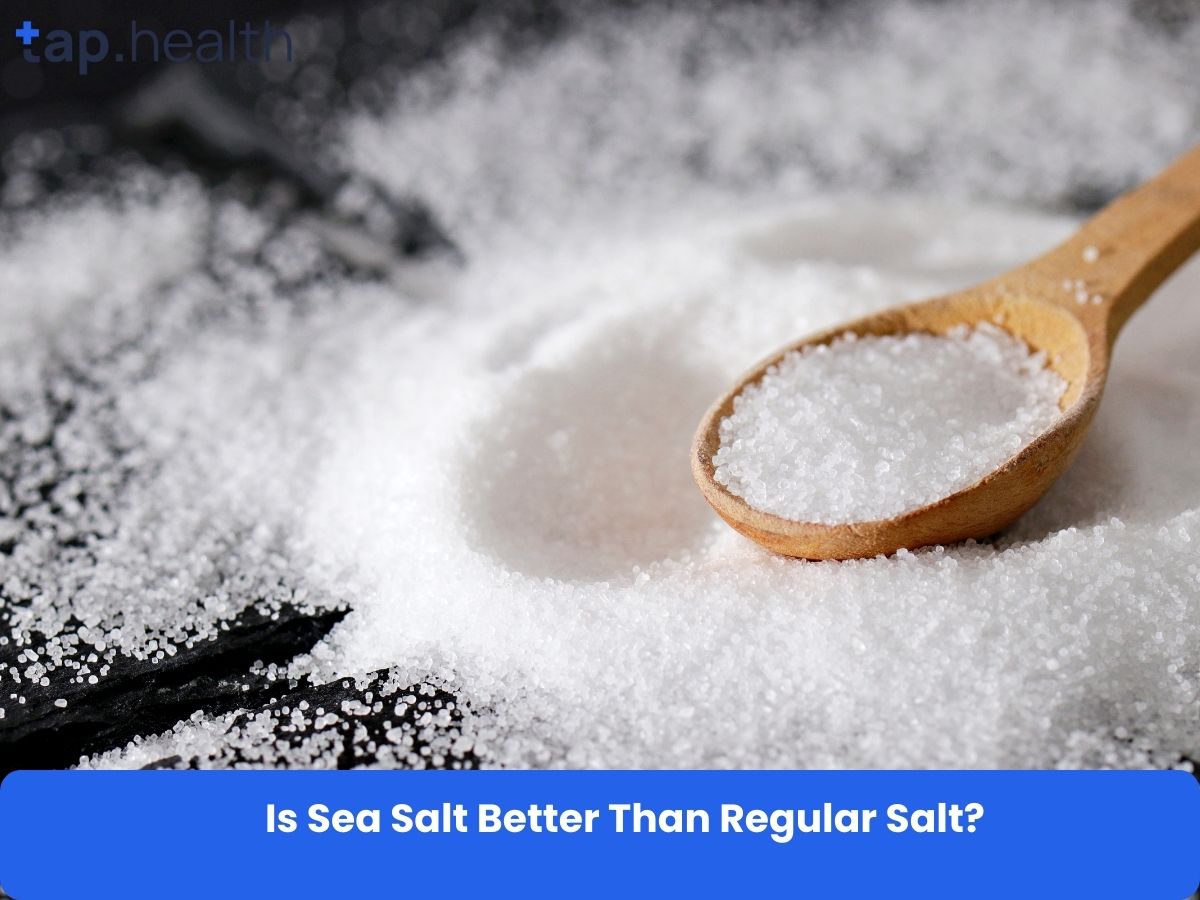
Walk into any modern Indian supermarket, and the salt aisle looks very different from how it did ten years ago. Gone are the days when you only saw the familiar packet of white Tata Salt. Now, you are greeted by jars of coarse sea salt, pink Himalayan salt, and fancy “gourmet” flakes.
You might have heard from a neighbour or a health influencer that switching to sea salt is the secret to lowering your blood pressure. Or maybe you have seen chefs on TV sprinkling coarse grains over a salad and wondered if you should be doing the same.
This leads to the big question: Is sea salt better than regular salt?
It is a question that confuses millions. Is the “natural” label on sea salt worth the extra price? Does it actually have less sodium? Or is it just a marketing gimmick?
In this detailed guide, written in simple Indian English, we will strip away the marketing hype and look at the raw science. We will compare the chemical makeup, health benefits, and risks of both salts so you can decide exactly what belongs in your kitchen cabinet.
What Actually Is Sea Salt?
To understand the difference, we first need to look at how these salts are born.
Sea salt is made by evaporating ocean water or water from saltwater lakes. It is produced with very little processing.
- The Process: The sun and wind evaporate the water, leaving behind the minerals.
- The Look: Because it is less processed, it retains trace minerals like magnesium, calcium, and potassium. These minerals give sea salt its coarser texture and sometimes a slightly greyish colour.
- The Taste: Many chefs prefer it because it has a “brighter” or more distinct flavour due to these impurities.
What Is Regular Salt (Table Salt)?
Regular salt, or table salt, is typically mined from underground salt deposits (which are basically ancient, dried-up oceans).
- The Process: It goes through a heavy refining process to remove minerals and impurities.
- The Additives: Anti-caking agents are added to prevent it from clumping in humid Indian weather.
- The Big Plus: Most importantly, in countries like India, regular salt is fortified with Iodine. This was a public health move started decades ago to prevent thyroid problems (goiter).
Is Sea Salt Better Than Regular Salt? The Core Comparison
Now, let’s tackle the main keyword head-on. Is one actually “better” for your health? To answer this, we need to compare them on three fronts: Sodium, Minerals, and Health Impact.
1. The Sodium Myth
This is the biggest misconception people have.
- The Myth: “Sea salt has less sodium, so I can eat more of it.”
- The Fact: Both sea salt and regular salt are primarily Sodium Chloride. By weight, they both contain roughly 40% sodium.
- The Confusion: The only reason people think sea salt has less sodium is the crystal size. Because sea salt crystals are larger and jagged, fewer of them fit on a teaspoon compared to fine table salt. So, a teaspoon of sea salt does weigh less than a teaspoon of table salt. But if you sprinkle the same amount (by weight), the sodium impact on your blood pressure is exactly the same.
2. The Mineral Content
Sea salt fans often boast about the trace minerals like magnesium and potassium.
- The Reality: While sea salt does have these minerals, they exist in tiny, trace amounts.
- The Math: You would have to eat dangerous amounts of sea salt (which would destroy your kidneys) just to get a meaningful amount of magnesium. You are much better off getting these minerals from spinach, bananas, or dal.
3. The Iodine Issue (Crucial for India)
This is where regular salt often wins.
- The Risk: Sea salt naturally contains very little iodine.
- The Consequence: If you switch 100% to sea salt and do not eat enough seafood, you risk developing an iodine deficiency. This can lead to thyroid issues and goiter. Regular iodized salt is the primary source of iodine for most vegetarians in India.
Is Sea Salt Better Than Regular Salt for High Blood Pressure?
This is perhaps the most searched query on the topic. If you suffer from hypertension (high BP), you are likely looking for any way to lower your numbers.
The Answer: No, sea salt is not better for high blood pressure.
Sodium is the enemy of blood pressure because it holds water in your bloodstream, increasing the volume and pressure against your vessel walls.
- Chemistry doesn’t lie: Since sea salt is still sodium chloride, it raises your blood pressure just as much as regular salt does.
- The Danger: The danger lies in the “Health Halo.” If you believe sea salt is safer, you might accidentally use more of it, which could actually spike your BP higher than before.
Sea Salt vs. Himalayan Salt vs. Regular Salt
Let’s quickly compare the three giants in the salt world.
| Feature | Regular (Table) Salt | Sea Salt | Himalayan Pink Salt |
| Source | Mined & Refined | Evaporated Seawater | Mined in Pakistan |
| Sodium Content | ~40% | ~40% | ~40% |
| Texture | Fine, uniform | Coarse, crunchy | Coarse or fine |
| Iodine | Added (Fortified) | Trace (Natural) | Trace (Natural) |
| Best Use | Baking, daily cooking | Finishing salads/steaks | Finishing, aesthetics |
Is Sea Salt Better Than Regular Salt for Cooking?
While the health differences are negligible, the culinary differences are huge. This is where sea salt shines.
1. Texture and Crunch
If you are sprinkling salt on top of a salad, a grilled piece of paneer, or a slice of watermelon, sea salt is superior.
- Why: The large crystals don’t dissolve instantly. They provide a pleasant “crunch” and a burst of salty flavour that hits your tongue in spots. This can actually help you use less salt because the flavour is more concentrated on the surface.
2. Dissolving in Curries
If you are making a pot of sambar or dal, it does not matter which salt you use. Once the salt dissolves in the liquid, the texture disappears, and the flavour difference is undetectable. Using expensive sea salt in boiling pasta water is essentially pouring money down the drain.
Is Sea Salt Better Than Regular Salt for Diabetics?
People with diabetes often have to worry about their heart and kidney health.
- The Verdict: Sea salt offers no specific advantage for diabetics over regular salt.
- The Reason: The primary concern for diabetics regarding salt is kidney strain and blood pressure. Since the sodium content is identical, both salts pose the same risk if consumed in excess.
- The Recommendation: For diabetics, the goal is not to switch the type of salt, but to reduce the amount of salt.
Potential Downsides of Sea Salt
It is not all sunshine and ocean breezes. There is a modern concern with sea salt: Pollution.
Microplastics
Our oceans are becoming polluted with plastic waste. Recent studies have found traces of microplastics in sea salt brands derived from ocean water. While the health impact of this is still being studied, it is a factor that makes mined salt (which comes from ancient underground deposits protected from modern pollution) seem cleaner to some experts.
Real-Life Scenario
Let’s look at a relatable story to make this clear.
Meet Anjali (42, Home Baker):
Anjali was diagnosed with mild hypertension. She read online that “natural” foods are better, so she threw away her Tata Salt and bought an expensive bag of coarse Sea Salt. She started using it generously in her cooking, thinking it was “heart-healthy.”
The Result: Two months later, her blood pressure hadn’t budged. In fact, it was slightly higher.
The Mistake: Because the crystals were large, she was finding it hard to measure. A “pinch” of sea salt was actually delivering inconsistent amounts of sodium.
The Correction: Her dietician explained that sodium is sodium. Anjali went back to using moderate amounts of iodized salt for cooking and saved the sea salt just for sprinkling on top of her salads.
Read this: Is Sea Salt Good for Diabetics?
Expert Contribution
We consulted Dr. S. Mehta, a General Physician and Nutritionist, to weigh in on the debate.
“I see patients every day who switch to sea salt or pink salt expecting their blood pressure to drop. I have to burst that bubble. Salt is salt. The body does not distinguish between sodium from the Himalayas or sodium from a factory. The real health upgrade comes from reducing your total intake to under one teaspoon a day—not from changing the brand. Also, please do not stop iodized salt completely; we are seeing a comeback of thyroid issues in people who switch exclusively to ‘gourmet’ salts.”
Recommendations Grounded in Proven Research and Facts
According to the American Heart Association (AHA) and the Mayo Clinic:
- The Sodium Limit: The limit for healthy adults is 2,300 mg of sodium per day (about 1 teaspoon of salt). For those with high blood pressure, the ideal limit is 1,500 mg. This applies to all types of salt.
- Iodine is Essential: The World Health Organization (WHO) strongly recommends iodized salt in regions where soil iodine is low (like much of India) to prevent brain damage in foetuses and goiter in adults.
- Taste Bud Adaptation: Research shows it takes about 21 days for your taste buds to adjust to lower salt. If you cut back gradually, you won’t even miss it.
Key Takeaways
- Sodium is the Same: By weight, sea salt and regular salt have roughly the same sodium content.
- No BP Benefit: Sea salt does not lower blood pressure any better than table salt.
- Texture Matters: Sea salt is great for a crunchy “finishing” touch; table salt is better for baking and measuring.
- Watch the Iodine: Regular salt protects your thyroid. If you use sea salt, ensure you eat other iodine-rich foods (like dairy or seafood).
- Microplastics: Sea salt may contain trace microplastics from ocean pollution.
FAQ: Frequently Asked Questions
Is sea salt better than regular salt for high blood pressure?
No. Sea salt contains roughly the same amount of sodium as regular salt. Sodium is the main driver of high blood pressure. Switching to sea salt will not lower your BP; only reducing the total amount of salt you eat will help.
Is sea salt better than regular salt for cooking?
It depends on how you are cooking. For general cooking (like curries, soups, or baking), regular salt is better because it dissolves easily and measures accurately. Sea salt is better as a “finishing salt” sprinkled on top of food just before serving for texture and a burst of flavour.
Is sea salt better than regular salt for diabetics?
No. Diabetics need to be careful with their kidneys and heart health, which means watching sodium intake. Sea salt offers no special benefits for blood sugar or insulin sensitivity. The advice remains the same: consume less salt overall.
What are the disadvantages of sea salt?
The main disadvantages are the lack of iodine (which can lead to thyroid issues if it’s your only salt source), the higher cost, and the potential presence of microplastics from ocean pollution.
Is sea salt better than regular salt for mouth rinse?
Yes, slightly. Many dentists recommend warm salt water rinses for gum healing. Sea salt is often preferred here because it lacks the anti-caking additives and iodine found in table salt, which can sometimes irritate very sensitive open wounds in the mouth. However, regular salt works perfectly fine for most people.
Which salt is the healthiest?
The “healthiest” salt is simply the one used in moderation. However, if we look at public health needs in India, Iodized Table Salt is often considered the most essential to prevent thyroid disease. If you want lower sodium, a Potassium-Enriched Salt (Low Sodium Salt) is the only type that actually lowers BP risks (but check with a doctor first).
Sea salt vs Himalayan salt: Which is better?
Both are chemically very similar (mostly sodium chloride) and lack sufficient iodine. Himalayan salt is mined from the earth and is generally free of microplastics, whereas sea salt comes from modern oceans. Himalayan salt also has a pink colour due to iron oxide. Neither is significantly “healthier,” but Himalayan salt is often considered purer due to the lack of ocean pollution.
Is table salt bad for you?
Table salt is not “bad” for you; it is an essential nutrient. The problem is the quantity. We need a small amount of sodium for our nerves and muscles to work. Table salt only becomes bad when we eat too much of it, leading to heart and kidney strain. The additives in table salt are generally safe and consumed in tiny amounts.
References
- Mayo Clinic: Sea salt vs. table salt: What’s the difference?
- American Heart Association: Sea Salt vs. Table Salt
Disclaimer: This content is for educational purposes only. If you have specific health conditions like hypertension or thyroid issues, please consult your doctor or dietician before making major changes to your diet.