Imagine your body is a high-performance car. For this car to move, it needs fuel (petrol). In your body, that fuel is glucose (sugar). But simply pouring petrol over the car won’t make it move; the fuel needs to be carefully pumped into the engine to be burned for energy.
In this scenario, the Pancreas is the fuel pump.
When you have Diabetes Mellitus, it means this fuel system is broken. Either the pump has stopped working entirely, or the engine is refusing to accept the fuel. This breakdown leads to high blood sugar, leaving you tired and your body’s “engine” struggling to run.
Many patients ask: “Is my pancreas dead?” “Did I break it by eating too many sweets?” “Can it ever recover?”
Understanding the relationship between Diabetes Mellitus and the pancreas is the first step to taking control of your health. It is not just about high sugar numbers; it is about an overworked organ crying for help.
We will open the hood of the human body. We will explain exactly how the pancreas “talks” to your blood using hormones, the difference between Type 1 and Type 2 pancreatic damage, and scientifically proven ways to support this hardworking organ.
What Is Diabetes Mellitus?
Before we dive into the organ, let’s define the disease. Diabetes Mellitus is a group of metabolic diseases characterized by high blood sugar (hyperglycaemia).
It happens because of a defect in:
- Insulin Secretion: The pancreas isn’t making enough insulin.
- Insulin Action: The body isn’t using insulin properly (resistance).
- Both: A combination of the two.
Whether you have Type 1, Type 2, or Gestational diabetes, the root of the problem always leads back to one organ: the Pancreas.
What Is the Pancreas and Its Role in Blood Sugar Control?
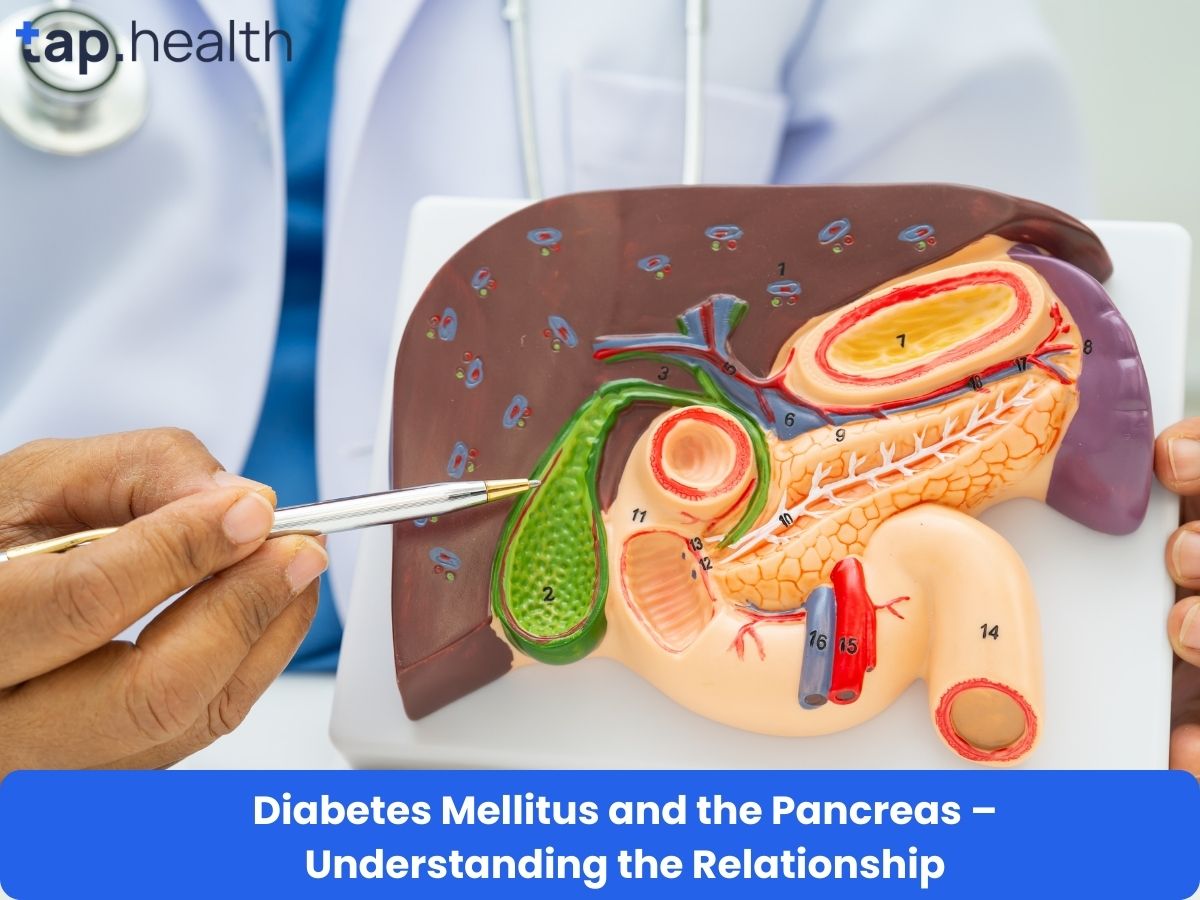
The pancreas is a long, flat gland, roughly 6 inches long, sitting tucked behind your stomach. It has a “dual personality” because it performs two very different jobs:
- Exocrine Function (Digestion): It creates powerful enzymes that travel to your gut to digest food. (Think of this as the digestion factory).
- Endocrine Function (Blood Sugar Control): It creates hormones that travel directly into your blood to manage energy. (Think of this as the sugar control room).
For diabetes, we are focused on the Endocrine job. Inside the pancreas, there are tiny clusters of cells called the Islets of Langerhans. These islands contain special cells that act like a thermostat, constantly sensing if your blood sugar is too high or too low.
Short Answer – How Is Diabetes Mellitus Related to the Pancreas?
Diabetes Mellitus is fundamentally a malfunction of the pancreas.
- In Type 1 Diabetes: The body’s immune system mistakenly attacks the pancreas, destroying the cells that make insulin. The “fuel pump” is broken.
- In Type 2 Diabetes: The pancreas works overtime to pump out extra insulin because the body is resisting it. Eventually, the pancreas gets exhausted and slows down. The “fuel pump” is overworked and burned out.
In both cases, the result is the same: Sugar stays in the blood instead of powering your cells.
Hormones Produced by the Pancreas
The pancreas controls your sugar using two main hormones. Think of them as the accelerator and the brake.
Insulin (The Key)
Produced by Beta Cells in the pancreas.
- Role: Lowers blood sugar.
- Action: When you eat Roti or Rice, sugar enters your blood. The pancreas releases Insulin. Insulin acts like a key, unlocking your cells so sugar can enter and be used for energy.
Glucagon (The Reserve)
Produced by Alpha Cells in the pancreas.
- Role: Raises blood sugar.
- Action: If you are fasting or sleeping and your sugar drops, the pancreas releases Glucagon. This tells your liver to release stored sugar into the blood, ensuring you don’t faint.
How the Pancreas Functions in a Healthy Person
In a healthy body, this system is a masterpiece of timing.
- The Trigger: You eat a meal. Digestion turns food into glucose.
- The Signal: Blood sugar rises. The pancreas detects this immediately.
- The Response: Beta cells release the precise amount of insulin needed.
- The Uptake: Cells open up, sugar enters, and blood levels drop back to normal.
- The Rest: Once levels are normal, the pancreas stops making insulin and rests.
It is a perfect feedback loop. But in Diabetes Mellitus, this loop gets broken.
What Happens to the Pancreas in Diabetes Mellitus
The damage to the pancreas looks very different depending on the type of diabetes.
Type 1 Diabetes Mellitus and Pancreatic Damage
This is an Autoimmune Disease.
- The Attack: The body’s immune system (which usually fights viruses) gets confused. It identifies the Beta cells in the pancreas as “enemies.”
- The Destruction: White blood cells attack and destroy these Beta cells entirely.
- The Result: The pancreas produces Zero Insulin. The “keys” to the cells are lost forever.
- Pancreas Status: Permanently damaged regarding insulin production.
Type 2 Diabetes Mellitus and Pancreatic Dysfunction
This is a metabolic disorder caused by Insulin Resistance.
- The Resistance: Your cells stop responding to insulin. The “locks” on the cells become rusty.
- The Overwork (Compensation): The pancreas notices that sugar isn’t entering the cells. It thinks, “Maybe I didn’t send enough insulin.” So, it works overtime, pumping out 2x or 3x the normal amount.
- The Burnout: You cannot run a car engine at max speed forever. Eventually, the Beta cells get exhausted and die off or malfunction.
- Pancreas Status: Struggling and tired, but usually not dead.
Gestational Diabetes and Pancreatic Stress
During pregnancy, the placenta produces hormones that cause insulin resistance.
- Usually, a healthy pancreas just makes extra insulin to handle this.
- In Gestational Diabetes, the mother’s pancreas cannot keep up with this extra demand, leading to high sugar.
Insulin Resistance vs Insulin Deficiency – Role of the Pancreas
It is crucial to understand the difference between these two terms:
| Condition | What it means | What the Pancreas is doing |
| Insulin Resistance | Cells ignore insulin. | Working Overtime. It is pumping out massive amounts of insulin (Hyperinsulinemia) to force sugar into cells. |
| Insulin Deficiency | Not enough insulin is made. | Failing/Slowing Down. The Beta cells are damaged or dead and cannot produce enough hormone. |
Type 2 Diabetes usually starts with Resistance and ends with Deficiency.
Does Diabetes Mellitus Damage the Pancreas Permanently?
This is the most common fear: “Is the damage permanent?”
- Type 1: Currently, yes. Since the immune system destroys the cells, the body cannot regrow them.
- Type 2:Not necessarily.
- In the early stages, the Beta cells are often just “stunned” or “asleep” due to the toxic environment of high fat and sugar (Glucotoxicity).
- If you remove the pressure (lose weight, lower sugar), these cells can “wake up” and start working again. This is the basis of Diabetes Remission.
Changes in the Pancreas Over Time in Diabetes Mellitus
Diabetes is not a static condition; it changes over time.
- Stage 1 (Pre-Diabetes): The pancreas is actually bigger or hyperactive. It is pumping excess insulin to fight resistance. Blood sugar is slightly high, but the pancreas is holding the fort.
- Stage 2 (Diagnosis): Approximately 50% of Beta cell function is already lost or dysfunctional by the time you are diagnosed. The pancreas can no longer keep up.
- Stage 3 (Long-term): If sugar remains high for years, the toxic sugar kills the remaining Beta cells. The pancreas shrinks in function, and the patient may need external insulin injections.
Can the Pancreas Recover or Improve in Diabetes Mellitus?
YES. This is the most hopeful part of modern research.
The famous DiRECT Trial (a major study from the UK) showed that Type 2 Diabetes is reversible in many people.
- The Culprit: They found that excess fat clogs the liver and spills over into the pancreas. This fat “suffocates” the Beta cells.
- The Cure: When patients lost significant weight (approx 10-15kg), the fat was removed from the pancreas.
- The Result: The Beta cells woke up! They started producing insulin normally again.
Note: This applies to Type 2. In Type 1, research is ongoing into islet cell transplants and stem cell therapy, but there is no natural “cure” yet.
Impact of Lifestyle and Diet on Pancreatic Function
You don’t need a transplant to help your pancreas; you need to change its environment.
- Stop “Whipping the Horse”: Eating high-sugar foods (sweets, maida, soda) forces your pancreas to release massive insulin spikes. This is like whipping a tired horse.
- Eat Low GI Foods: Whole grains, dals, and vegetables release sugar slowly. This gives your pancreas a gentle workload instead of a shock.
- Lose Belly Fat: Visceral fat (fat around the tummy) releases inflammatory chemicals that damage the pancreas. Losing inches off your waist directly helps the organ heal.
Medical Conditions Affecting the Pancreas and Diabetes Mellitus
Sometimes, diabetes is caused by direct physical damage to the organ. This is often called Type 3c Diabetes.
- Pancreatitis: Chronic inflammation (often from alcohol or gallstones) scars the tissue, destroying Beta cells.
- Pancreatic Cancer: A tumor can block enzymes or hormones, causing sudden diabetes in older adults.
- Cystic Fibrosis: Thick mucus blocks the pancreas, leading to scarring and insulin deficiency.
Read this: Can Cancer Cause Diabetes Symptoms?
When Pancreatic Function Should Be Evaluated
Doctors use a specific test called C-Peptide.
- When the pancreas makes Insulin, it also makes a byproduct called C-Peptide.
- High C-Peptide: Your pancreas is working hard (Insulin Resistance). You need lifestyle changes.
- Low C-Peptide: Your pancreas is failing (Type 1 or Advanced Type 2). You likely need insulin.
Real-Life Scenario
Meet Rahul (45, IT Manager from Bangalore):
Rahul was diagnosed with Type 2 Diabetes with an HbA1c of 9.2%. He was terrified his pancreas had “failed” and he would need insulin for life.
The Reality Check:
His doctor explained: “Rahul, your pancreas isn’t dead; it is suffocating in fat. It is tired.”
The Action Plan:
Rahul cut out sugar and lost 12kg over 4 months through diet and walking.
The Result:
His pancreas “woke up.” His HbA1c dropped to 6.0% without insulin injections. By removing the visceral fat, he allowed his Beta cells to function again. He is now in remission.
Expert Contribution
We consulted Dr. S. Chatterjee, Endocrinologist:
“Patients often ask for a ‘pancreas tonic.’ I tell them the best tonic is Rest.
In Type 2 Diabetes, your pancreas has been running a marathon every day for years to handle your diet. To heal it, you must give it metabolic rest. Intermittent fasting and a low-carb diet stop the constant demand for insulin, allowing the Beta cells to recover. Don’t look for a pill; look at your plate.”
Recommendations Grounded in Proven Research and Facts
According to the American Diabetes Association (ADA) and Newcastle University Research:
- The “Twin Cycle” Hypothesis: Type 2 diabetes is caused by excess fat in the liver spilling into the pancreas. Reversing this fat buildup reverses the diabetes in early stages.
- Beta Cell Rest: Early intensive insulin therapy for a few weeks right after diagnosis can sometimes “rest” the pancreas enough to preserve function for years.
- Avoid Alcohol: Heavy alcohol use causes pancreatitis, which is the fastest way to permanently destroy your pancreas.
Key Takeaways
- The Hub: The pancreas is the control center for blood sugar. Diabetes is essentially a pancreatic malfunction.
- The Difference: Type 1 is an attack (autoimmune); Type 2 is burnout (overwork/fat).
- Hope: In Type 2 diabetes, the pancreas is often “stunned,” not dead. Weight loss can restore function.
- Protection: Low-carb diets and weight loss protect your remaining Beta cells from dying.
Your pancreas is a resilient organ. Treat it kindly with good food and movement, and it will serve you for a lifetime.
Frequently Asked Questions (FAQs) on Diabetes Mellitus and the Pancreas
Can the pancreas heal itself from diabetes?
In Type 2 diabetes, Yes. Research shows that if you lose weight and reduce liver/pancreatic fat, beta cells can “re-differentiate” and start working again. This is called remission. In Type 1 diabetes, the damage is currently permanent, though stem cell research is promising.
What damages the pancreas in diabetes?
In Type 1, the immune system attacks it. In Type 2, two things damage it: Glucotoxicity (high sugar poisoning the cells) and Lipotoxicity (fat clogging the cells).
How do I know if my pancreas is working?
You cannot feel it. Doctors measure C-Peptide levels in the blood. This tells them exactly how much insulin your pancreas is still capable of producing on its own.
Does insulin injection mean my pancreas is dead?
No. Many Type 2 diabetics take insulin to give their pancreas a “break.” It doesn’t mean the organ is dead; it means it needs help to manage the load. This can sometimes preserve the remaining function for longer.
Which part of the pancreas is affected in diabetes mellitus?
The Islets of Langerhans are affected. Specifically, the Beta Cells within these islets are the ones that get destroyed (Type 1) or become dysfunctional (Type 2). The rest of the pancreas (which helps digestion) often continues to work normally.
References
- American Diabetes Association: Insulin and Glucagon Explained
- Mayo Clinic: Type 2 Diabetes Symptoms and Causes
- National Institutes of Health (NIH): Beta Cell Dysfunction
Disclaimer: This article is for informational purposes only and does not constitute medical advice. If you suspect issues with your blood sugar or pancreas, please consult an endocrinologist immediately.