You’ve been feeling a dull ache in your knees. Maybe it’s worse in the morning. Or it flares up when you walk, climb stairs, or stand for too long. You’ve tried rest, ice, and over-the-counter painkillers—but nothing seems to help.
Could the real problem be something deeper? Something you can’t see?
Here’s a surprising fact: Yes, vitamin D deficiency can cause knee pain.
That’s right—low levels of vitamin D, the “sunshine vitamin,” are strongly linked to joint pain, muscle weakness, and especially knee discomfort. And it’s more common than you think.
In this article, we’ll answer every question you might have about the link between vitamin D and knee pain. We’ll cover:
- How vitamin D affects your bones and joints
- Why low levels cause knee pain
- Who’s at risk
- How to know if you’re deficient
- What tests to ask your doctor for
- How much vitamin D you really need
- The best food and supplement sources
- How long it takes to feel better
All explained in simple, everyday language—no confusing medical terms.
Let’s get to the bottom of this.
What Is Vitamin D and Why Is It Important?
Vitamin D is a special nutrient your body needs to stay strong. Unlike other vitamins, your body can make it when your skin is exposed to sunlight.
It’s often called the “sunshine vitamin” for that reason.
But vitamin D does way more than just come from the sun. It plays a critical role in:
- Building and maintaining strong bones
- Helping your muscles work properly
- Supporting your immune system
- Reducing inflammation in the body
Without enough vitamin D, your bones can become weak, your muscles may feel tired, and your joints—especially your knees—can start to hurt.
How Does Vitamin D Affect Your Bones and Joints?
To understand why low vitamin D causes knee pain, you need to know how it works in your body.
Vitamin D Helps Your Body Absorb Calcium
Calcium is the main mineral that makes your bones strong. But your body can’t absorb calcium properly without vitamin D.
Think of vitamin D as a key. Calcium is the lock. Without the key, the lock doesn’t open.
So even if you drink milk or eat cheese every day, your bones won’t get the calcium they need if you’re low on vitamin D.
Weak Bones = Joint Stress
When your bones are weak, your joints have to work harder. Your knees, which carry most of your body weight, take the biggest hit.
Over time, this added stress can lead to:
- Knee pain
- Stiffness
- Swelling
- Difficulty walking or standing
It’s like driving a car with bald tires—the whole system suffers.
Can Low Vitamin D Cause Knee Pain?
Yes—absolutely.
Multiple studies and health experts confirm that vitamin D deficiency is a common cause of knee pain, especially in adults.
What the Research Says
- A study published in The Journal of Rheumatology found that people with low vitamin D levels were more likely to have knee pain and osteoarthritis.
- The National Institutes of Health (NIH) states that vitamin D deficiency can lead to bone pain and muscle weakness, often felt in the legs and knees.
- Doctors at the Mayo Clinic report that patients with unexplained joint pain often improve once their vitamin D levels are corrected.
So it’s not just a theory—it’s real, proven science.
Why Does Vitamin D Deficiency Hurt the Knees Specifically?
Your knees are weight-bearing joints. That means they carry your entire body weight every time you stand, walk, or run.
When vitamin D is low, your bones lose density and become softer. This condition is called osteomalacia in adults (or rickets in children).
How This Leads to Knee Pain
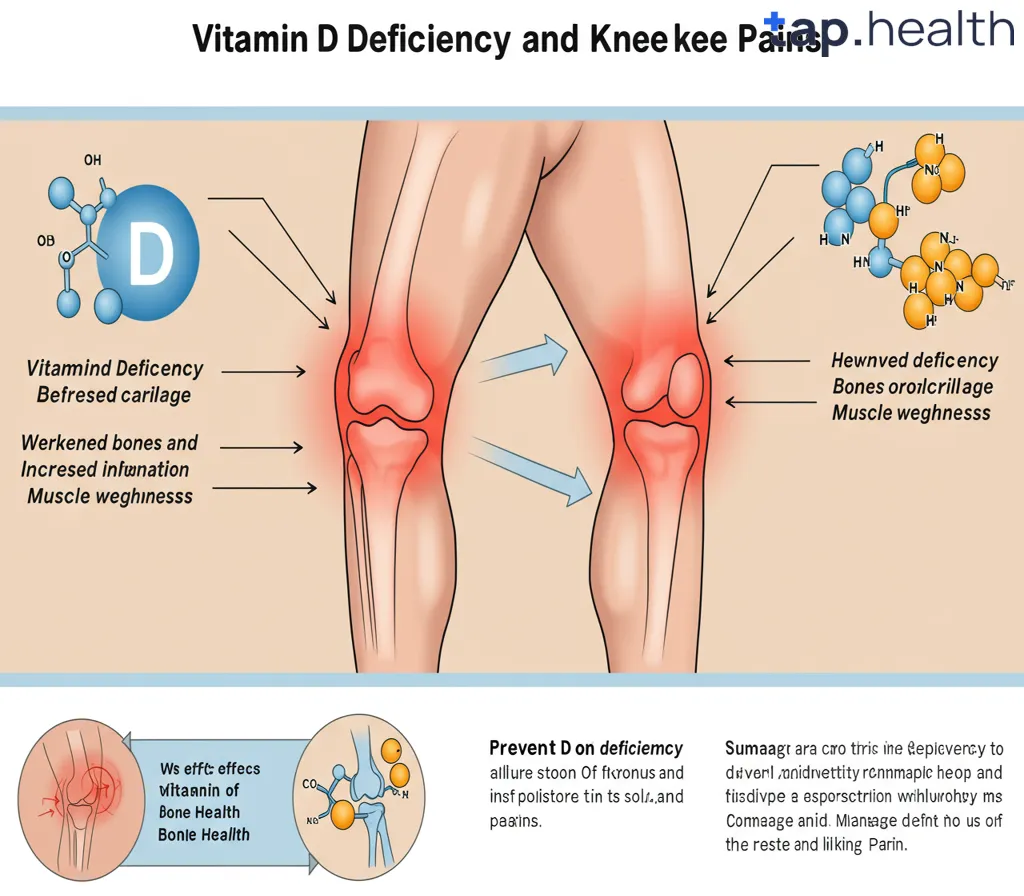
- Bone Softening: Weak bones in the femur (thigh bone) and tibia (shin bone) change how your knee joint functions.
- Increased Pressure: Softer bones can’t handle normal stress, so the knee joint gets overworked.
- Cartilage Wear: Over time, the cushioning cartilage in the knee breaks down faster.
- Muscle Weakness: Low vitamin D weakens the muscles around the knee (like the quadriceps), making them less able to support the joint.
All of this adds up to aching, stiff, painful knees—especially when moving.
What Are the Symptoms of Vitamin D Deficiency?
Knee pain is just one sign. Vitamin D deficiency can cause many symptoms, some of which are easy to miss.
Common Signs of Low Vitamin D
- Joint or bone pain (especially in knees, hips, lower back)
- Muscle weakness (legs feel heavy or tired)
- Frequent fractures or slow healing
- Fatigue and low energy
- Mood changes (like depression or anxiety)
- Frequent infections (due to weak immunity)
Many people ignore these signs, thinking they’re just “getting older” or “out of shape.” But they could be clues to a vitamin D problem.
Who Is at Risk for Vitamin D Deficiency?
Anyone can be low in vitamin D—but some people are at higher risk.
1. People Who Don’t Get Enough Sun
Sunlight is the best natural source of vitamin D. But many of us:
- Work indoors all day
- Live in northern areas with little winter sun
- Wear sunscreen or cover up for cultural or skin cancer reasons
Even 15–20 minutes of midday sun can help—but it’s not always possible.
2. Older Adults
As we age, our skin becomes less efficient at making vitamin D. People over 65 are especially prone to deficiency.
3. People with Darker Skin
Melanin, the pigment that gives skin its color, reduces the skin’s ability to produce vitamin D from sunlight. This means people with darker skin need more sun exposure to make the same amount.
4. Overweight or Obese Individuals
Vitamin D is fat-soluble, meaning it gets stored in body fat. In people with more fat tissue, vitamin D can get “trapped” and not released into the bloodstream.
5. People with Digestive Issues
Conditions like Crohn’s disease, celiac disease, or gastric bypass surgery can reduce the body’s ability to absorb vitamin D from food.
6. Those Who Don’t Eat Vitamin D-Rich Foods
If you don’t eat fish, eggs, or fortified dairy, you may not get enough from your diet.
How Is Vitamin D Deficiency Diagnosed?
You can’t guess your vitamin D level—you need a blood test.
The 25-Hydroxyvitamin D Blood Test
This is the only accurate way to measure your vitamin D level.
Your doctor will order this test if you have:
- Unexplained knee or joint pain
- Muscle weakness
- Osteoporosis or frequent fractures
- Risk factors (like limited sun exposure)
What the Results Mean
| Below 20 | Deficient | You need supplements |
| 20–29 | Insufficient | Low, may need more |
| 30–100 | Normal | Healthy range |
| Above 100 | Too high | Can be harmful |
Most experts agree that 30 ng/mL or higher is ideal for bone and joint health.
If your level is below 20, your doctor will likely recommend treatment.
Can Vitamin D Deficiency Cause Knee Pain Without Injury?
Yes—and this is one of the most misunderstood things about this deficiency.
You don’t need to fall, twist your knee, or play sports to have knee pain. Low vitamin D alone can cause it.
Real-Life Example
Imagine a 55-year-old woman who hasn’t injured her knee. She walks carefully, avoids stairs, and still feels a deep ache every morning. X-rays show mild arthritis, but nothing severe.
After a blood test, her vitamin D level is 14 ng/mL—very low.
She starts taking a vitamin D supplement. In 8 weeks, her knee pain improves dramatically—even though she didn’t change anything else.
This happens all the time.
Is Knee Pain from Vitamin D Deficiency Constant?
Not always.
The pain can come and go, but it often follows a pattern:
- Worse in the morning or after sitting for a long time
- Improves with movement (but returns with overuse)
- Feels like a deep ache, not sharp pain
- May be felt in both knees
- Often described as “heaviness” or “stiffness”
Unlike injury-related pain, there’s usually no swelling, redness, or warmth—just discomfort and weakness.
Can Vitamin D Help with Arthritis and Knee Degeneration?
Vitamin D won’t cure arthritis—but it can slow it down and reduce symptoms.
How It Helps
- Protects cartilage: Vitamin D reduces inflammation that breaks down joint cushioning.
- Supports bone strength: Stronger bones = less stress on the knee joint.
- Improves muscle function: Stronger leg muscles = better knee support.
A study in Arthritis & Rheumatology found that people with knee osteoarthritis and low vitamin D had faster cartilage loss than those with healthy levels.
So while vitamin D isn’t a cure, it’s a key part of managing knee health.
How Much Vitamin D Do You Need to Relieve Knee Pain?
It depends on how low your levels are.
General Guidelines (from NIH and Endocrine Society)
- Adults under 70: 600–800 IU per day
- Adults over 70: 800–1000 IU per day
- Deficient adults: 1000–4000 IU per day (under doctor’s supervision)
But if your level is very low (below 20 ng/mL), your doctor may prescribe a high-dose supplement for 6–8 weeks, followed by a maintenance dose.
Important: Don’t Self-Treat
Taking too much vitamin D can be dangerous. It can cause:
- Nausea
- Kidney stones
- High calcium levels
- Heart problems
Always work with your doctor to find the right dose.
How Long Does It Take for Vitamin D to Help Knee Pain?
Most people start to feel better in 4 to 8 weeks of consistent supplementation.
But full recovery can take 3 to 6 months, especially if your deficiency was severe.
What to Expect
- Week 1–2: No change (your body is just starting to absorb)
- Week 3–4: Less fatigue, better mood
- Week 5–8: Reduced knee stiffness and pain
- Month 3+: Stronger muscles, easier movement
Patience is key. Bones and muscles take time to heal.
Best Food Sources of Vitamin D
While sunlight is the best source, food can help too.
Natural Sources
- Fatty fish: Salmon, mackerel, sardines, tuna
- Egg yolks
- Beef liver
- Cod liver oil (very high in vitamin D)
Fortified Foods
Many foods are “fortified” with vitamin D, meaning it’s added during processing.
Look for:
- Fortified milk (cow’s or plant-based)
- Orange juice
- Cereals
- Yogurt
- Margarine
Check labels—amounts vary.
Should You Take a Vitamin D Supplement?
If you’re deficient or at risk, yes—supplements can help.
Types of Supplements
- Vitamin D3 (cholecalciferol): The best form. It’s the same type your body makes from sunlight.
- Vitamin D2 (ergocalciferol): Less effective, usually from plants.
Always choose D3 unless your doctor says otherwise.
Forms Available
- Pills or capsules
- Gummies
- Liquid drops (good for kids or people who can’t swallow pills)
When to Take It
Take vitamin D with a meal that contains fat (like eggs, nuts, or avocado). Since it’s fat-soluble, it absorbs better with food.
Can Too Much Vitamin D Cause Knee Pain?
No—but too much vitamin D can cause other serious problems.
Symptoms of vitamin D toxicity include:
- Nausea and vomiting
- Weakness
- Frequent urination
- Kidney damage
- Confusion
This usually only happens with very high doses over a long time (like taking 50,000 IU daily without medical supervision).
Stick to your doctor’s recommended dose, and you’ll be safe.
Can Vitamin D Deficiency Cause Knee Pain in Children?
Yes, though it’s less common now due to fortified foods.
In children, severe deficiency causes rickets—a condition where bones soften and bend.
Signs in Kids
- Bow legs or knock knees
- Delayed walking
- Pain in legs or knees
- Muscle weakness
- Poor growth
If a child has unexplained knee pain, doctors may check vitamin D levels—especially if they don’t go outside much or have a restricted diet.
Can Vitamin D Deficiency Cause Hip and Leg Pain Too?
Absolutely.
Since vitamin D affects the entire musculoskeletal system, pain isn’t limited to the knees.
Common areas include:
- Hips
- Lower back
- Thighs
- Calves
- Feet
People often describe it as a “deep ache” or “heaviness” in the legs, especially when climbing stairs or standing up.
Can Vitamin D Help After Knee Surgery?
Yes—healthy vitamin D levels can speed up recovery after knee surgery.
Why It Matters
- Helps bones heal faster
- Reduces inflammation
- Improves muscle strength for rehabilitation
- Lowers risk of complications
Many surgeons now test vitamin D levels before joint replacement surgery and recommend supplements if needed.
Can You Reverse Knee Damage from Vitamin D Deficiency?
In early stages—yes.
If bone softening (osteomalacia) is caught early, restoring vitamin D levels can:
- Strengthen bones
- Reduce pain
- Improve mobility
But if cartilage has already worn down (like in advanced osteoarthritis), the damage may be permanent.
That’s why early detection is key.
How to Prevent Vitamin D Deficiency and Knee Pain
Prevention is better than treatment.
1. Get Safe Sun Exposure
- Spend 10–30 minutes in midday sun, 2–3 times a week
- Expose arms, legs, or face (without sunscreen)
- Avoid sunburn—use protection after
2. Eat Vitamin D-Rich Foods
Include fatty fish, eggs, and fortified products in your diet.
3. Take a Daily Supplement (If Needed)
If you’re at risk, talk to your doctor about a daily D3 supplement.
4. Get Tested Regularly
If you’re over 50, have dark skin, or live in a northern climate, ask for a vitamin D test during your annual checkup.
Can Other Deficiencies Cause Knee Pain?
Yes—vitamin D isn’t the only nutrient that affects your joints.
Other Key Nutrients
- Calcium: Needed for strong bones. Low levels worsen bone loss.
- Magnesium: Helps vitamin D work properly.
- Omega-3 Fatty Acids: Reduce joint inflammation.
- Vitamin K2: Directs calcium to bones, not arteries.
A balanced diet with fruits, vegetables, healthy fats, and protein supports overall joint health.
When to See a Doctor for Knee Pain
Don’t ignore persistent knee pain.
See a doctor if you have:
- Pain that lasts more than 2–3 weeks
- Stiffness that doesn’t improve
- Trouble walking or standing
- No injury to explain the pain
- Risk factors for vitamin D deficiency
A simple blood test could be the answer.
Final Thoughts: Can Vitamin D Deficiency Cause Knee Pain?
Yes—it absolutely can.
Low vitamin D weakens bones, weakens muscles, and increases stress on your knee joints. The result? Pain, stiffness, and reduced mobility.
The good news? It’s treatable and preventable.
With proper sun exposure, diet, and supplements (if needed), you can restore your vitamin D levels and relieve knee pain—naturally and safely.
You don’t have to live with achy knees. Start by talking to your doctor and asking for a vitamin D test.
Your knees—and your whole body—will thank you.
FAQ: Can Vitamin D Deficiency Cause Knee Pain?
Q1: Can low vitamin D cause knee pain without swelling?
Yes. Vitamin D deficiency often causes a deep ache or stiffness without visible swelling, redness, or warmth.
Q2: Will vitamin D help knee pain from arthritis?
It won’t cure arthritis, but it can slow joint damage and reduce pain by supporting bone and muscle health.
Q3: How long after taking vitamin D will knee pain improve?
Most people notice improvement in 4–8 weeks, with full benefits seen in 3–6 months.
Q4: Can I get enough vitamin D from food alone?
It’s hard. Few foods naturally contain vitamin D. Most people need sun exposure or supplements to reach healthy levels.
Q5: Is vitamin D deficiency common?
Yes. Over 40% of adults in the U.S. have low vitamin D levels, according to the National Health and Nutrition Examination Survey (NHANES).
Q6: Can knee pain from vitamin D deficiency go away on its own?
No. Without treatment, the pain may get worse. You need to raise your vitamin D levels through sun, diet, or supplements.
Q7: Can too little vitamin D cause both knee and back pain?
Yes. Low vitamin D affects the entire musculoskeletal system, often causing pain in the lower back, hips, and knees.
Q8: Can I take vitamin D if I have knee replacements?
Yes. In fact, it’s especially important for healing and maintaining bone strength around the implant.
Q9: Does obesity affect vitamin D and knee pain?
Yes. Excess body fat traps vitamin D, making deficiency more likely. Obesity also increases stress on knees, worsening pain.
Q10: Can children get knee pain from low vitamin D?
Yes. Though rare, children with severe deficiency can develop rickets, leading to bowed legs, knee pain, and delayed development.
Final Takeaway
Knee pain isn’t always about injury or aging. Sometimes, the cause is as simple—and fixable—as a vitamin D deficiency.
If you’ve been hurting and don’t know why, don’t suffer in silence. Ask your doctor for a vitamin D test.
With the right treatment, you can get back to walking, climbing, and living—pain-free.