It is a common scenario in Indian homes, especially during winter.
Your mother hands you a small bowl of soaked almonds. Sitting right on top are a few wrinkled, golden Raisins (Kishmish).
Or, perhaps you are trying to quit white sugar. You decide to make a healthy Gajar ka Halwa or a smoothie, and you reach for the sticky, dark Dates (Khajoor) to sweeten it.
We are told that “Natural Sugar” is better than “White Sugar.” We are told that dry fruits are superfoods.
But for a diabetic, or anyone trying to control their insulin levels, the body does not care about the philosophy; it cares about the chemistry. Sugar is sugar.
So, when you are standing in the dry fruit aisle, which packet should you buy?
Is the Date—a fruit from the desert palm—a concentrated sugar bomb?
Or is the Raisin—a dehydrated grape—the real villain lurking in your oatmeal?
In this comprehensive guide, we are going to host the ultimate sweetness showdown: Dates vs. Raisins. We will analyze their Glycemic Index (GI), break down their sugar composition (Fructose vs. Glucose), and reveal exactly which one causes that dreaded insulin spike.
The Contenders: The Desert Fruit vs. The Dried Grape
They look different, taste different, but share one common trait: Dehydration.
1. Dates (Khajoor)
- The Source: The fruit of the Date Palm tree.
- The Process: Most dates are naturally dried on the tree itself before harvesting. They are not “processed” in factories; they are just harvested and packaged.
- The Varieties: From the soft, caramel-like Medjool to the dry, chewy Chuara (Dry Dates).
- The Reputation: Known as an instant energy booster, rich in iron and potassium.1
2. Raisins (Kishmish)
- The Source: Grapes (usually seedless varieties like Thompson Seedless).
- The Process: Grapes are laid out in the sun or dried in mechanical dehydrators until they shrivel up.2
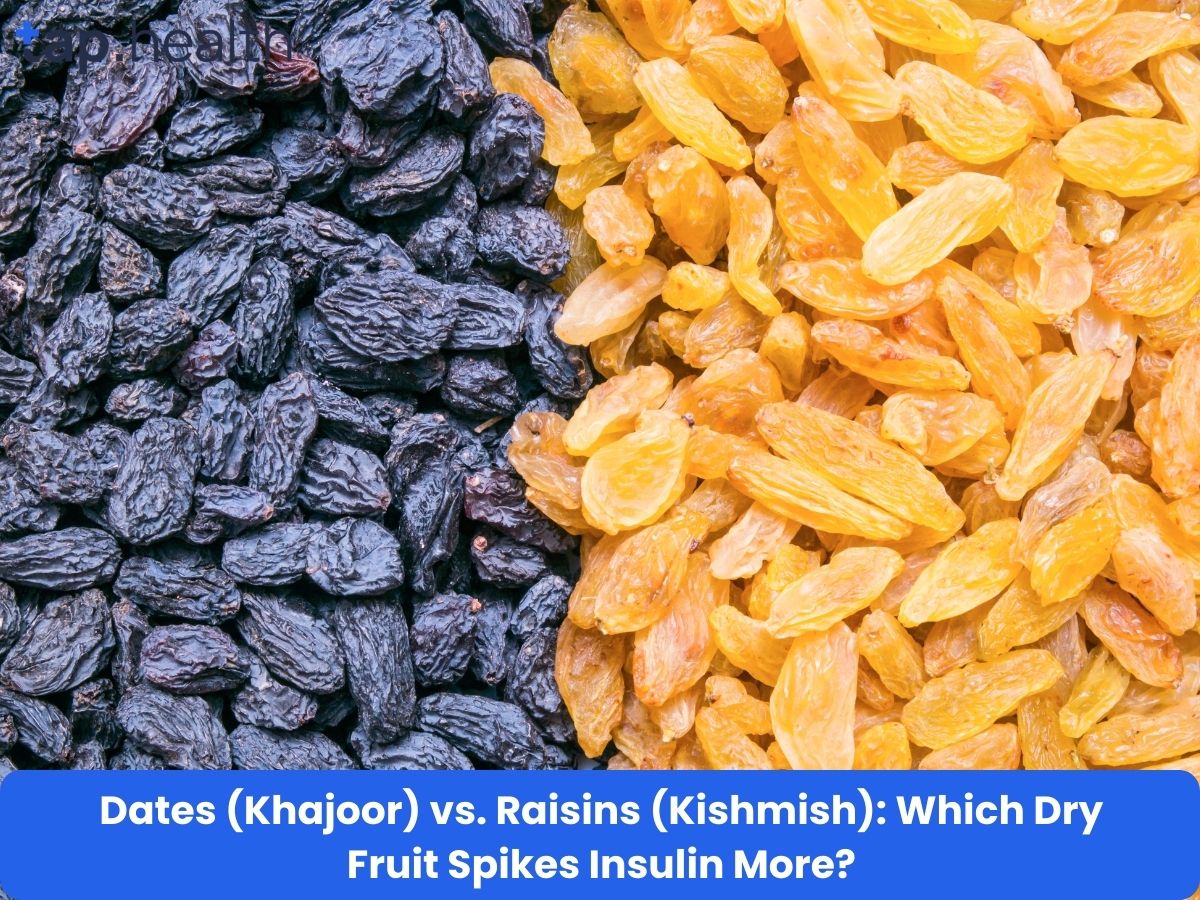
- The Concentration: To get 1 kg of raisins, you need about 4 kg of grapes. This means the sugar of 4 grapes is concentrated into the size of 1 raisin.
- The Reputation: A digestion aid and a common addition to Kheer, Pulao, and cereals.3
Nutritional Face-Off: The Sugar Density
Let’s look at the numbers. Since both are “Dry Fruits,” the water has been removed, making the sugar highly concentrated.4
Here is the comparison for a standard serving size: roughly 40g (a small handful or about 3-4 dates).
| Feature | Dates (Medjool, 40g) | Raisins (Kishmish, 40g) | The Winner |
| Calories | ~110 kcal | ~120 kcal | Dates (Slightly lower) |
| Carbohydrates | ~30g | ~32g | Dates (Slightly lower) |
| Total Sugar | ~26g | ~24g | Raisins (Less sugar by weight) |
| Dietary Fiber | ~3.2g | ~1.5g | Dates (Double the fiber) |
| Potassium | High | Moderate | Dates |
| Iron | Moderate | Good | Tie |
The Analysis:
- The Sugar Trap: Both are about 75-80% sugar by weight. If you eat 100g of dates, you are eating 75g of sugar.
- The Fiber Shield: This is the game changer. Dates have double the fiber of raisins. Fiber slows down the absorption of sugar.5
- Volume Trick: 40g of Dates is just 2 large Medjool dates. 40g of Raisins is a large handful (approx 60 raisins). It is much easier to overeat raisins.
The Glycemic Index Battle: The Surprise Winner
Most people assume Dates are worse because they taste sweeter. The science says otherwise.
1. The Glycemic Index of Raisins
GI Score: ~64 to 66 (Medium)
Raisins are essentially dehydrated grapes.6
- The Spike: The sugar in raisins is a mix of glucose and fructose. The skin of the raisin is thin and easily broken down by saliva.
- The Acid Factor: While grapes are acidic, the sheer concentration of sugar in raisins hits the bloodstream relatively fast. They fall into the “Medium” GI category, bordering on High.
2. The Glycemic Index of Dates (Khajoor)
GI Score: ~42 to 55 (Low to Low-Medium)
This shocks almost everyone.
- Why is it lower? Despite tasting sweeter, dates have a unique fiber structure and specific tannins that slow down digestion.
- The Variety Matters:
- Khalas Dates: GI ~35 (Very Low).
- Barhi Dates: GI ~50.
- Medjool Dates: GI ~55.
- The Verdict: Generally, Dates have a significantly lower Glycemic Index than Raisins. They release energy slower than the quick burst you get from Kishmish.
Fructose vs. Glucose: The Liver vs. The Blood
It’s not just about how much sugar, but what kind of sugar.
Raisins: High in Glucose and Fructose.7
- Glucose goes straight into your bloodstream, spiking insulin instantly.
Dates: Higher in Fructose.
- Fructose does not spike insulin immediately because it must be processed by the liver first.8
- The Catch: While this keeps your blood sugar reading lower, excessive fructose can overload the liver (leading to fatty liver) if consumed in huge amounts.9 But in small amounts (2-3 dates), it is metabolically safer for immediate blood sugar control than the glucose hit from raisins.
The “Sticky” Situation: Dental Health and Digestion
Raisins are sticky.
Chew a raisin, and it sticks to your molars. It stays there for hours.
- Digestion: Because they are small and often swallowed half-chewed, raisins can bypass early enzymatic breakdown in the mouth, leading to rapid fermentation in the gut (gas).
Dates are fibrous.
The flesh of a date dissolves more uniformly.
- Satiety: The fiber density in dates triggers a stronger “fullness” signal. You are likely to stop after 2 dates. You are unlikely to stop after 10 raisins.
Soaking: Does Water Change the Glycemic Index?
In Indian Ayurveda, we are taught to soak dry fruits.10
“Soak the Kishmish overnight.”
Does this help diabetes?
Yes.
When you soak raisins or dry dates (Chuara):
- Rehydration: The fruit absorbs water and swells up.11 This increases the volume.
- Dilution: The sugar concentration per bite decreases (because it’s now full of water).
- Digestibility: The skin becomes softer, making the fiber more active and easier to digest.
Recommendation: Always eat Soaked Raisins rather than dry, chewy ones. The water content helps slow down the sugar rush.
Real-Life Scenario
Let’s meet Mrs. Verma, a 60-year-old diabetic from Pune.
The Craving:
Mrs. Verma had a sweet tooth. She loved eating Kheer. Since she couldn’t use sugar, she started adding a handful of raisins to her bowl.
The Problem:
Her post-meal sugar was still hitting 180 mg/dL.
- Why? She was adding about 30-40 raisins. Raisins are small, so the brain underestimates the sugar load. She was essentially adding 2 tablespoons of sugar in the form of fruit.
The Switch:
Her nutritionist told her to swap the handful of raisins for 2 Chopped Dates.
The Result:
- The Texture: The dates were sweeter and richer, so she felt satisfied with less.
- The Fiber: The fiber in the dates blunted the spike from the rice in the Kheer.
- The Numbers: Her reading dropped to 150 mg/dL. The lower GI of the dates combined with better portion control worked.
Expert Contribution
We consulted medical experts to get the professional stance.
Dr. A. Gupta, Diabetologist:
“I prefer Dates over Raisins for my patients, but with a strict limit. Dates are a ‘whole food’ with the fiber intact.12 Raisins are often treated as candy. The problem with raisins is that they are so small, you eat 20 without thinking. You would never eat 20 grapes in one breath, but you will eat 20 raisins. That concentration is dangerous for insulin.”
Ayurvedic Perspective:
“Dates (Khajoor) are considered ‘Ojas’ building—they build strength and stamina.13 They are heavy to digest, which is good for slowing sugar. Raisins (Draksha) are cooling and good for acidity, but for diabetes (Madhumeh), the heaviness of the date is preferred over the quick sugar of the raisin.”
Recommendations Grounded in Proven Research and Facts
Based on data from the Nutrition Journal and University of Sydney GI Database, here are actionable tips:
- The “Walnut Pair” Rule:Never eat a Date or Raisin alone.
- The Hack: Stuff a Date with a Walnut half. Or eat Raisins with Almonds.
- Why? The healthy fats and protein in the nuts reduce the overall Glycemic Index of the snack by nearly 30%.
- Avoid “Shiny” Raisins:Many commercially available golden raisins are treated with Sulfur Dioxide to keep them yellow and shiny.14 This preservative can trigger asthma or gut issues. Buy dark, organic raisins or “Munakka” (seeded raisins) which are more natural.
- The Smoothie Sweetener:If you are making a smoothie, use 1 Date instead of a tablespoon of Raisins. The date provides creaminess and fiber, whereas raisins just add grit and sugar.
- Quantity Limits for Diabetics:
- Dates: Max 2 per day (e.g., Medjool or Kimia).
- Raisins: Max 10-15 pieces per day.
Key Takeaways
- Dates have a Lower GI (~42-55) compared to Raisins (~64-66).
- Fiber: Dates have double the fiber of raisins, which helps prevent insulin spikes.
- Portion Control: It is easier to overeat raisins due to their small size.
- Nutrition: Dates are better for energy and potassium; Raisins are better for digestion and acidity.
- The Verdict: Dates are the safer choice for insulin control, provided you stick to the limit of 2 per day.
Conclusion
So, Dates vs. Raisins: Who is the villain?
In the battle of the insulin spike, Raisins (Kishmish) are the loser. They are smaller, easier to overeat, and hit the bloodstream faster. They are essentially nature’s candy.
Dates (Khajoor), while still high in sugar, are the “gentle giant.” Their robust fiber content and complex tannins release the sugar slowly, giving your insulin a fighting chance.
However, remember the golden rule of diabetes: “Even natural sugar is still sugar.”
Whether you choose the Date or the Raisin, treat it as a luxury garnish, not a main course. Pair it with a nut, chew it slowly, and respect the potency of these concentrated energy bombs.
Frequently Asked Questions (FAQ)
Which variety of dates is best for diabetics?
Kimia or Khalas dates. These varieties are soft but have a lower Glycemic Index compared to the very sticky and sweet Medjool dates. Avoid dates that are coated in glucose syrup or processed sugar (often sold in cheap packets).
Are Black Raisins (Munakka) better than Yellow Raisins?
Yes. Black raisins (Munakka) usually contain seeds and have a thicker skin.15 This extra fiber and the presence of seeds lowers the Glycemic Index compared to the seedless, thin-skinned yellow raisins. Munakka is also superior for hemoglobin levels.
Can I eat dates if I want to lose weight?
Yes, in moderation. Dates are excellent for curbing sugar cravings. Eating one date can stop you from eating a slice of cake. The fiber promotes fullness. However, they are calorie-dense, so limit intake to 2-3 per day.16
Do soaked almonds reduce the sugar spike of raisins?
Yes. If you eat your morning soaked almonds along with the raisins, the fiber and fat from the almond slows down the digestion of the raisin sugar. Never eat the raisins first and the almonds later; eat them together.
Is Date Syrup healthy?
No. Commercial Date Syrup is highly processed. The fiber is removed, leaving only the concentrated liquid sugar. It digests almost as fast as honey or white sugar. Always eat the whole fruit, not the syrup.
References:
- Nutrition Journal: Glycemic indices of five varieties of dates. Link
- University of Sydney: GI Search Database (Raisins). Link
- Diabetes.co.uk: Fruit and Diabetes. Link
- USDA FoodData Central: Dates vs Raisins. Link
- Journal of Ethnopharmacology: Benefits of Phoenix dactylifera (Date Palm). Link
(Disclaimer: This content is for educational purposes only. Always consult your doctor or a certified dietitian before making significant changes to your diet, especially if you have high potassium levels or kidney issues.)