You’re 14, 15, 16… maybe even 17 or 18. You’re growing fast, thinking about school, sports, friends, maybe even your future. And you probably don’t spend much time thinking about vitamin B12.
But here’s the thing: vitamin B12 is one of the most important nutrients for teenage guys—especially between the ages of 14 and 18.
It helps your body:
- Make red blood cells
- Keep your nerves working right
- Turn food into energy
- Support brain health and focus
- Build muscle and grow strong
So, how much do you really need?
The quick answer:
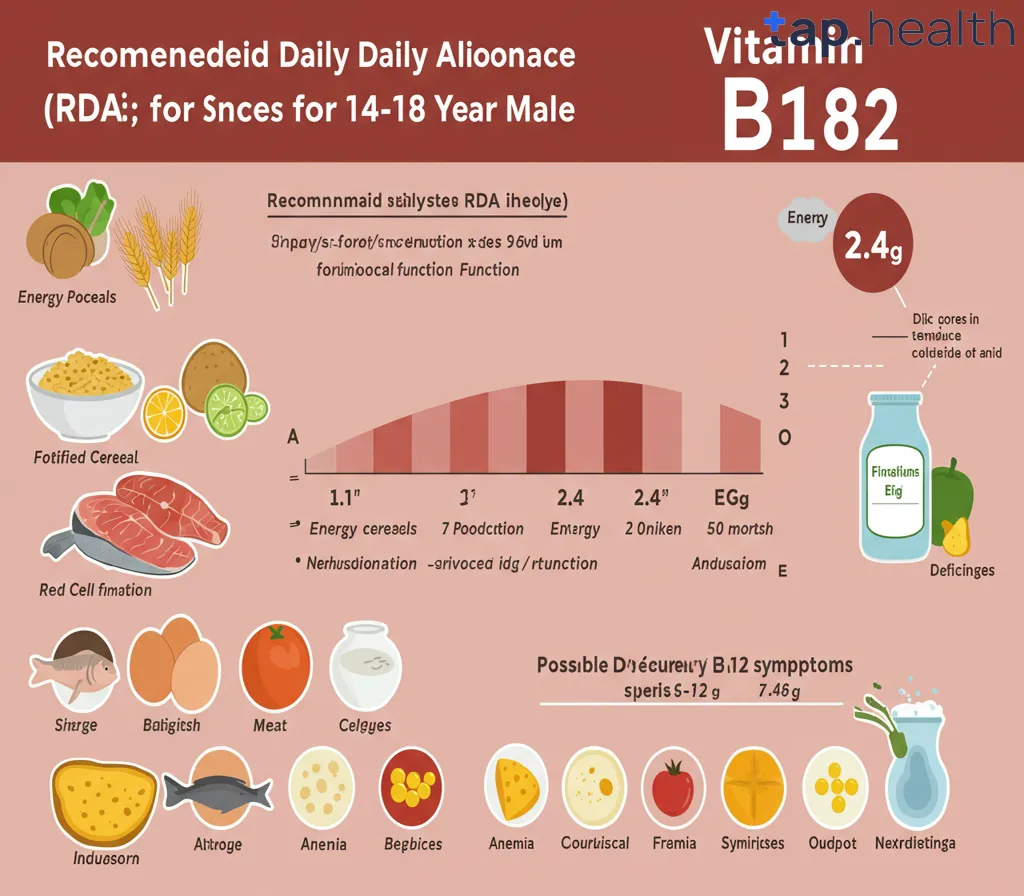
A male between 14 and 18 years old needs 2.4 micrograms (mcg) of vitamin B12 every day.
That’s the official recommendation from the National Institutes of Health (NIH) and the U.S. Department of Agriculture (USDA).
But that tiny number doesn’t tell the whole story.
In this article, we’ll go deep—answering every question you (or your parents) might have about vitamin B12 for teenage boys. We’ll cover:
- Why B12 matters so much during the teen years
- What happens if you don’t get enough
- Best food sources
- Who’s at risk for low B12
- When you might need a supplement
- And much more
All in simple, easy-to-understand language—no confusing science talk, no robotic tone. Just real, honest facts from trusted sources like the NIH, Mayo Clinic, Cleveland Clinic, and Harvard Health.
Let’s get into it.
Why Is Vitamin B12 So Important for Teenage Boys?
Your body goes through huge changes between 14 and 18. You’re growing taller, gaining muscle, and your brain is still developing. You need more energy, better focus, and stronger cells.
That’s where vitamin B12 comes in.
Think of B12 as your body’s energy and brain fuel. It helps:
- Make DNA (the instructions inside every cell)
- Create red blood cells that carry oxygen
- Maintain the protective coating around your nerves
- Convert protein, fat, and carbs into usable energy
Without enough B12, your body can’t keep up with the demands of being a growing teen.
And since you can’t make B12 yourself, you have to get it from food—or supplements.
B12 Supports Growth and Muscle Building
During puberty, your body builds more muscle and bone. B12 plays a role in cell growth and repair, helping your muscles recover after workouts and your body grow stronger.
Low B12 can lead to:
- Fatigue
- Weakness
- Poor recovery after exercise
So if you’re active in sports or lifting weights, B12 is extra important.
B12 Helps Brain Function and Mood
Your brain is still developing until your mid-20s. B12 supports:
- Memory
- Focus
- Learning
- Nerve signaling
Low B12 has been linked to:
- Brain fog
- Trouble concentrating
- Mood swings
- Depression-like symptoms
For teens juggling school, sports, and social life, a sharp mind and stable mood are priceless.
B12 Prevents Anemia
One of the biggest jobs of B12 is helping make healthy red blood cells.
Without enough B12, your body can’t make enough red blood cells—or they come out too large and don’t work well. This is called megaloblastic anemia.
Symptoms include:
- Feeling tired all the time
- Pale skin
- Shortness of breath
- Dizziness
- Cold hands and feet
Teen guys need strong blood to stay active and alert—and B12 keeps that system running.
How Much B12 Does a 14-18 Year Old Male Need?
As we said earlier:
2.4 micrograms (mcg) per day.
That’s the official Recommended Dietary Allowance (RDA) set by the NIH for all males aged 14 and older.
To put that in perspective:
- A single scrambled egg has about 0.6 mcg
- A cup of milk has about 1.2 mcg
- A 3-ounce piece of salmon has about 5 mcg
So it doesn’t take much to meet your daily need.
But here’s the catch: Just because the number is small doesn’t mean it’s easy to get—especially if you don’t eat animal foods.
What Happens If You Don’t Get Enough B12?
Not getting enough B12 over time can lead to deficiency, and the effects can sneak up slowly.
At first, you might just feel tired or have trouble focusing. But over months or years, it can cause serious problems.
Early Signs of Low B12
- Constant fatigue, even after sleeping
- Weakness in arms or legs
- Trouble concentrating in class
- Mood changes (irritability, sadness)
- Pale or yellowish skin
- Sore or swollen tongue
These can be mistaken for stress, lack of sleep, or “just being a teen.” But they could be a sign of low B12.
Long-Term Risks of B12 Deficiency
If left untreated, B12 deficiency can cause:
- Nerve damage – numbness, tingling in hands and feet
- Memory problems – especially in teens and young adults
- Anemia – leading to low energy and poor athletic performance
- Delayed growth or development – because cells can’t divide properly
The good news? Most of these problems can be reversed if caught early.
Who Is at Risk for Low B12?
Most teenage guys get enough B12 from their diet. But some are at higher risk.
1. Vegetarians and Vegans
Vitamin B12 is only found naturally in animal foods—meat, fish, eggs, and dairy.
If you don’t eat any of these:
- You’re at high risk for deficiency
- Even lacto-ovo vegetarians (who eat eggs and dairy) may not get enough if their diet is limited
Studies show that up to 80% of vegans and 50% of vegetarians have low B12 levels.
2. Teens with Digestive Issues
Some health conditions make it hard to absorb B12, including:
- Crohn’s disease
- Celiac disease
- Ulcerative colitis
- Gastritis
These affect the gut, where B12 is absorbed.
3. Teens Taking Certain Medications
Some medicines can lower B12 levels, such as:
- Metformin (used for type 2 diabetes)
- Proton pump inhibitors (PPIs) (used for heartburn or acid reflux)
- H2 blockers (like famotidine)
If you take any of these long-term, talk to your doctor about checking your B12.
4. Teens with Pernicious Anemia (Rare)
This is an autoimmune condition where the body can’t make a protein called intrinsic factor, which is needed to absorb B12.
It’s rare in teens but can happen.
Best Food Sources of Vitamin B12
The easiest way to get B12 is by eating animal-based foods. Here are some top choices:
| Beef liver | 3 oz | 70.7 mcg |
| Salmon | 3 oz | 5.0 mcg |
| Tuna | 3 oz | 2.5 mcg |
| Ground beef | 3 oz | 2.1 mcg |
| Milk | 1 cup | 1.2 mcg |
| Yogurt | 1 cup | 1.1 mcg |
| Eggs | 2 large | 1.0 mcg |
| Cheese (cheddar) | 1 oz | 0.3 mcg |
| Chicken breast | 3 oz | 0.3 mcg |
Tip: You don’t need to eat liver every day. Just include a mix of meat, fish, eggs, and dairy in your meals.
Can You Get B12 from Plant Foods?
No—not from natural plant sources.
Plants do not make or store vitamin B12.
But some fortified foods contain added B12. These include:
- Fortified breakfast cereals
- Nutritional yeast (often labeled “B12-fortified”)
- Plant-based milks (soy, almond, oat)
- Some meat substitutes (like veggie burgers)
Always check the label. Look for:
- “Cobalamin” or “Vitamin B12”
- At least 1–2 mcg per serving
For vegetarians and vegans, fortified foods and supplements are essential.
Do You Need a B12 Supplement?
Maybe. Here’s who should consider one:
1. Vegans
Yes—all vegans need a B12 supplement or fortified foods every day. It’s not optional.
Even if you feel fine now, B12 stores can last a few years—but eventually, you will run out.
2. Vegetarians with Limited Diet
If you don’t eat eggs or dairy often, you may not get enough. A daily supplement (25–100 mcg) is a safe backup.
3. Teens with Digestive Disorders
If you have Crohn’s, celiac, or another gut issue, your doctor may recommend a supplement—even if you eat meat.
4. Anyone with Symptoms of Deficiency
If you’re tired, weak, or having brain fog, ask your doctor for a B12 blood test.
If levels are low, a supplement (or even B12 shots) may be needed.
What’s the Best Type of B12 Supplement?
Not all B12 supplements are the same. Here are the most common forms:
| Cyanocobalamin | Synthetic form, cheap and stable | Most people, daily use |
| Methylcobalamin | Natural, active form | Better absorption, nerve health |
| Sublingual (under the tongue) | Dissolves in mouth | People with absorption issues |
| Gummies | Chewable, tasty | Teens who hate pills—but check sugar content |
For most teens, a daily multivitamin or B-complex with 2.4–25 mcg of B12 is enough.
Vegans may take 1,000 mcg daily to ensure full absorption, since only a small amount is absorbed at once.
Can You Take Too Much B12?
No—vitamin B12 is very safe, even in high doses.
Why? Because it’s water-soluble. That means your body uses what it needs and flushes out the rest in your urine.
You can’t overdose on B12 from food or supplements.
Even doses of 1,000–2,000 mcg daily are used to treat deficiency—and they’re safe.
But one thing to know:
High-dose B12 can interfere with some lab tests, like thyroid or hormone panels. Always tell your doctor if you take B12 supplements.
How Often Should a Teen Take B12?
If you eat meat, fish, eggs, or dairy every day, you probably don’t need a supplement.
But if you’re vegan or at risk, here’s a simple guide:
| Daily diet with animal foods | No supplement needed |
| Vegetarian with eggs/dairy | Optional: 25–100 mcg daily |
| Vegan | 2.4 mcg from fortified foods OR 1,000 mcg supplement 2–3 times per week |
| Deficiency | As prescribed by doctor (may include high-dose pills or shots) |
Note: The body absorbs B12 best in small amounts. Large doses (like 1,000 mcg) are only partly absorbed, but that’s okay—because you need the extra to make up for it.
Does B12 Give You Energy?
Yes—but not like caffeine.
B12 doesn’t give you a “buzz.” Instead, it helps your body turn food into energy at the cellular level.
If you’re low in B12, you may feel tired or weak. Taking a supplement can help you feel more alert—but only if you were deficient to begin with.
If your levels are normal, extra B12 won’t make you feel supercharged.
So no, B12 isn’t an energy drink. It’s more like the oil in your car’s engine—necessary for smooth performance, but invisible when it’s working right.
Can B12 Help with Focus and Grades?
It might.
Since B12 supports brain function, nerves, and red blood cells (which carry oxygen to your brain), having enough can help you:
- Stay focused in class
- Think more clearly
- Remember what you study
One study found that teens with low B12 had worse memory and attention than those with healthy levels.
So while B12 won’t magically boost your GPA, it can help your brain work at its best.
What If You’re Not Eating Enough?
Many teens skip meals, eat fast food, or follow trendy diets (like keto or intermittent fasting). This can make it harder to get enough B12.
If your diet is:
- Low in meat, fish, or dairy
- High in processed foods
- Unbalanced or restrictive
You may not be getting enough B12—even if you’re not vegan.
A daily multivitamin can help fill the gap.
How Do You Know If You’re Getting Enough B12?
You might not know—until you start feeling off.
But here are signs you’re likely getting enough:
- You eat meat, fish, eggs, or dairy regularly
- You have good energy
- You’re not unusually tired
- Your skin and tongue look healthy
- You’re growing and developing normally
If you’re vegan or have symptoms, the only way to know for sure is a blood test.
Ask your doctor to check:
- Serum B12 level
- Methylmalonic acid (MMA) – a more accurate sign of deficiency
Final Thoughts: How Much Vitamin B12 Does a 14-18 Male Need?
Let’s wrap it up:
- ✅ All males aged 14–18 need 2.4 mcg of vitamin B12 daily.
- ✅ It’s essential for energy, brain health, red blood cells, and growth.
- ✅ Best sources: meat, fish, eggs, dairy, and fortified foods.
- ❌ Vegans cannot get B12 from plants—supplements are required.
- ✅ Deficiency is preventable and treatable.
- ✅ Supplements are safe, even in high doses.
Being a teen is hard enough. You don’t need fatigue, brain fog, or weakness slowing you down.
The good news? B12 is easy to get—just eat a balanced diet with animal foods, or take a simple supplement if you’re vegan.
Your body—and your future self—will thank you.
Frequently Asked Questions (FAQ) on How Much Vitamin B12 Does a 14-18 Male Need?
How much vitamin B12 does a 14-18 male need?
2.4 micrograms (mcg) per day. This is the recommended amount for all males 14 and older.
Can a teenage boy get too much B12?
No. B12 is water-soluble, so extra amounts are flushed out in urine. Even high doses are safe.
What foods are high in B12 for teens?
Salmon, tuna, beef, eggs, milk, yogurt, and cheese are all excellent sources.
Do vegans need B12 supplements?
Yes. Since B12 is only found in animal foods, all vegans must take a supplement or eat fortified foods daily.
Can low B12 cause fatigue in teens?
Yes. B12 deficiency can lead to tiredness, weakness, and anemia—common signs in teens who don’t eat enough animal products.
How do I know if I need a B12 supplement?
If you’re vegan, vegetarian with a limited diet, have digestive issues, or feel constantly tired, talk to your doctor about testing and supplements.
Is 1,000 mcg of B12 too much for a teen?
No. While only a small amount is absorbed, high doses are safe and often used to treat deficiency.
Can B12 improve focus and memory?
Yes, if you’re low in B12. It supports brain function and nerve health, which can help with concentration and learning.
Does milk have B12?
Yes. One cup of milk has about 1.2 mcg of B12—about half the daily need.
Can you get B12 from eggs?
Yes. Two large eggs have about 1.0 mcg of B12. Not a lot, but helpful as part of a balanced diet.
What are the signs of B12 deficiency in teens?
Fatigue, weakness, pale skin, brain fog, mood changes, and tingling in hands or feet.
Can B12 help with muscle growth?
Indirectly. B12 supports cell growth and energy, which helps muscle recovery and overall development.
Do B12 shots work better than pills?
Only for people who can’t absorb B12 from food or pills. For most teens, oral supplements work just fine.
Can a blood test show low B12?
Yes. A simple blood test can check your B12 levels. Your doctor may also test methylmalonic acid (MMA) for a more accurate result.
Should all teenage guys take a multivitamin with B12?
Not necessary if you eat a balanced diet. But if you’re picky, vegan, or have health issues, a multivitamin can help fill the gap.
Vitamin B12 might seem like a small detail, but it plays a big role in your health—especially during the teenage years. Whether you’re hitting the gym, acing exams, or just trying to stay awake in first period, B12 helps your body and brain run smoothly. Eat well, stay aware, and don’t ignore this tiny but mighty vitamin.