EFor many people, losing weight is the ultimate battle. But for a select group—the “hardgainers,” the athletes, and those recovering from illness—the struggle is completely opposite. You might feel like you are eating all day, yet the weighing scale refuses to budge.
If you are asking, “How to eat 3,000 calories daily?”, you have likely realised that your current diet just isn’t cutting it.
Eating this much food is not as easy as it sounds. It requires strategy, discipline, and the right food choices. If you just start eating junk food, you will gain belly fat and risk heart issues. The goal here is “clean bulking”—gaining muscle and healthy weight, not just flab.
As a senior health strategist, I am here to guide you through this journey. Think of this as a prescription for a stronger, healthier you. We will break this down simply (the KISS method) so you can start today.
Why Do You Need 3,000 Calories?
Before we look at how, let’s understand why.
Your body burns energy just to keep you alive—this is called your Basal Metabolic Rate (BMR). When you add walking, working, and exercising to the mix, you burn even more. This total number is your maintenance level.
If you burn 2,500 calories a day but only eat 2,500, your weight stays the same. To gain weight, you must be in a Caloric Surplus. This means you must eat more energy than your body burns.
Who is this diet for?
- The “Hardgainer”: People with a very fast metabolism who stay skinny no matter what they eat.
- The Athlete: Cricketers, rugby players, or bodybuilders who burn massive amounts of energy.
- The Recovery Patient: Someone recovering from a long illness or surgery who needs to rebuild strength.
Note: 3,000 calories is a high number. If you are a small, sedentary person, this might be too much. Always listen to your body.
The “Clean Bulk” vs. The “Dirty Bulk”
This is the most critical part of the guide. Please pay attention.
There are two ways to hit 3,000 calories:
- The Dirty Bulk: Eating pizzas, burgers, sugary colas, and fried samosas.
- Result: You will hit 3,000 calories easily, but you will feel sluggish, your skin might break out, and you will gain unhealthy visceral fat (fat around your organs).
- The Clean Bulk: Eating nutrient-dense whole foods like rice, oats, eggs, chicken, nuts, and healthy fats.
- Result: You gain quality weight (muscle), feel energetic, and protect your heart health.
We are going to focus strictly on the Clean Bulk.
How to Eat 3,000 Calories Daily: The Strategy
You cannot eat three giant meals of 1,000 calories each. Your stomach will feel like it is going to explode, and you will feel sick. The secret is frequency and density.
1. Increase Meal Frequency
Instead of 3 meals, you need to eat 6 times a day.
- Breakfast
- Mid-Morning Snack
- Lunch
- Evening Snack
- Dinner
- Pre-Bed Snack
This breaks the 3,000 calories into manageable chunks of 500 calories each.
2. Drink Your Calories
Chewing solid food takes effort and makes you feel full. Liquids bypass the “I’m full” signal in your brain more easily.
- The Strategy: Do not just drink water. Drink milk, fruit juices, or homemade mass gainer shakes. A single shake can easily pack 800 calories without making you feel overly stuffed.
3. Focus on Calorie-Dense Foods
You need foods that pack a lot of energy into a small size.
- Low Density: Popcorn (High volume, low calories).
- High Density: Peanut Butter (Small volume, high calories).
The Best High-Calorie Indian Foods
To reach your goal using ingredients available in your local Indian kitchen, focus on these food groups.
Carbohydrates (Your Main Fuel)
- Rice: White rice is easy to digest and great for bulking.
- Roti/Paratha: Especially if topped with ghee.
- Potatoes & Sweet Potatoes: Boil them or mash them.
- Oats: Great for breakfast shakes.
- Bananas: The ultimate weight gain fruit.
Proteins (The Building Blocks)
- Eggs: The gold standard. Eat the yolk; that is where the healthy fats and calories are.
- Paneer (Cottage Cheese): Very high in calories and protein.
- Chicken Thighs: Choose thighs over breast meat; they are tastier and have more calories.
- Lentils (Dal) & Chickpeas (Chana): Essential for vegetarians.
Fats (The Calorie Boosters)
- Ghee: Add a teaspoon to your dal and rice.
- Nuts: Almonds (Badam), Walnuts (Akhrot), and Cashews (Kaju).
- Peanut Butter: A weight gainer’s best friend.
- Full-Cream Milk: Stop buying “toned” or “skimmed” milk. You need the fat.
Real-Life Scenario
Let’s look at a practical example to help you understand how this works in daily life.
Meet Arjun: Arjun is a 24-year-old software developer from Pune. He is 6 feet tall but weighs only 60kg. He skips breakfast because he is in a rush, eats a canteen lunch, and has a heavy dinner. He feels weak and hates how his clothes hang loosely on him.
The Problem: Arjun is only eating about 1,800 calories a day. He has a massive “calorie gap” of 1,200 calories.
The Solution: We didn’t change his entire life. We just added “bookends” and “boosters.”
- Morning: We added a liquid smoothie (Milk + Banana + Peanut Butter) before he leaves for work. (+600 calories)
- Lunch: We asked him to add a bowl of curd and a handful of almonds to his canteen lunch. (+300 calories)
- Night: We added a glass of warm full-fat milk with honey before bed. (+300 calories)
The Result: Arjun closed the gap without forcing himself to eat giant plates of rice. In three months, he gained 6kg of healthy weight.
Expert Contribution
Based on consensus from sports nutritionists and metabolic health experts.
Dr. Simran Saini, a renowned Nutritionist, explains:
“The biggest mistake I see clients make when trying to hit 3,000 calories is relying on sugar. They drink colas or eat sweets to hit the number. This causes an insulin spike and crash, leading to fatigue.
My expert advice is simple: Treat fat as a tool. Fat has 9 calories per gram, whereas carbs and protein only have 4. By simply adding healthy fats—like olive oil on salads, ghee on rotis, or seeds in your smoothie—you can increase your calorie intake by 50% without increasing the volume of food on your plate. It is the most efficient way to eat 3,000 calories without feeling sick.”
Recommendations Grounded in Proven Research and Facts
If you are serious about this goal, here are the scientific rules you must follow.
1. Track Your Intake for 2 Weeks
Fact: Research shows humans are terrible at guessing how much they eat. You might think you ate 3,000 calories, but you actually ate 2,200. Recommendation: Use a free app like MyFitnessPal or HealthifyMe for at least two weeks. This teaches you what 3,000 calories actually looks like.
2. Prioritise Resistance Training
Fact: If you eat 3,000 calories and sit on the sofa, the law of thermodynamics says that energy will be stored as fat. Recommendation: You must lift weights or do bodyweight exercises (pushups, squats) at least 3-4 times a week. This sends a signal to your body: “Use this extra food to build muscle, not belly fat.”
3. Never Skip Breakfast
Fact: A study published in the Journal of Nutrition found that people who skip breakfast rarely make up those calories later in the day. Recommendation: Eat within 60 minutes of waking up. This kickstarts your metabolism and gets the first 500-800 calories in early.
4. Sleep is Non-Negotiable
Fact: Muscle is built while you sleep, not while you eat. Lack of sleep increases cortisol (stress hormone), which can actually break down muscle. Recommendation: Aim for 7-9 hours of quality sleep.
Sample 3,000 Calorie Indian Meal Plan
Here is a template you can use. Feel free to swap items based on your taste.
Breakfast (8:00 AM) – ~700 Calories
- 3 Whole Eggs (Boiled or Omelette)
- 2 slices of Whole Wheat Bread with Butter
- 1 Banana
Mid-Morning Snack (11:00 AM) – ~400 Calories
- 1 cup Full-Fat Curd (Yogurt)
- Handful of Mixed Nuts (Almonds, Cashews)
Lunch (2:00 PM) – ~750 Calories
- 1.5 cups White Rice
- 1 bowl Toor Dal with 1 tbsp Ghee
- 100g Chicken Curry or Paneer Bhurji
- Green Salad
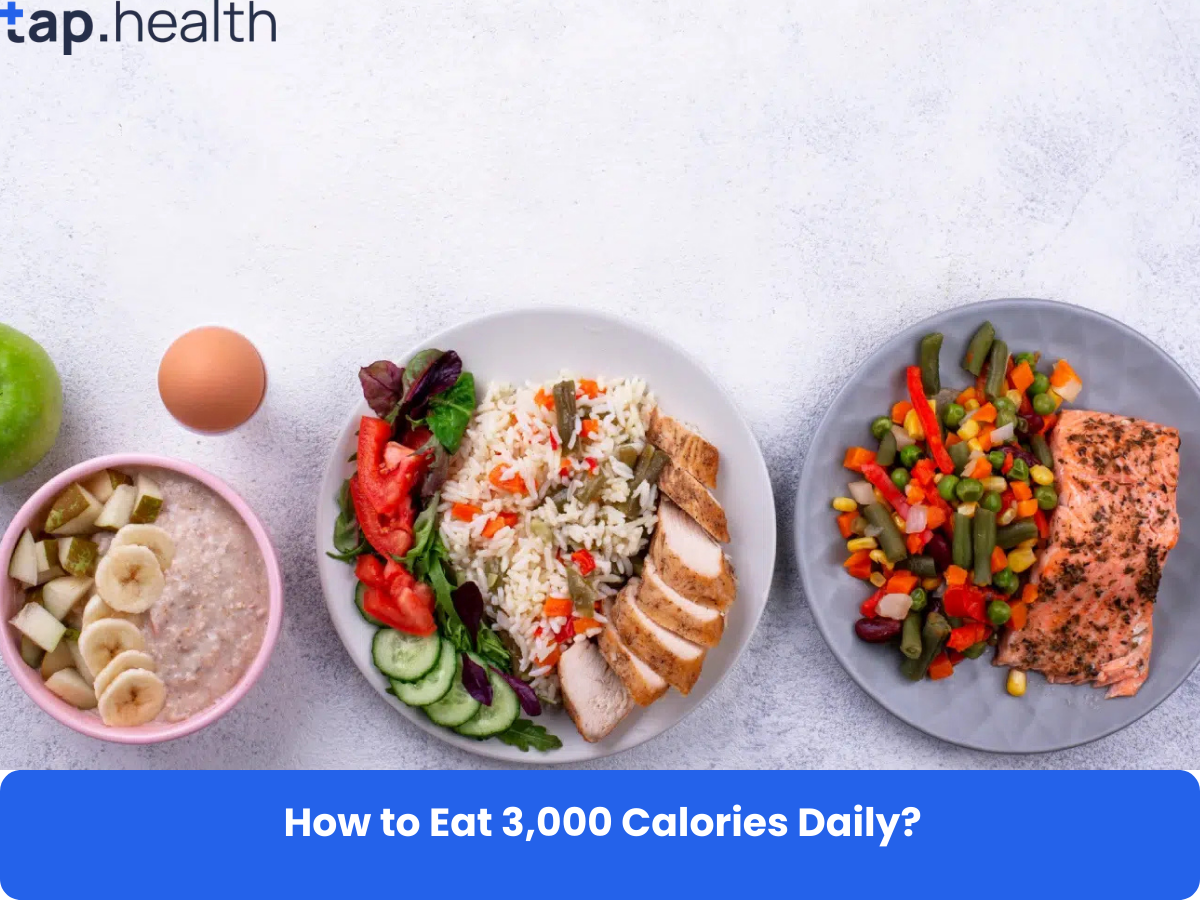
Evening Snack (5:00 PM) – ~600 Calories (The Power Shake)
- Blend together: 300ml Full Cream Milk, 2 tbsp Peanut Butter, 1 Scoop Whey Protein (optional) or 1 tbsp Honey, 1 Banana.
Dinner (8:30 PM) – ~550 Calories
- 3 Roti (with Ghee)
- 1 bowl Mixed Vegetable Sabzi
- Small portion of Dal
Total: Approx. 3,000 Calories.
Frequently Asked Questions (FAQs) on How to Eat 3,000 Calories Daily?
Will eating 3,000 calories make me fat?
If you live a sedentary life (sitting all day) and do not exercise, yes, you will gain fat. However, if you are naturally skinny (high metabolism) or if you are lifting weights regularly, your body will use these calories to repair tissue and build muscle.
I have no appetite. How can I eat this much?
This is common. The trick is to eat faster (before your brain realises you are full) and to use liquid calories (shakes). Also, try to eat at the exact same times every day; your stomach will eventually start expecting food at those times and you will feel hungry naturally.
Is it safe for everyone to eat 3,000 calories?
No. If you have diabetes, high cholesterol, or kidney issues, do not follow this diet without talking to your doctor. This high amount of food puts a workload on your digestive system.
Can I take mass gainer supplements?
You can, but real food is better. Mass gainers often contain a lot of cheap sugars (maltodextrin). It is cheaper and healthier to make your own shake using milk, bananas, oats, and peanut butter.
How much water should I drink on this diet?
Eating more food requires more water for digestion. You also need water to help your kidneys process the extra protein and salt. Aim for at least 3 to 4 litres of water daily.
Conclusion
Eating 3,000 calories daily is a job. It requires planning, shopping, and cooking. There will be days when you don’t feel like eating, but consistency is the key.
Start by adding just 300 calories extra this week. Next week, add another 300. Slowly build your capacity. Your body is adaptable, and with the right food and exercise, you will see the strong, healthy changes you desire.
References
NHS UK: Underweight adults: How to gain weight safely – Link to NHS
National Institutes of Health (NIH): Dietary Guidelines and Caloric Intake – Link to NIH
Mayo Clinic: Nutrition and Healthy Eating – Link to Mayo Clinic
Harvard Health Publishing: Calorie counting made easy – Link to Harvard Health