It is a crisp January morning in North India. The fog is thick, the air is cold, and in every kitchen, there is a distinct smell of winter sweets. Gajar ka Halwa, Til Ladoos, and Chikki.
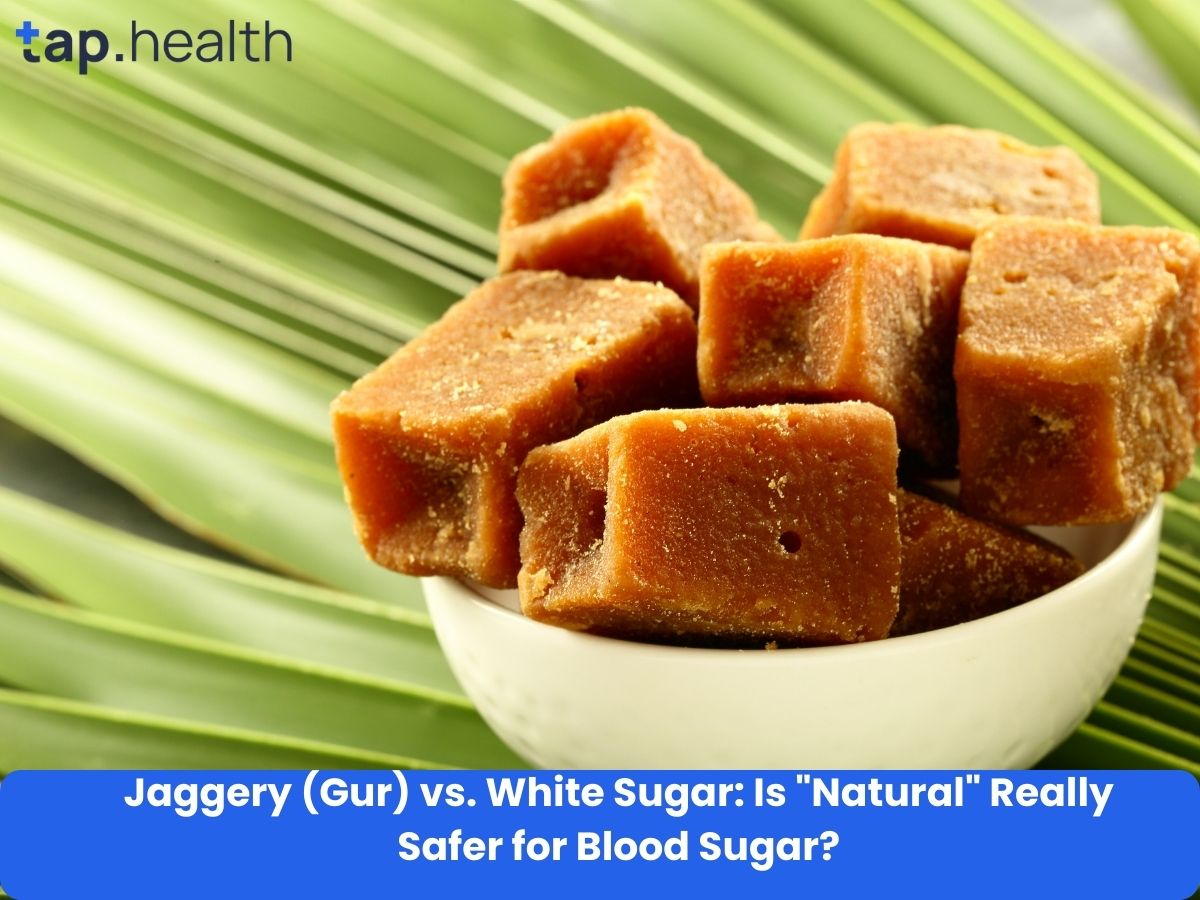
And at the center of it all is the golden-brown lump of sweetness: Jaggery (or as we affectionately call it, Gur).
For centuries, Indian grandmothers have sworn by it. “Eat a piece of Gur after dinner,” they say. “It aids digestion. It cleans the lungs. It warms the blood.” In contrast, the jar of glistening White Sugar is looked at with suspicion. We call it “White Poison.” We blame it for diabetes, obesity, and lethargy.
So, the logic seems simple: Sugar = Bad. Jaggery = Good.
But for the millions of Indians struggling with diabetes or pre-diabetes, is it really that simple? When you replace the sugar in your tea with Jaggery, are you saving your life, or are you just swapping one form of sugar for another?
In this comprehensive guide, we are going to strip away the nostalgia and look at the science. We will compare the Jaggery vs. White Sugar Glycemic Index, analyze the chemical makeup, and answer the burning question: Is “Natural” really safer for your blood sugar?
The Contenders: The Crystal vs. The Rock
To understand how they affect your body, you first need to understand how they are made. Surprisingly, they both start their journey from the exact same plant: Sugarcane.
1. White Sugar (Refined Sucrose)
- The Process: Sugarcane juice is extracted and boiled.1 Then, it undergoes a heavy industrial process. It is spun in centrifuges to separate the crystals from the molasses. It is bleached with chemicals (like sulphur dioxide) to make it stark white.2+1
- The Result: Pure Sucrose (99.9%).3 All the minerals, vitamins, and fiber are stripped away. It is pure energy, nothing else.
2. Jaggery (Gur/Vellam)
- The Process: Sugarcane juice is extracted and boiled in massive iron pans until it thickens into a paste. It is not spun. It is not bleached. It is simply poured into molds to set.
- The Result: Mostly Sucrose (~65-85%) + Invert Sugars (Glucose/Fructose) + Minerals. Because the molasses isn’t removed, it retains iron, magnesium, and potassium.4
Understanding Glycemic Index (GI)
To judge the winner, we use the Glycemic Index (GI).
Think of GI as a speedometer for your blood sugar. It measures how fast a food converts into glucose and hits your bloodstream on a scale of 0 to 100.
- Low GI (0-55): Digests slowly. Releases energy steadily. (The Goal).
- Medium GI (56-69): Moderate rise. Safe in moderation.
- High GI (70+): Digests instantly. Causes a rapid “sugar spike” like rocket fuel.
We want foods that stay in the Low range to keep our insulin levels stable.
1. The Glycemic Index of White Sugar
Let’s start with the villain.
The Glycemic Index of White Sugar is approximately 65.
This places it in the Medium category.
Because it is refined, your body breaks it down relatively quickly. The glucose rushes into your bloodstream, causing the pancreas to pump out insulin.5 This spike is often followed by a “crash,” making you feel tired and hungry again.
2. The Glycemic Index of Jaggery (Gur)
Here is the fact that shocks almost everyone.
The Glycemic Index of Jaggery is extremely high, ranging from 84.4 to 85.6
Read that again. 84.
That is higher than white sugar (65).
How is this possible?
It seems counter-intuitive. Jaggery is complex and natural; sugar is refined. Shouldn’t Jaggery be lower?
The reason lies in the absorption.
- High Glucose Availability: Jaggery contains not just sucrose, but also free glucose and fructose (invert sugars) formed during the boiling process.7 This free glucose hits the bloodstream instantly.
- No Fiber: Despite being unrefined, Jaggery has zero fiber to slow down digestion.8 It dissolves in the stomach almost as fast as glucose powder.
The Verdict: Biologically speaking, Jaggery spikes your blood sugar faster and higher than white sugar.
The Nutritional Myth: “But It Has Iron!”
This is the main argument used by Jaggery lovers. “But Gur has minerals! Sugar has nothing!”
This is absolutely true. Let’s compare 100g of each.
| Feature | White Sugar (100g) | Jaggery / Gur (100g) | The Winner |
| Glycemic Index | ~65 (Medium) | ~84 (High) | Sugar (Surprisingly) |
| Calories | ~387 kcal | ~383 kcal | Tie |
| Iron | 0 mg | ~11 mg | Jaggery |
| Magnesium | 0 mg | ~70-90 mg | Jaggery |
| Potassium | 0 mg | ~1000 mg | Jaggery |
| Antioxidants | None | Present | Jaggery |
The Reality Check:
Yes, Jaggery is nutritious. It is rich in iron.
BUT, to get a significant amount of iron, you would have to eat 100 grams of Jaggery.
If a diabetic eats 100g of Jaggery to get some iron, their blood sugar will skyrocket to dangerous levels. You are better off getting iron from Spinach or Dals, which don’t come with a side of diabetes.
Think of it this way: Drinking beer gives you some B-vitamins. But you wouldn’t drink 10 beers just to get your vitamins, would you? The harm (alcohol) outweighs the benefit. Similarly, the harm (sugar spike) of Jaggery outweighs the benefit (minerals) for a diabetic.
The “Ayurvedic” Perspective: Digestion vs. Diabetes
Why does Ayurveda recommend Jaggery?
Ayurveda values Jaggery for its Heating Property (Ushna) and its ability to cleanse the lungs and aid digestion.9 In ancient times, people walked miles and worked in fields. They burned off the sugar instantly.
Today, we sit in chairs. We have sedentary lifestyles.
For a modern human with Type 2 Diabetes, the “warming” property of Jaggery is irrelevant if it sends their glucose levels to 300 mg/dL.
The Cold Truth: Natural sugar is still sugar.
Real-Life Scenario
Let’s meet Mr. Singh, a 55-year-old from Punjab.
The Context:
Mr. Singh was diagnosed with diabetes. He immediately stopped buying white sugar. However, he loved his Masala Chai. He started adding a piece of Gur to his tea instead. He also started eating a small piece of Gur after lunch “for digestion.”
The Confusion:
Three months later, his HbA1c (average sugar) had not gone down. It had actually gone up slightly. He was furious. “I quit sugar! Why is this happening?”
The Explanation:
His doctor explained the math.
- 1 Teaspoon Sugar = 5g Carbs.
- 1 Piece of Jaggery (size of a walnut) = 15g Carbs.By thinking it was “safe,” Mr. Singh was actually consuming triple the amount of sugar he used to eat. He wasn’t counting the Jaggery as “sugar,” but his body definitely was.
The Fix:
He stopped the Jaggery. He learned to drink Chai without sugar (or used Stevia). His levels dropped within weeks.
Expert Contribution
We consulted medical experts to get the professional stance.
Dr. R. Kapoor, Diabetologist:
“I call Jaggery the ‘Halo Effect’ food. Because people think it is healthy, they eat more of it. I tell my patients: If you have diabetes, Jaggery and Sugar are brothers. One wears a suit (Sugar), the other wears a kurta (Jaggery). But they are both the same person underneath. Avoid both.”
Nutritionist Perspective:
“If you are NOT diabetic, Jaggery is better than sugar because it is chemical-free and alkaline.10 It doesn’t trigger the acidity that white sugar does. But if you ARE diabetic, the mineral content doesn’t matter. The glycemic spike is the only thing that counts. And Jaggery fails that test.”
Recommendations Grounded in Proven Research and Facts
Based on data from the National Institute of Nutrition (NIN) and Indian Journal of Clinical Practice, here are actionable tips:
- For Diabetics:Treat Jaggery like Sugar. Do not use it as a “healthier substitute.” If your sugar is high, avoid it completely. If your sugar is controlled, treat it as a rare indulgence, not a daily habit.
- For Weight Loss:Calories are Calories. Jaggery has almost the exact same calories as sugar (approx 380 per 100g). Switching to Gur will not help you lose weight unless you reduce the total quantity.
- The Color Test:If you do buy Jaggery, buy the Dark Brown/Black one.
- Yellow/Light Gold Gur: Often bleached with chemicals to look attractive.
- Dark Brown/Salty Gur: More minerals, less processing, no chemicals.
- The “Palm Jaggery” Alternative:If you must have Jaggery, try Palm Jaggery (Karupatti). It is made from the sap of the palm tree, not sugarcane. It has a slightly lower Glycemic Index (~40-50) and is safer than Sugarcane Jaggery, though portion control is still key.
Key Takeaways
- White Sugar has a Medium GI (~65) but provides zero nutrition.
- Jaggery (Gur) has a High GI (~84), meaning it spikes blood sugar faster than sugar.
- The “Natural” Myth: Being natural does not make it low-carb. Honey, Jaggery, and Sugar are all metabolically similar in the body.
- Nutrient Trap: While Jaggery has iron and magnesium, you cannot eat enough of it to make a difference without harming your glucose levels.
- The Verdict: If you have diabetes, both are unsafe. If you are healthy, Jaggery is the better choice simply because it is chemical-free.
Conclusion
So, Jaggery vs. Sugar: Is “Natural” Really Safer for Blood Sugar?
No.
For a diabetic, the label “Natural” is a dangerous trap. Your blood sugar meter cannot read labels; it only reads glucose. And Jaggery is a potent source of glucose.11
If you are a healthy individual with an active lifestyle, by all means, enjoy the earthy, mineral-rich taste of Gur in your winter sweets. It is cleaner and more wholesome than industrial white sugar.
But if you are managing insulin resistance or diabetes, do not let the golden color fool you. Step away from the Jaggery jar just as you would step away from the sugar bowl. Your pancreas will thank you.
Frequently Asked Questions (FAQ)
Is Jaggery good for weight loss?
No, not directly. Jaggery is calorie-dense, containing about 383 calories per 100g, which is almost identical to white sugar.12 Eating jaggery will not burn fat. However, because it is sweeter and richer in flavor, you might be satisfied with a smaller amount compared to sugar, which can help calorie reduction indirectly.
Can diabetics eat Jaggery powder?
Ideally, no. Jaggery powder is just crushed jaggery. It has the same high Glycemic Index (~84) and carbohydrate content as the block form. It will spike blood sugar rapidly. Stevia or Monk Fruit are safer sweeteners for diabetics.13
Why is Jaggery darker in color sometimes?
Darker is better. The color of jaggery ranges from golden yellow to dark brown. Golden yellow jaggery often contains chemicals like sodium hydrosulphite used for bleaching.14 Dark brown jaggery is typically organic, unbleached, and richer in minerals.
Does Jaggery purify the blood?
In traditional medicine, yes. Ayurveda states that jaggery helps flush out toxins from the liver and cleanses the blood.15 It is often eaten after meals to aid digestion and remove toxins accumulated from pollution.16 However, this detox benefit does not negate its sugar content.
Is Coconut Sugar better than Jaggery?
Yes, slightly. Coconut sugar has a lower Glycemic Index (roughly 35-54) compared to Sugarcane Jaggery (~84). It contains a fiber called Inulin which slows glucose absorption.17 It is a safer alternative, though still a form of sugar.
Can I eat Jaggery if I have low iron (Anemia)?
Yes. Jaggery is a good source of plant-based iron.18 Combining it with Vitamin C (like lemonade or amla) helps the body absorb this iron better.19 However, do not rely only on jaggery; include green leafy vegetables in your diet too.+1
Does Jaggery cause heat in the body?
Yes. According to Ayurveda, Jaggery has a “Hot” potency (Ushna Virya).20 This is why it is consumed largely in winter (in Gajak and Chikki) to keep the body warm. Eating excessive jaggery in summer might cause nosebleeds or acidity in some people.21+1
References:
- Ayu (Journal of Research in Ayurveda): Scientific validation of Jaggery. Link
- National Institute of Nutrition (NIN): Glycemic Index of Indian Foods. Link
- Diabetes.co.uk: Natural Sweeteners and Diabetes. Link
- Times of India: Jaggery vs Sugar for Diabetics. Link
- International Journal of Chemical Studies: Nutritional profile of Jaggery. Link
(Disclaimer: This content is for educational purposes only. Always consult your doctor or a certified dietitian before making significant changes to your diet, especially if you have diabetes.)