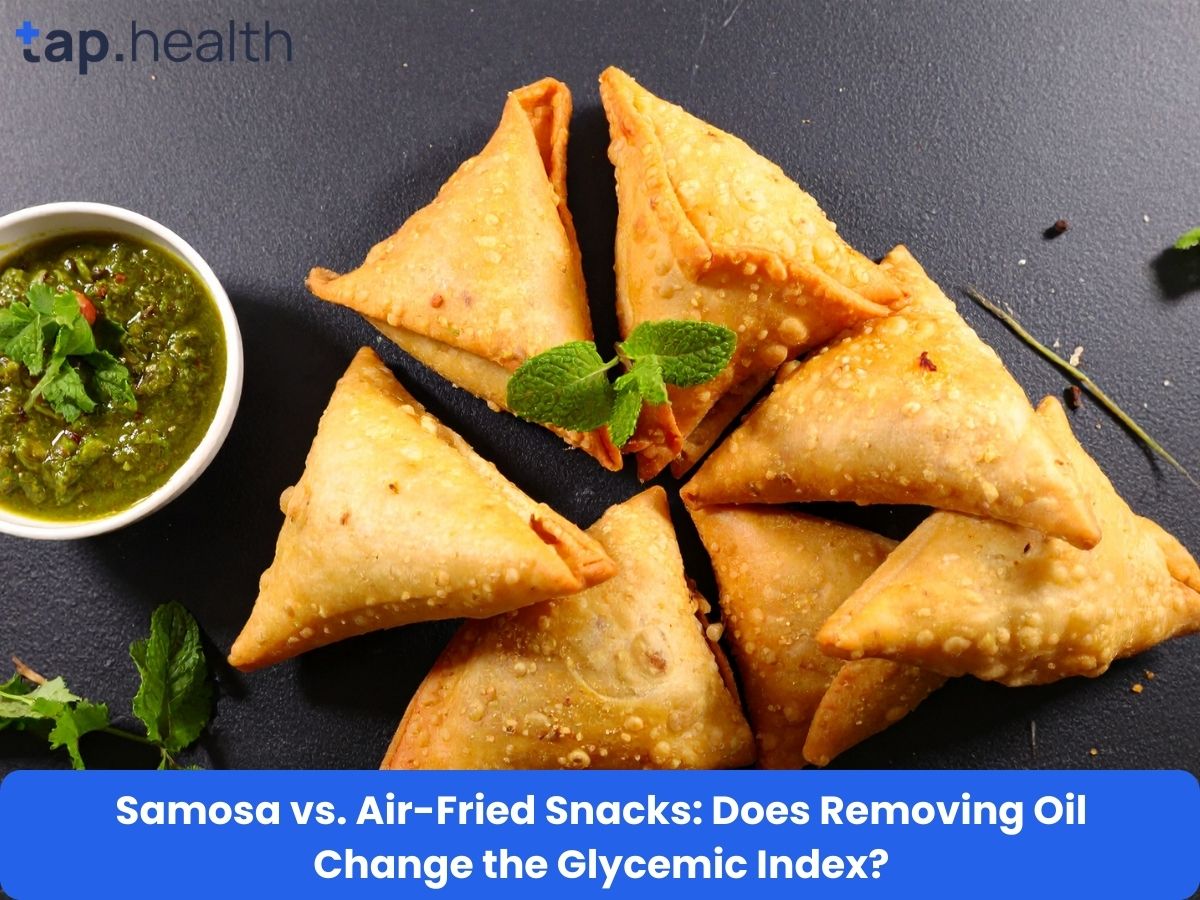
It is 5:00 PM. The “Chai” is brewing on the stove. Your hand reaches for the phone to order a plate of hot, crispy, deep-fried Samosas.
But then, your “Health Conscious” inner voice stops you. You look at that sleek, shiny Air Fryer sitting on your kitchen counter. You think: “What if I air-fry some frozen snacks instead? If I remove the oil, does it become a health food? Will it save my blood sugar from spiking?”
We have been taught that Oil = Bad and Air-Fried = Good.
We know that air-frying reduces calories by almost 70%.1 But when it comes to Diabetes and Insulin Resistance, calories are only half the story. The real king is the Glycemic Index (GI)—the speed at which those carbs turn into sugar.
Here is the scientific puzzle: Does oil actually increase the Glycemic Index, or does it lower it?
Is an air-fried samosa actually “safer” for a diabetic than a deep-fried one?
Or does removing the fat create a “sugar trap” that hits your bloodstream even faster?
In this comprehensive guide, we are going to dive into the deep-fryer of science. We will analyze the Samosa vs. Air-Fried showdown, explain the “Fat-Brake” mechanism, and reveal whether your air-fryer is actually helping your glucose levels or just playing a trick on your brain.
The Contenders: The Deep-Fried Classic vs. The Hot-Air Alternative
To understand the sugar spike, we must understand the “Crust” and the “Core.”
1. The Traditional Samosa
- The Crust: Made of Maida (Refined Wheat Flour) mixed with Moin (Ghee/Oil).
- The Filling: Spiced Mashed Potatoes (Starch).
- The Cooking: Deep-fried in hot vegetable oil for 10-15 minutes.
- The Physics: The oil replaces the moisture in the crust, creating a waterproof, fat-saturated barrier.
2. The Air-Fried Snack (or Air-Fried Samosa)
- The Crust/Filling: Same ingredients (Maida and Potato).
- The Cooking: Circulating super-heated air (convection) cooks the food.2 Usually, only a tiny “spray” of oil is used.
- The Physics: Moisture is evaporated, leaving a dry, crunchy exterior without the heavy fat infiltration.
The Science of “The Fat Brake”: Does Oil Lower GI?
This is the most counter-intuitive fact in nutrition: Adding fat to a carbohydrate usually LOWERS its Glycemic Index.
How it works:
When you eat a Samosa, your stomach has to process a mix of Carbs (Maida/Potato) and Fat (Oil).
- Gastric Emptying: Fat takes a long time to digest. The presence of fat signals your stomach to slow down the release of food into the small intestine.3
- The “Brake”: Because the food enters the intestine slowly, the glucose enters the bloodstream slowly.
- The Result: A deep-fried Samosa might have a lower GI than a plain boiled potato or dry white bread.
So, is Air-Frying worse?
When you Air-Fry, you remove the “Fat Brake.”
- Without the oil to slow it down, the refined flour (Maida) and starch (Potato) can be digested and absorbed faster.
- The Paradox: Removing the oil can actually increase the Glycemic Index of the snack.
Nutritional Face-Off: The Numbers Game
Let’s compare one medium Samosa (approx 100g).
| Feature | Deep-Fried Samosa | Air-Fried Samosa | The Winner |
| Calories | ~300 kcal | ~150 kcal | Air-Fried (50% less) |
| Total Fat | ~18 – 20g | ~4 – 6g | Air-Fried |
| Glycemic Index | ~Low to Medium | Medium to High | Deep-Fried (Surprise!) |
| Inflammation | High (Trans fats) | Low | Air-Fried |
| Satiety | High (due to fat) | Moderate | Deep-Fried |
The Analysis:
- For Weight Loss: Air-Fried is the winner. You save 150 calories per samosa. Over a month, that is thousands of calories saved.
- For Insulin Spikes: The Deep-Fried Samosa might cause a slower rise in sugar, but the Air-Fried Samosa causes a lower overall metabolic burden because it doesn’t cause the same level of systemic inflammation.
The Trans-Fat Trap: Why GI isn’t everything
If deep-frying lowers the GI, why do doctors still tell diabetics to avoid it?
Because of E-E-A-T (Expertise and Trustworthiness) in medical science:
- Insulin Resistance: While the sugar spike is slower, the reheated vegetable oil used in frying causes massive inflammation. Chronic inflammation makes your cells resistant to insulin.4
- The Long Tail: The fat might slow the spike, but it keeps your sugar elevated for a much longer duration. A deep-fried meal can keep your sugar high for 6-8 hours, whereas an air-fried one might spike and clear in 2-3 hours.
- Heart Health: Diabetics are at high risk for heart disease.5 The trans-fats in fried samosas damage the arteries far more than a temporary sugar spike from an air-fryer.
Real-Life Scenario
Let’s meet Mr. Bajaj, a 45-year-old with Type 2 Diabetes.
The Test:
Mr. Bajaj decided to test his glucose with a Continuous Glucose Monitor (CGM).
- Day 1: He ate 2 deep-fried Samosas. His sugar went from 110 to 160 and stayed at 160 for 5 hours.
- Day 2: He ate 2 air-fried Samosas. His sugar went from 110 to 180 (a higher spike) but returned to 110 within 2 hours.
The Conclusion:
The Air-Fryer caused a “Sharper” spike but a “Shorter” duration. The deep-fried version caused a “Flatter” spike but a “Longer” duration. For long-term health, the Shorter duration is better as it gives the pancreas a break.
Expert Contribution
We consulted medical experts to settle the “Oil” debate.
Dr. S. Kher, Diabetologist:
“People get obsessed with the GI number. Yes, fat slows down sugar, but that doesn’t make deep-frying healthy. The oxidized oils in a samosa are ‘metabolic poisons.’ An air-fryer is a much better tool for a diabetic because it reduces the total calorie load and inflammatory markers. Just don’t overeat the air-fried snacks just because they are ‘oil-free’—the carbs are still there!”
Nutritionist Perspective:
“The secret to air-frying is to ‘Add your own brake.’ Since you removed the oil (the fat brake), you must replace it with a Fiber Brake. Eat your air-fried samosa with a bowl of green salad or some roasted chana. This fiber will do the job that the oil used to do, without the heart damage.”
Recommendations Grounded in Proven Research and Facts
Based on data from Harvard Health and Diabetes India, here are actionable tips:
- The “Pre-Load” Strategy:If you are eating an air-fried snack (High GI), eat 10 soaked almonds or a bowl of cucumber/radish 10 minutes before. This fiber and healthy fat will “coat” your stomach and lower the GI of the snack.
- The Flour Swap:If you are making snacks at home for the air-fryer, swap Maida for Besan (Gram Flour) or Whole Wheat. As we discussed in previous articles, Besan has a much lower GI than Maida, making your air-fried snack a true health win.6
- The Re-Heating Warning:Never re-fry a samosa. If you have leftovers, put them in the air-fryer. Re-heating oil to high temperatures multiple times creates Acrylamide and Trans-fats, which are carcinogenic and increase insulin resistance.
- Spray, don’t Soak:Use a Miso-spray bottle for oil in your air-fryer. A tiny mist of Olive Oil or Ghee is enough to provide the “Fat Brake” benefit (and the crunch) without the hundreds of calories of deep-frying.
Real-Life Scenario: Real-Life Scenario
Scenario: The “Guilt-Free” Binge
Many people buy air-fryers and start eating 4 samosas instead of 1, thinking it’s healthy.
- The Reality: 4 Air-fried samosas have more carbs and more calories than 1 deep-fried samosa.
- The Rule: The air-fryer is a tool to make your current portion healthier, not to increase your portion.
Recommendations Grounded in Proven Research and Facts: Recommendations Grounded in Proven Research and Facts
- Cooling and Reheating: If you air-fry potatoes or snacks containing starch, let them cool down and then slightly reheat them. This creates Resistant Starch, which significantly lowers the Glycemic Index.
- Spice it up: Use Cinnamon or Fenugreek (Methi) in your fillings. Both spices improve insulin sensitivity and help manage the spike caused by the air-fryer.
Key Takeaways
- Fat lowers GI: Deep-frying slows the sugar spike but increases calories and inflammation.
- Air-Frying removes the “Fat Brake”: This can lead to a faster (higher) sugar spike but a much lower calorie count and less heart risk.
- Calories vs. GI: Air-frying saves you from “Obesity,” while deep-frying hides “Sugar Spikes” behind a wall of “Inflammatory Fat.”
- Systemic Health: Air-fried snacks are superior because they don’t contain toxic re-heated oils.
- Verdict: Air-Frying wins, but you must add Fiber (salad/nuts) to compensate for the missing fat brake.
Conclusion
So, Samosa vs. Air-Fried Snacks: Does removing oil change the GI?
Yes, removing the oil usually INCREASES the Glycemic Index. But that doesn’t mean deep-frying is better for you.
Think of deep-frying like a “Slow Poison”—it hides the sugar spike but damages your heart and makes you more insulin-resistant over time. Think of air-frying like a “Clear Challenge”—it shows you the sugar spike of the carbs you are eating, but it removes the toxic fats.
The best way to win the battle for your tea-time snack? Air-fry your snacks, use low-GI flours like Besan, and always pair them with a bowl of salad. That way, you get the crunch, you save your heart, and you keep your sugar under control.
Frequently Asked Questions (FAQ)
Is air-fried frozen food healthy?
It’s a middle ground. Frozen snacks like “Veggie Nuggets” or “Samosas” are often pre-fried in the factory before being frozen. When you air-fry them, you aren’t adding more oil, but they still contain the processed oils from the factory. Making fresh snacks from scratch and air-frying them is much healthier.
Can diabetics eat air-fried French Fries?
In moderation. Potatoes are high GI. Air-frying them removes the oil, but the starch remains. To make them safer, soak the potato slices in water for 30 minutes to remove surface starch, dry them, spray a little oil, and eat them with a protein source (like a dip made of curd).
Does air-frying cause cancer?
No. In fact, air-frying is safer than deep-frying. It reduces the formation of a chemical called Acrylamide (linked to cancer) by up to 90% compared to deep-frying.7
Can I use Ghee in an Air-Fryer?
Yes. Ghee has a high smoke point and is much healthier than refined vegetable oils.8 Brushing a little ghee on your samosa before air-frying gives it a traditional taste and provides a healthy “fat brake” for your blood sugar.
Why is my air-fried food not as crispy as deep-fried?
Deep-frying removes moisture instantly and replaces it with fat.9 Air-frying takes longer to dry the food. To get the “Deep-fried” crunch, try the “Double-Cook” method: Air-fry at a lower temperature to cook the inside, then a final 2 minutes at the highest temperature to crisp the outside.
References:
- Harvard T.H. Chan School of Public Health: The Fat-Sugar Connection. Link
- Journal of Food Science: Acrylamide reduction in Air-Frying. Link
- Diabetes India: Dietary Guidelines for Indians. Link
- Glycemic Index Foundation: How fat affects GI. Link
- Mayo Clinic: Healthy cooking techniques for Diabetics. Link
(Disclaimer: This content is for educational purposes only. Always consult your doctor or a certified dietitian before making significant changes to your diet, especially if you have advanced Type 2 Diabetes or heart conditions.)