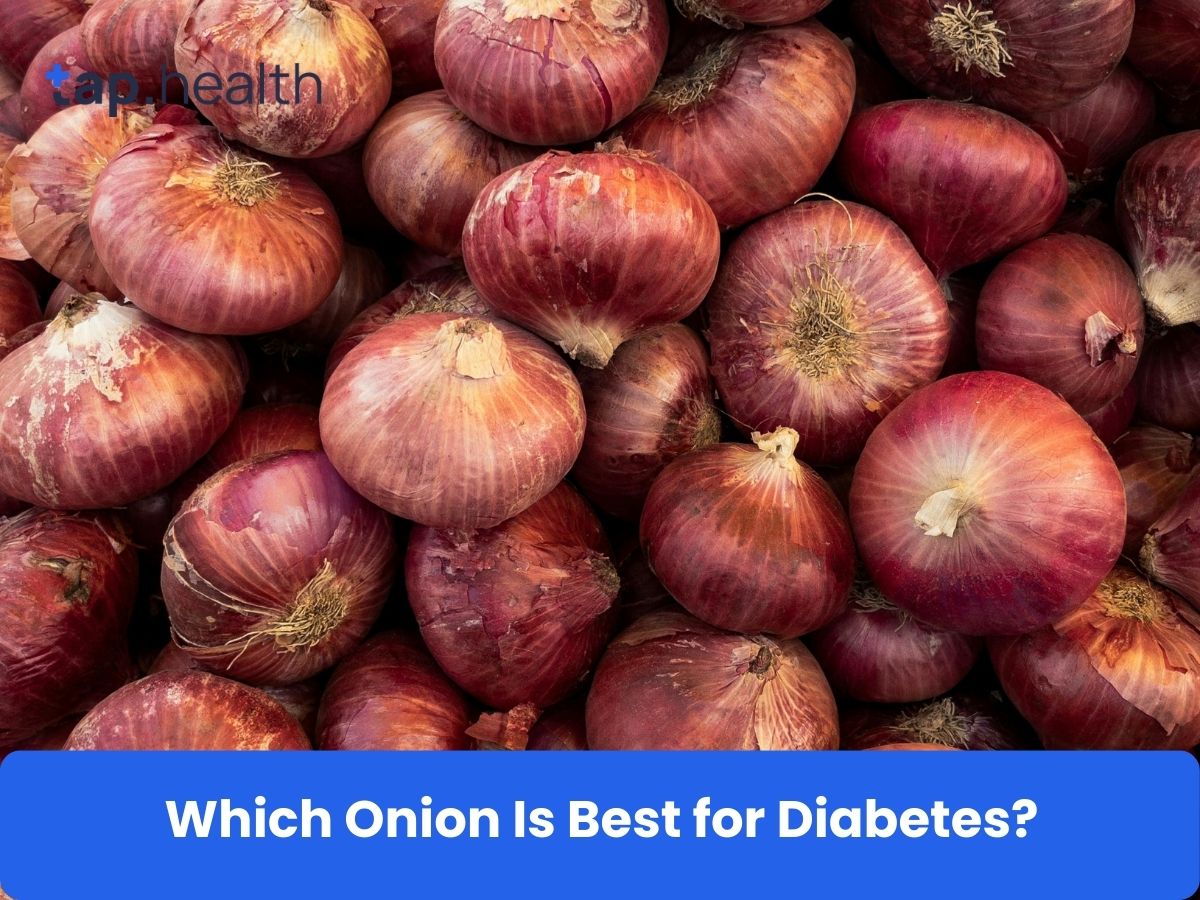
It is a staple in every Indian kitchen. Whether it is the crunch in your kachumber salad, the base of your thick masala gravy, or the garnish on your poha, onions are everywhere.
But if you are living with diabetes, you know that even common foods come with questions. You might have heard that onions are good for blood sugar. But then you go to the market and see a variety: the common Red Onion (Pyaz), the milder White Onion, and the leafy Spring Onion (Hara Pyaz).
You start wondering: “Is one better than the other?” “Does the red one have too much sugar?” “Should I be eating the green leaves instead of the bulb?”
These are not just culinary questions; they are health decisions. In the world of diabetes management, small choices add up to big results.
In this comprehensive 3,000-word guide, written in simple Indian English, we will peel back the layers of this vegetable. We will put the different types of onions head-to-head in a nutritional battle. We will analyze their antioxidant levels, their impact on insulin, and help you decide exactly which onion is best for diabetes to keep your sugar levels steady and your taste buds happy.
Why Onions Are Considered Diabetes-Friendly
Before we pick a winner, let’s understand why onions are in the race at all. Onions belong to the Allium family, the same family as garlic and leeks. For centuries, they have been used in traditional medicine for various ailments.
For diabetics, onions are a “Superfood” for three main reasons:
- Low Carbohydrate: They add volume and flavour without adding a heavy glucose load.
- High Fibre: They contain prebiotic fibres that support gut health, which is linked to better blood sugar control.
- Powerful Compounds: They are packed with Quercetin (an antioxidant) and Sulfur compounds (which give the pungent smell). These compounds have profound anti-diabetic effects.
So, regardless of the colour, eating onions is generally a “Green Light” for diabetes. But as we dig deeper, we find that the colour does make a difference.
Is Any Onion Better for Blood Sugar Control?
The Short Answer: Yes.
While all onions are healthy, Red Onions and Spring Onions generally have a slight edge over White or Yellow onions when it comes to specific anti-diabetic compounds like antioxidants.
However, the “best” onion also depends on how you eat it. A raw white onion in a salad might be better than a deep-fried red onion in a pakora. Let’s break down the nutritional profiles to see why.
Nutritional Profile of Different Types of Onions
Not all onions are created equal. The colour of the skin tells you a lot about the nutrients hiding inside.
Red Onion Nutrition
This is the most common onion in India.
- Colour: Deep purple/red skin.
- Key Nutrient: Loaded with Anthocyanins. These are the pigments that give it the red colour. Anthocyanins are powerful antioxidants known to reduce inflammation and heart disease risk.
- Quercetin: Very high.
- Taste: Sharp, pungent, and spicy when raw.
White Onion Nutrition
Often used in salads or Mexican cuisine.
- Colour: Pure white skin and flesh.
- Key Nutrient: Contains Allicin (like garlic) but lacks the Anthocyanin pigments found in red onions.
- Quercetin: Moderate to low compared to red.
- Taste: Milder, sweeter, and crunchier. Easier to eat raw.
Yellow/Brown Onion Nutrition
Common in Western cooking (soups/stews), less common in Indian homes.
- Colour: Golden brown skin.
- Key Nutrient: Extremely high in Sulfur. This makes them very pungent and great for cooking as they hold flavour well.
- Taste: Very strong raw; turns very sweet when caramelized.
Spring Onion (Green Onion) Nutrition
This is the young onion harvested before the bulb swells completely.
- Composition: You eat the green leafy stalks and the small white bulb.
- Key Nutrient: The green stalks are leafy greens! They are rich in Vitamin K, Vitamin C, and Fibre.
- Carb Count: The lowest of all onions because it is mostly leaf, not bulb.
Glycaemic Index and Glycaemic Load of Onions
For a diabetic, these numbers are the bible.
- Glycaemic Index (GI): All onions (Red, White, Spring) have a very low GI, typically between 10 and 15.
- Verdict: Safe. They digest slowly.
- Glycaemic Load (GL): Because they have very few carbs per serving (about 9g per 100g), the GL is less than 1.
- Verdict: Extremely Safe. Eating a whole onion won’t spike your sugar significantly.
Note: Cooking onions (caramelizing them) breaks down complex carbs into simpler sugars, making them taste sweeter. However, even cooked onions remain a Low GI food compared to potatoes or rice.
Red vs White vs Yellow Onion – Which Is Best for Diabetes?
If we look strictly at the chemical composition, we can rank them.
Antioxidants and Quercetin Content
Winner: Red Onion.
- Why: Red onions contain Quercetin (good for heart/immunity) AND Anthocyanins (good for reducing blood sugar and inflammation).
- White Onions: Contain Quercetin but zero Anthocyanins.
- Yellow Onions: High Quercetin, but again, no Anthocyanins.
The deep colour of the red onion is its superpower. Research suggests that darker-coloured vegetables usually have higher antioxidant capacities.
Sulphur Compounds and Insulin Sensitivity
Winner: Yellow/Red Onion.
- The more pungent the onion (the more it makes you cry), the better it is for diabetes.
- The sulfur compounds (like allyl propyl disulfide) mimic the effect of insulin and help the liver manage glucose.
- White onions are milder, meaning they have slightly less of these sulfur compounds.
Taste, Cooking Use, and Portion Control
Winner: White Onion.
- Why: For raw salads (Kachumber), white onion is often preferred because it is less sharp. If the milder taste helps you eat more raw onion salad, then it is the “best” for you in that context because you are consuming more fibre.
Spring Onion for Diabetes – Is It Better Than Regular Onion?
Yes, in a different way.
Spring onions (Hara Pyaz) should be treated almost like a leafy green vegetable rather than a root vegetable.
- Lower Carbs: They have fewer carbohydrates than the bulb onions.
- Nutrient Density: The green tops provide Vitamin A and C, which are crucial for eye health (diabetics are prone to eye damage).
- Versatility: You can eat a large bowl of spring onion sabzi without worrying about the carb count at all.
Expert Verdict: If you are strictly counting carbs (e.g., on a Keto diet), Spring Onion is the winner. If you are looking for antioxidants to fight inflammation, Red Onion is the winner.
Raw vs Cooked Onion – Which Helps More in Diabetes?
This is a classic debate. Does the tadka kill the nutrients?
Raw Onion:
- Pros: Retains all the Sulfur compounds and Vitamin C. The anti-diabetic effect is strongest in raw juice or raw slices.
- Cons: Hard to digest for some; causes acidity or bad breath.
Cooked Onion:
- Pros: Cooking breaks down the cell walls, making Quercetin more absorbable by the body. It is easier on the stomach.
- Cons: Heat destroys Vitamin C and some sulfur compounds.
Recommendation: Do both. Use cooked red onions in your curry base for the quercetin, and have a side of raw white/red onion salad for the sulfur and fibre.
Read this : Is onion good for diabetic patients?
Best Ways to Eat Onion for Diabetes
Now that we know red and spring onions are top-tier, how should you eat them?
Salad, Raita, and Lightly Cooked Options
- Sirka Pyaz: Small red onions soaked in vinegar. Vinegar is known to lower the glycaemic index of meals. This is a double-win combo!
- Curd-Onion Raita: The protein in curd + fibre in raw onion is an excellent blood sugar stabilizer.
- Kachumber: Chopped tomatoes, cucumbers, and red onions with lemon juice.
Onion in Curries and Gravies (How to Keep It Diabetes-Friendly)
- Avoid Deep Frying: Making Birista (deep-fried golden onions for Biryani) destroys the nutrients and adds unhealthy fats.
- Light Sauté: Sauté chopped onions in mustard oil until pink. Do not burn them.
- Paste: Boiled onion paste is healthier than fried onion paste.
Pairing Onion with Fibre and Protein
Never eat onion alone (who does?).
- Omelette: Add lots of chopped spring onions and red onions to your eggs.
- Besan Chilla: Add finely chopped onions to gram flour pancakes. The fibre in onions prevents the besan from spiking sugar too fast.
How Much Onion Can a Diabetic Eat Per Day?
There is no upper limit like there is for sugar, but moderation prevents digestive issues.
- Recommended: 50 to 100 grams per day (approx. 1 medium onion).
- Why limit? Onions contain Fructans (a type of carb). Eating too many can cause severe bloating, gas, and acidity, especially if you have sensitive digestion.
Real-Life Scenario
Meet Sunita (52, Homemaker from Mumbai):
Sunita has Type 2 Diabetes. She loves food but struggles with high fasting sugar levels (around 150 mg/dL). She usually eats a heavy dinner with cooked vegetable gravies.
The Change: Her nutritionist advised her to add a raw onion salad to her lunch and dinner.
- The Choice: She chose Red Onions because she likes the spice.
- The Method: She soaked the slices in lemon juice and a little vinegar for 10 minutes before eating to reduce the bite.
The Result: After 1 month, she noticed two things:
- She felt fuller faster, so she ate less rice/roti.
- Her post-dinner sugar spike was lower (160 mg/dL instead of 190 mg/dL). The fibre and raw sulfur compounds in the red onion helped slow down the absorption of her dinner carbs.
Expert Contribution
We consulted Dr. R. Kapoor, Dietitian & Diabetes Educator:
“Patients often ask me if they should buy imported yellow onions or expensive shallots. I tell them: Stick to the desi Red Onion.
Nature has designed the Red Onion perfectly for us. The high anthocyanin content (the red colour) is excellent for heart health, which is a major concern for diabetics. Also, don’t ignore the Spring Onion. During winter, I tell my patients to make Hara Pyaz ki Sabzi at least twice a week. It is low-carb comfort food.”
Recommendations Grounded in Proven Research and Facts
According to the National Institutes of Health (NIH) and studies published in Environmental Health Insights:
- Red Onion Efficacy: A study showed that fresh red onion consumption significantly reduced fasting blood glucose levels in Type 2 diabetic patients by roughly 40 mg/dL after 4 hours.
- Quercetin Power: Research confirms that quercetin (highest in red/yellow onions) interacts with cells in the pancreas, small intestine, and liver to control blood sugar regulation.
- Spring Onion Benefits: Studies on Allium fistulosum (Spring Onion) extracts show potent alpha-glucosidase inhibitory activity—meaning they stop carbs from turning into sugar in your gut.
When Onion May Not Be Ideal
While they are a superfood, they are not for everyone.
IBS, Acidity, Gas, or GERD
If you have diabetes and acid reflux (GERD) or Irritable Bowel Syndrome (IBS):
- Raw onions can trigger severe heartburn and bloating.
- Solution: Switch to Cooked Onions or use only the green tops of Spring Onions (which are low FODMAP and easier to digest).
Onion in Fried or High-Oil Foods
- Onion Pakoras/Bhajiyas: The gram flour batter and deep frying negate the benefits of the onion. The trans fats induce insulin resistance.
- Onion Rings: The breading is refined flour (Maida). This is a high-sugar food disguised as a vegetable.
Common Myths About Onion and Diabetes
Let’s clear the air.
- Myth: “Eating onion soaked in water cures diabetes.”
- Fact: It helps manage it, but it does not “cure” it. You cannot stop your medication just because you ate an onion.
- Myth: “Cooked onions turn into sugar.”
- Fact: No. Caramelization brings out natural sweetness, but it does not increase the total carbohydrate count significantly or turn the onion into “pure sugar.” It is still safe.
- Myth: “White onions have no nutrition.”
- Fact: False. They lack the red pigment (anthocyanin), but they still have fibre, Vitamin C, and Allicin. They are still very healthy.
Conclusion: Key Takeaways
So, which onion is best for diabetes?
- The Champion: Red Onion (Raw). It has the highest antioxidants (Anthocyanins + Quercetin) and strong sulfur compounds to lower blood sugar.
- The Runner Up: Spring Onion (Cooked/Raw). Lowest in carbs, high in vitamins, and great for weight management.
- The Specialist: White Onion (Raw). Best for salads if you find red onions too spicy.
- The Advice: Do not stress too much about the type. Any onion is better than no onion. The key is to include them in your daily diet—preferably raw in salads or lightly cooked in curries—to harness their fibre and medicinal properties.
Next time you are at the vegetable market, grab that bag of bright red onions. Your heart, your gut, and your glucometer will thank you.
Frequently Asked Questions on Which Onion Is Best for Diabetes?
How to reduce blood sugar with onions?
The most effective way is to eat them raw. Consuming 50-100g of raw red onion daily (e.g., in salads or with lemon) ensures you get the maximum amount of active sulfur compounds and chromium, which improve insulin sensitivity.
What onions are best for diabetics?
Red Onions are generally considered the best due to their high content of quercetin and anthocyanins. These antioxidants help fight the inflammation associated with diabetes. Spring Onions are also excellent due to their low carbohydrate content.
How much onions can a diabetic eat?
A safe and effective amount is about one medium onion per day. Eating excessive amounts won’t lower sugar faster but might cause gas, bloating, and acidity.
Does soaking onions in water help?
Yes. Soaking raw chopped onions in water for 10 minutes can reduce the harsh “bite” and pungency, making them easier to eat raw. It does not wash away the beneficial fibre or major nutrients.
Can I eat fried onions (Birista)?
Avoid them. Fried onions are dehydrated and soaked in oil. They are calorie-dense and can lead to weight gain. The high heat also destroys some of the heat-sensitive vitamins.
Is spring onion good for gestational diabetes?
Yes. Spring onions are excellent for gestational diabetes because they are very low in carbs and provide essential Folate and Vitamin C for both the mother and the baby.
References
- National Institutes of Health (NIH): Hypoglycemic effects of Allium cepa (Onion)
- Healthline: Onions 101: Nutrition Facts and Health Effects
- Environmental Health Insights: The effect of red onion on blood glucose in Type 1 and Type 2 diabetics
Disclaimer: This article is for informational purposes only. While onions are a healthy addition to a diabetic diet, they are not a replacement for prescribed medication. Always consult your doctor or dietician for personalized advice.