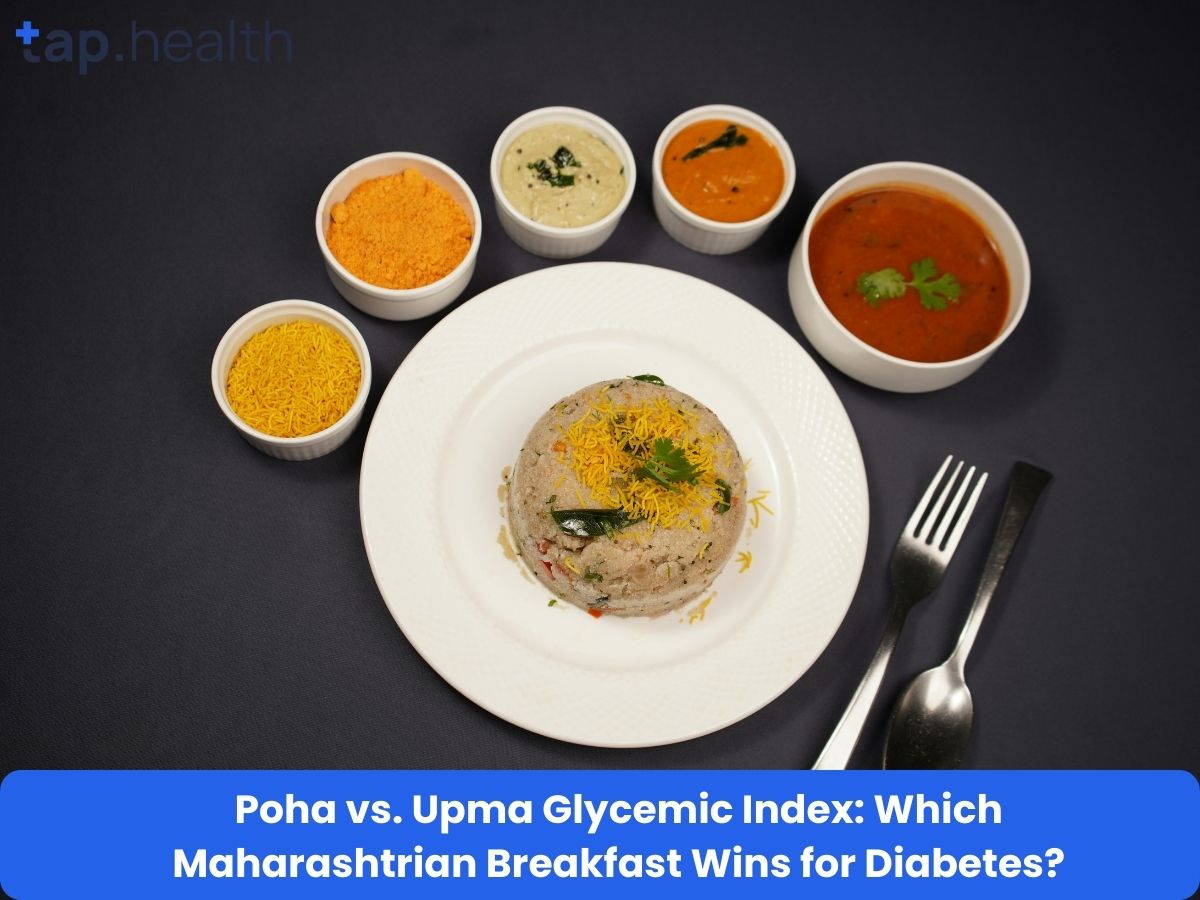
In Maharashtra and indeed across most of India, the morning sun brings with it a tough decision. The kitchen is set, the tea is brewing, and the stomach is rumbling. But what hits the plate?
On one side, we have Poha (Flattened Rice)—yellow, fluffy, tangy, and loaded with peanuts. It is the pride of Indore and Mumbai alike.
On the other side, we have Upma (Savory Semolina Porridge)—warm, soft, comforting, and speckled with mustard seeds and curry leaves.
For decades, we ate whatever our mothers cooked without a second thought. But today, with diabetes becoming a household concern in India, we pause. We look at that plate and wonder: “Will this spike my sugar?” “Is Poha just rice in disguise?” “Is Upma better because it is wheat?”
The battle of Poha vs. Upma isn’t just about taste anymore; it is about health. It is about the Glycemic Index.
In this comprehensive guide, we are going to dissect these two legendary breakfasts. We will strip away the nostalgia and look at the cold, hard nutritional facts. We will compare their Glycemic Index, their impact on your insulin, and finally answer the question: Which one wins the trophy for diabetes management?
Also Read: 20 Best Food for Diabetes
The Contenders: What Are We Eating?
Before we dive into the complex numbers, let’s go back to basics. What exactly are Poha and Upma made of? Understanding the raw ingredient is the first step to understanding how it behaves inside your body.
1. Poha (Flattened Rice)
Poha is essentially rice that has been parboiled, rolled, flattened, and dried to produce flakes.
- The Source: Paddy (Rice).
- The Process: Unlike white rice which is polished, Poha undergoes a unique process. It is parboiled and then flattened. This process includes a very mild fermentation step (often ignored) which produces probiotics.
- The Vibe: It is light on the stomach, gluten-free, and cooks in minutes.
2. Upma (Rava/Suji)
Upma is a thick porridge made from dry-roasted semolina (Rava or Suji).
- The Source: Wheat.
- The Process: Semolina is the coarse, purified wheat middlings of durum wheat. It is basically the heart of the wheat grain, but with most of the bran removed.
- The Vibe: It is dense, filling, and provides sustained energy.
Understanding Glycemic Index (GI)
To pick a winner, we need a referee. In the world of diabetes, that referee is the Glycemic Index (GI).
Think of GI as a speedometer for your blood sugar. It measures how fast a carbohydrate-containing food converts into glucose and hits your bloodstream on a scale of 0 to 100.
- Low GI (0-55): These foods digest slowly. They release energy steadily, like a slow-burning candle. (Ideal for Diabetics).
- Medium GI (56-69): A moderate rise in sugar. Safe in moderation.
- High GI (70+): These digest instantly, causing a rapid “sugar spike” like rocket fuel.
For a diabetic patient, the goal is to keep most meals in the Low to Medium range to avoid putting stress on the pancreas.
Poha Glycemic Index: The Rice Paradox
The biggest argument against Poha is simple: “It is rice! Rice is bad for diabetes!”
But is Poha really the same as a bowl of steamed white rice?
The Glycemic Index of Poha is approximately 70.
This places Poha on the borderline of the High GI category.
However, this number is misleading if you look at it in isolation.
The “Parboiling” Effect:
Because Poha is made from parboiled rice, it contains something called Retrograded Starch. When starch is cooked and then cooled (and dried), its structure changes. It becomes harder to digest. This means that even though the GI is technically high, a significant portion of the starch passes through your gut without turning into sugar immediately.
The Iron Bonus:
Poha passes through iron rollers during the flattening process. This enriches it with iron, making it a great choice for anaemic patients.
The Verdict on Plain Poha:
If you eat raw Poha flakes, it will spike your sugar. But nobody eats raw Poha. We eat Kanda Poha (Onion Poha), which changes the equation completely.
Upma Glycemic Index: The Wheat Reality
Now, let’s look at the challenger. Upma is made of wheat, so people assume it must be healthier than rice.
The Glycemic Index of Upma (made from Rava) is approximately 68.
This places Upma in the Medium GI category.
The Texture Trap:
Rava (Suji) is granular. Unlike fine flour (Maida) which digests instantly, the granules of Rava take a bit of time for stomach enzymes to break down. This results in a slower release of energy compared to bread or biscuits.
The Gluten Factor:
Since Upma is wheat-based, it contains gluten. For most people, this is fine. But for those with gluten sensitivity or inflammation issues (which often coexist with diabetes), Upma can cause bloating and lethargy.
The Verdict on Plain Upma:
It has a slightly lower GI than Poha on paper, but it is calorie-dense. A small bowl of Upma has more calories than the same-sized bowl of Poha because wheat is denser than rice flakes.
The Showdown: Poha vs. Upma Nutritional Battle
Let’s put them side-by-side in a nutritional cage match.
| Feature | Poha (Flattened Rice) | Upma (Semolina) |
| Glycemic Index | ~70 (High/Borderline) | ~68 (Medium) |
| Calories (1 bowl) | Lower (~180 cal) | Higher (~250 cal) |
| Fiber Content | Low (unless Red Poha) | Moderate |
| Gluten | Gluten-Free | Contains Gluten |
| Iron Content | High | Low |
| Probiotic Potential | Yes (Mildly Fermented) | No |
| Digestion | Very Easy/Light | Moderate/Heavy |
The Twist:
Looking at the table, Upma seems to win on Glycemic Index (68 vs 70). It seems like the safer bet for blood sugar.
BUT… usually, we don’t eat these grains alone.
The “Add-On” Effect: How We Actually Eat
This is where the science gets interesting. The GI of a single ingredient doesn’t matter as much as the Glycemic Load of the whole meal.
1. The Poha Advantage:
How do you make Poha?
- You add mustard seeds, curry leaves, turmeric.
- You add a mountain of Onions (Kanda).
- You add Peanuts.
- You squeeze a Lemon.
This combination is magic.
- Peanuts: High fat and protein. This slows down the absorption of the rice starch.
- Lemon: Acidity lowers the GI of any meal by almost 30%.
- Onions: Fiber.
By the time you finish cooking, the GI of your Kanda Poha plate drops from 70 down to roughly 60.
2. The Upma Disadvantage:
How do you make Upma?
- You roast the rava in ghee/oil.
- You add water and maybe some onions or peas.
Upma often becomes a sticky, dense mass. While you can add veggies, the Rava tends to absorb them. Also, people rarely add nuts or lemon to Upma in the same quantity as Poha. The lack of acidity and crunch means the GI stays around 65-68.
The Real Winner:
In a real-life Indian kitchen scenario, Poha often ends up being the lower glycemic meal if it is made with plenty of peanuts and lemon.
The Probiotic Secret of Poha
Here is a fact that most doctors won’t tell you because it’s hidden in food technology textbooks.
Poha is a Probiotic Food.
During the manufacturing process, paddy is soaked in water for 12-18 hours. During this time, the water undergoes mild fermentation. This alters the starch and introduces beneficial gut bacteria. Even after drying, some of these properties remain.
For a diabetic, Gut Health is King.
A healthy gut microbiome helps regulate insulin sensitivity. Because Poha is easy to digest and gut-friendly, it doesn’t cause the inflammation that wheat (Upma) sometimes can.
Red Poha: The Game Changer
If you really want to crush the competition, switch your white Poha to Red Poha.
Red Poha is made from Red Rice (unpolished).
- GI: ~50 (Low).
- Fiber: Very High.
- Anthocyanins: Powerful antioxidants that fight diabetes.
If you use Red Poha, there is no contest. Red Poha beats Upma hands down.
Oats Upma: The Challenger
Similarly, Upma has an evolution: Oats Upma.
If you replace the Suji with Rolled Oats:
- GI: ~55 (Low).
- Beta-Glucan: Soluble fiber that actively lowers blood sugar.
Verdict: Oats Upma > Red Poha > White Poha > Suji Upma.
Real-Life Scenario
Let’s meet Mr. Deshmukh, a 55-year-old bank clerk from Pune.
The Context:
Mr. Deshmukh has had Type 2 Diabetes for 10 years. He is strictly vegetarian. He loves his morning breakfast. For years, he ate Upma because he was told “Rice is poison.” However, he felt heavy and lethargic after eating it, and his post-breakfast sugar was hovering around 180 mg/dL.
The Experiment:
His new nutritionist suggested a change. “Switch to Poha,” she said. “But use the 50-50 rule.”
- The Rule: 50% Poha Flakes, 50% Mixed Sprouted Matki (Moth beans) and Onions.
- The Topping: A generous squeeze of lime.
The Result:
Mr. Deshmukh was skeptical. Poha is rice, right?
But after one week:
- Digestion: He felt lighter. The bloating from the wheat (Upma) was gone.
- Sugar: His post-meal sugar dropped to 150 mg/dL.
- Why? The sprouts added massive protein and fiber, neutralizing the Poha starch. The lemon lowered the GI.
Expert Contribution
We consulted medical experts to get the professional stance on this debate.
Dr. A. Patil, Diabetologist (Mumbai):
“I see this debate daily. Patients fear Poha because it looks like white rice. But chemically, Poha is retrograded starch. It is better than fresh hot rice. Upma, on the other hand, is wheat. If a patient is obese, I prefer Poha because it has fewer calories for the same visual volume. You get a full bowl of Poha for 200 calories, but a full bowl of Upma might be 350 calories.”
Nutritionist Perspective:
“The problem isn’t the grain; it’s the ratio. A typical Indian breakfast is 90% grain and 10% onion. That is a sugar bomb. Whether you eat Poha or Upma, if you don’t add 1 cup of vegetables to 1 cup of grain, you are doing it wrong. But generally, Poha allows for more vegetable integration without becoming mushy.”
Recommendations Grounded in Proven Research and Facts
Based on data from the National Institute of Nutrition (NIN) and general diabetic guidelines, here are actionable tips to make your breakfast rank-ready for your health:
- The “Sprout” Strategy for Poha:Always add steamed sprouts (Moong or Matki) to your Poha. This turns a carb-heavy meal into a high-protein meal. Protein slows down sugar spikes.
- The “Rava” Roast for Upma:If you must eat Upma, roast the Rava until it is brown. Dry roasting changes the starch structure slightly, making it harder to digest (which is good!). Avoid “Instant Upma” mixes; they are full of preservatives and sodium.
- The Peanut Power:Don’t skimp on peanuts in your Poha. The healthy fats in peanuts are essential for blunting the glycemic response of the rice flakes.
- Portion Control:Stop at one medium katori (bowl). Both Poha and Upma are carbohydrates. Excess of either will raise blood sugar.
- Vegetable Upma:If making Upma, try using Bansi Rava (a coarser variety of wheat) or Broken Wheat (Dalia) instead of fine Suji. It has much more fiber.
Key Takeaways
- Suji Upma has a Medium GI (~68) but is calorie-dense and contains gluten.
- White Poha has a High/Medium GI (~70) but is lower in calories, rich in iron, and probiotic.
- The Winner: Poha generally wins for weight loss and digestion.
- The Diabetes Strategy: Poha is safe only if loaded with veggies, peanuts, and lemon. Plain Poha is risky.
- Best Alternative: Red Poha or Oats Upma are superior to the traditional versions for strict blood sugar control.
Conclusion
So, Poha vs. Upma Glycemic Index: Which Maharashtrian Breakfast Wins?
It is a close call, but Poha takes the cup—not because its raw GI is lower (it isn’t), but because of how it is eaten.
The culture of eating Poha with lemon, peanuts, and onions naturally lowers its glycemic load. It is lighter on the gut, gluten-free, and nutrient-rich. Upma, while healthy, often becomes a calorie-dense wheat lump that can sit heavy in the stomach.
However, the ultimate secret isn’t choosing the grain; it’s choosing the vegetables. Whether you pick the yellow flakes or the white porridge, make sure your plate is half-filled with greens. That is the only way to truly win the battle against diabetes.
Frequently Asked Questions (FAQ)
Is Poha good for diabetes?
Yes, if modified. While Poha is rice-based, it is rich in iron and digestible starch. Diabetics can eat it safely by adding plenty of vegetables (peas, carrots, beans), protein (peanuts, sprouts), and squeezing lemon juice to lower the glycemic index.
Which has a lower glycemic index, Poha or Upma?
Upma is slightly lower on paper. Upma (Suji) has a GI of ~68, while White Poha has a GI of ~70. However, Poha is often consumed with high-fiber/high-fat add-ons (onions, peanuts) and acid (lemon) which can bring its effective meal GI down to around 60.
Can I eat Poha daily for weight loss?
Yes. Poha is an excellent breakfast for weight loss. It is low in calories (approx 180 calories per bowl) compared to Upma (approx 250 calories). It is also gluten-free, which prevents bloating and water retention, helping you feel lighter.
Is Upma heavy for digestion?
It can be. Upma is made from Semolina (Wheat), which contains gluten. For people with slow digestion or gluten sensitivity, Upma can feel heavy and cause lethargy. Poha is significantly lighter and easier to digest.
What is the healthiest way to eat Upma?
To make Upma healthy, replace fine Suji with Bansi Rava (coarse wheat) or Oats. Load it with vegetables like beans, carrots, and peas. Use less oil and serve it with a side of cooling coconut chutney to balance the meal.
Is Red Poha better than White Poha?
Absolutely. Red Poha is made from unpolished red rice. It retains the bran layer, giving it huge amounts of fiber and anthocyanins. It has a significantly lower GI (~50) than white Poha and is the best choice for diabetics.
Does Poha contain sugar?
Poha itself does not contain added sugar, but it is a carbohydrate which breaks down into glucose. However, traditional Maharashtrian Kanda Poha recipes often add a pinch of sugar for taste. Diabetics should skip this added sugar.
Can I eat curd with Poha?
Yes. Eating curd (dahi) with Poha is a great idea. The protein and fat in the curd help slow down the digestion of the Poha flakes, leading to a more stable blood sugar release. It is a popular combination in states like Odisha and Bihar (Dahi Chura).
References:
- National Institute of Nutrition (NIN): Glycemic Index of Indian Foods. Link
- Harvard Health Publishing: Glycemic Index for 60+ Foods. Link
- Times of India: Poha vs Upma – Which is Healthier? Link
- Diabetes.co.uk: Rice and Diabetes. Link
- WebMD: Benefits of Semolina. Link
(Disclaimer: This content is for educational purposes only. Always consult your doctor or a certified dietitian before making significant changes to your diet, especially if you have diabetes or celiac disease.)